
Key Summary
When you are living paycheck to paycheck, the margin for error is non-existent. A single unexpected expense, like a car repair, a medical bill, or a higher-than-usual utility bill, instantly derails a carefully balanced budget.
Instant cash advance is a practical way to manage these liquidity gaps without falling into high-interest debt cycles. These apps are designed for this specific reality; they do not run credit checks or require months of documentation. Instead, they focus on your current income pattern and provide a bridge between pay cycles when your bank balance doesn’t catch up to your immediate needs.
According to the CFPB, millions of Americans rely on short-term liquidity tools to cover gaps between income and expenses, with demand highest among workers who receive irregular or delayed pay. Cash advance apps serve this population specifically by evaluating real-time bank data rather than credit history. This guide explains the eligibility factors that matter, how they differ across apps, and what to do if you do not qualify on the first attempt.
Understanding Instant Cash Advances
An instant cash advance is a short-term advance against income you have already earned or income expected from a recurring source. It is not a traditional loan. There is no interest, no credit check in most cases, and no formal multi-month repayment schedule. You connect your bank account, the app evaluates your deposit history, and you receive access to a portion of your expected income before your paycheck actually arrives.
Repayment is automatic. The advance is deducted from your next qualifying deposit, whether that is a paycheck, a gig platform payment, or any other recurring income source the app can verify. This automatic repayment structure is what allows apps to approve users with poor or no credit history, since repayment comes from demonstrated income rather than a credit obligation that needs to be enforced separately.
Why Eligibility Criteria Exist
Even though cash advance apps do not use credit scores, they do evaluate your financial profile. The criteria protect both the user and the platform. They prevent users from borrowing more than they can realistically repay and keep the advance linked to verifiable income.
The evaluation process is automated and takes minutes rather than days. Understanding what the system is looking for before you apply helps you address any gaps in your profile and choose the app most likely to approve your specific situation.
Also Read: Why Free Cash Advance Apps Still Charge Fees
Step-by-Step: How to Qualify for an Instant Cash Advance
These five factors are universal across major cash advance apps, but each platform weighs them differently. Understanding these criteria helps you match the right app to your specific income type.
1. Show Consistent Income or Deposits
This is the most important qualifying factor across every cash advance platform. Apps analyze your bank transaction history to identify recurring deposits. They look for regular inflows, not necessarily large ones. A $400 weekly deposit from a food delivery platform qualifies in the same way a $1,200 biweekly paycheck does, as long as the pattern is consistent and directed to the same linked account.
The CFPB has noted that earned wage access and cash advance products are increasingly used by workers across income levels, reflecting a broader shift toward flexible pay cycle access as a standard financial tool. Apps typically look at 30 to 90 days of deposit history to establish your income pattern. This means the best time to link your bank account is before you need an advance and not when you need it.
EarnIn specifically requires income from a single verifiable employer via direct deposit.
Brigit evaluates overall bank deposit patterns across at least 60 days of account history before granting full access to its advance feature.
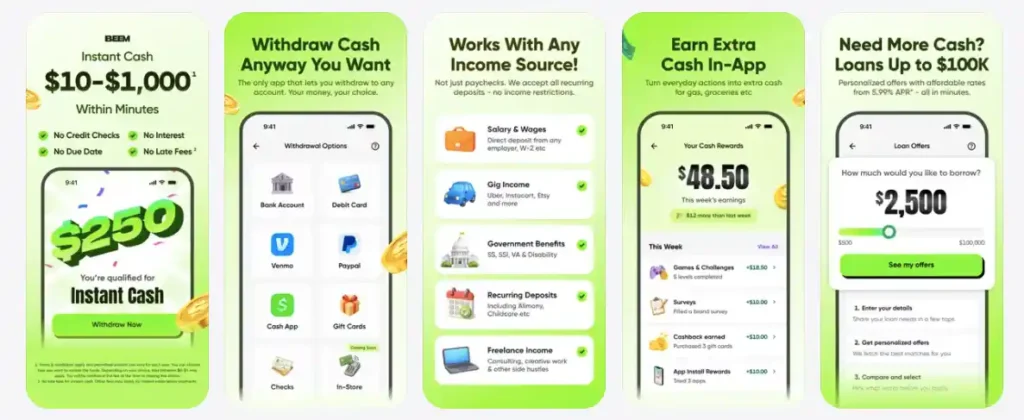
Beem‘s Everdraft uses bank account analysis to verify income from any recurring source, including gig platforms, freelance payments, and direct employer deposits.
2. Maintain an Active Bank Account
Your bank account is the center of every cash advance evaluation. Providers need to see regular transactions, incoming deposits, and account activity that demonstrates normal use. A dormant or rarely used account creates a gap in the data the app needs to make an approval decision.
Use one primary checking account for both income deposits and daily spending. This creates the activity pattern the app is looking for. Avoid splitting income across multiple accounts if you can, since most apps evaluate a single linked account rather than aggregating multiple sources. The platform needs to see the full picture of your cash flow in one place to model your repayment capacity.
3. Set Up Direct Deposit Where Possible
Direct deposit consistently unlocks higher advance limits and faster approval decisions across platforms. When your income arrives via direct deposit, the app verifies the source and amount in real time rather than waiting for the deposit to settle and clear through normal banking channels.
For EarnIn, direct deposit from a single employer is a hard requirement.
For Beem, directing your primary income via direct deposit into your linked account typically unlocks higher Everdraft limits faster than relying on manually transferred income from other accounts.
4. Avoid Negative Balances and Overdrafts
A bank account that frequently shows negative balances or overdraft charges signals to the app that your cash flow is not stable enough to support automatic repayment. Apps use your overdraft frequency and pattern as one input into their eligibility model. Frequent overdrafts reduce your chances of approval and your starting advance limit.
Maintaining even a small positive balance, $10 to $50, between expense cycles helps demonstrate that your account does not go negative as a routine matter. Some apps, like Brigit, are specifically designed to detect pre-overdraft patterns and deposit an advance before the balance hits zero, which makes them worth considering if overdrafts are the issue rather than a disqualifying factor.
5. Complete Identity Verification
All regulated financial platforms follow Know Your Customer requirements. This is a legal requirement, not a creditworthiness check. The process is fully digital and typically completes in minutes. You need a government-issued ID, your legal name, date of birth, and confirmed bank account information that matches the identity you provided.
Incomplete identity verification is one of the most common reasons for rejection that has nothing to do with your income or account activity. Complete this step fully before attempting to request an advance. Once verified, you typically do not need to repeat the process unless your personal information changes.
How Eligibility Criteria Differ Across Apps
Different apps weight these factors differently, which is why a user who does not qualify on one platform may qualify on another. The table below summarizes the eligibility approach across the four apps in this guide.
| App | Credit Check | Income Type Accepted | Min Account History | Direct Deposit Required | Starting Limit |
| Beem Everdraft | No | Any recurring deposit | Varies | No (but helps) | Up to $1,000 |
| EarnIn | No | Single employer direct deposit | Recent pay stubs | Yes | Up to $150/day |
| Brigit | No | Any recurring deposit | 60 days minimum | No | Up to $500 |
EarnIn has the most restrictive income requirements: a single employer, verifiable via direct deposit, with no income from multiple sources counted. This makes it less accessible for gig workers and freelancers. Brigit’s 60-day history requirement is longer than most competitors but reflects its use of predictive monitoring, which needs sufficient data to function accurately. Beem accepts the widest range of income sources and charges no mandatory fees while offering the highest advance ceiling of any app on this list.
Common Reasons for Rejection and How to Fix Them
Most rejections are not permanent. They reflect a specific gap in the data the app needs, and most can be resolved in two to four weeks by addressing the underlying issue before reapplying.
Irregular or fragmented income is the most common reason. If your income arrives in inconsistent amounts from multiple sources split across different accounts, the app cannot build a reliable picture of your cash flow. Consolidate income deposits into one primary account and allow two to four weeks of consistent inflows before reapplying.
An inactive or dormant account reduces the app’s confidence in its ability to collect automatic repayment from your deposits. Use your linked account for regular spending and incoming deposits before applying. Even three to four weeks of consistent activity often resolves this issue entirely.
Incomplete identity verification prevents the app from legally approving the advance regardless of your income situation. Check that all submitted information matches your government-issued ID exactly, including name spelling and date of birth.
Pro Tips to Boost Eligibility
Route your primary income directly to your linked account rather than transferring it after deposit. The app sees the direct deposit immediately and attributes it correctly. Avoid switching banks or changing your primary linked account frequently, since each switch resets your account history with the app and requires the eligibility model to rebuild from a shorter dataset.
When you do request an advance, repaying it promptly and from the expected deposit, rather than requesting extensions, builds the trust signal that unlocks higher limits over the following months. Apps reward consistent behavior with expanded access, so treating the advance as a structured tool rather than a flexible credit line produces better long-term eligibility outcomes. Building a paycheck buffer alongside consistent deposits signals financial stability and increases the limit within two to three advance cycles, which increases your access without requiring any new application step.
Frequently Asked Questions
Do I need a credit check to get an instant cash advance?
No. EarnIn, Brigit, and Beem’s Everdraft all approve advances without a hard credit check. Eligibility is based on bank account activity and deposit history. A low credit score, no credit history, or a damaged credit file has no bearing on your eligibility for the advance on any of these platforms.
Can I get a cash advance if I am a gig worker or freelancer?
Yes, on most platforms. Brigit, and Beem accept non-traditional income from gig platforms, freelance clients, and other irregular sources. EarnIn is the exception: it typically requires a single employer direct deposit and may not accept fragmented gig income. If you have multiple income streams, Beem is the most accessible options.
Why was my cash advance application rejected?
The most common reasons are insufficient account history, irregular income deposits, incomplete identity verification, and bank connectivity issues. None of these is a permanent barrier. Address the specific issue identified in the rejection notice, allow two to four weeks for your deposit history to build, and reapply on the same platform or try one with more flexible income requirements.
How long does it take to qualify for a higher advance limit?
Most apps start new users at a lower limit and increase it over time based on consistent deposit and repayment history. Two to three months of regular account activity, on-time advance repayments, and stable deposit patterns typically lead to a meaningful increase in lending limit. Some apps also link higher limits specifically to direct deposit enrollment.
What is the difference between a cash advance and a payday loan?
Cash advance apps charge no interest and repay automatically from your next deposit. Payday loans charge $15 to $30 per $100 borrowed, producing APRs above 300%, and require full repayment on a fixed date regardless of cash flow. The repayment timing difference is what makes cash advance apps significantly less likely to create a debt cycle.
Do cash advance apps affect my credit score?
No. None of the apps in this comparison perform a hard credit check, and most do not report advance activity to credit bureaus. Requesting and repaying an advance leaves no trace on your credit file. Some apps offer optional credit-building features that involve bureau reporting, but these are disclosed upfront and not applied by default.
What happens if I cannot repay a cash advance on time?
Contact the app proactively before the repayment date. Most apps allow at least one free extension or date adjustment per advance cycle when you reach out before the payment processes. EarnIn, Brigit, and Beem all have hardship provisions for users who communicate early. A missed payment without prior contact may pause future advance access until the balance clears.
What to Do If You Do Not Qualify Yet
A first-attempt rejection is not the end of the process. Most users who are rejected qualify within two to four weeks after addressing the specific issue that caused the rejection. The most productive steps are to consolidate your income deposits into a single linked account, allow that account to build at least 30 days of consistent activity, complete your identity verification fully, and check whether your bank supports the third-party integrations the app requires.
Choosing a different app is also worth considering. EarnIn’s single-employer requirement excludes many gig workers who would qualify on Beem. Brigit’s 60-day history requirement disqualifies users who are new to a bank account. Matching your income type to the app that evaluates it correctly is often the fastest path to approval.
Once you qualify, the habits that keep your advance access open are the same ones that strengthen your overall financial position: consistent deposits, a positive balance buffer, and repayments that process automatically from the income you were already expecting. Beem’s Everdraft is worth considering for users who want the highest fee-free advance limit alongside income verification that accepts the widest range of deposit types.