

Key Summary
AI-powered cash advance apps have changed how millions of Americans access short-term funds before payday. Instead of running a credit check, calling an employer, or waiting 24 to 72 hours for a manual approval decision, these apps analyze your bank account activity in real time and return an approval in seconds. The practical result is faster access, fewer rejections for people with thin credit files, and lower operating costs that can be passed on as lower or zero fees.
According to the Federal Reserve, roughly 37% of American adults would struggle to cover a $400 emergency expense from savings alone. AI-driven cash advance tools are specifically designed for this gap: the space between when a bill is due and when a paycheck arrives, where traditional bank lending is too slow, too expensive, and too credit-dependent to be useful. This guide explains how AI actually works in these products, which apps are using it in 2026, and what to look for when choosing one.
The 2026 Financial Landscape: Faster, Smarter, and Digital-First
The shift toward AI-based financial decisions has accelerated significantly over the past three years. Processes that previously required paperwork, human review, and multi-day approval windows now complete in seconds using automated systems that read bank data, assess patterns, and return a decision without any human involvement at any point in the workflow. The infrastructure behind these decisions includes machine learning models trained on millions of transactions, real-time connections to bank data through secure aggregation services, and automated fund transfer systems that execute immediately after approval.
Users who interact with these systems expect more than just speed. They want transparency, disclosed costs, and products that fit their actual financial behavior rather than requiring them to conform to the income patterns traditional lenders were built around. Salaried employment with consistent biweekly direct deposit is no longer the only profile these systems can serve. Gig workers, freelancers, part-time employees, and people with irregular income patterns can all qualify for AI-based advances that would have been inaccessible under traditional underwriting rules. This broadened access is one of the most significant practical consequences of applying AI to the short-term lending problem.
Also Read: Cash Advances During Unexpected Expenses
How AI Is Transforming Instant Cash Advances
The term AI gets applied broadly to financial products, but in cash advance apps specifically, it refers to a defined set of mechanisms that work together to replace the traditional credit underwriting model. Understanding each mechanism helps you evaluate what a given app is actually doing when it approves or declines your advance request.
1. Real-Time Income Verification
Traditional lenders verify income by requesting pay stubs, W-2s, or employer letters, a process that takes days and excludes anyone with non-traditional income sources. AI-based income verification works differently. The app connects to your bank account through a secure data link, reads your deposit history over the past 30 to 90 days, identifies recurring income patterns, and uses those patterns to confirm your ability to repay the advance from a future deposit.
This approach is faster and more inclusive than document-based verification. It picks up gig income, freelance payments, benefits deposits, and any other recurring inflows that a pay stub would not capture. The result is a more accurate picture of actual cash flow rather than a formal employment record that may not reflect current reality.
2. Predictive Risk Assessment
Standard credit risk models look backwards: they evaluate your payment history, debt levels, and credit utilization over months or years and translate that into a score. AI-based risk models look at a wider dataset. They evaluate your current deposit frequency, your balance patterns relative to your billing cycles, your overdraft history, and how consistently you repay previous advances.
This shift matters most for users with thin or damaged credit files who would get declined by a traditional credit-based system. A user with a 580 credit score who has received consistent deposits for six months and has never missed a repayment on a prior advance presents a meaningfully different risk profile than the credit score alone suggests. AI-based assessment can distinguish between these profiles where a three-digit score simply cannot.
3. Personalised Cash Flow Forecasting
Beyond eligibility assessment, some AI-powered apps build ongoing models of your cash flow and use them to predict when you are likely to face a shortfall. These systems analyze your recurring bills, their typical timing, your average deposit amount and frequency, and your spending patterns to identify weeks where a gap is likely to appear well before you are actually short.
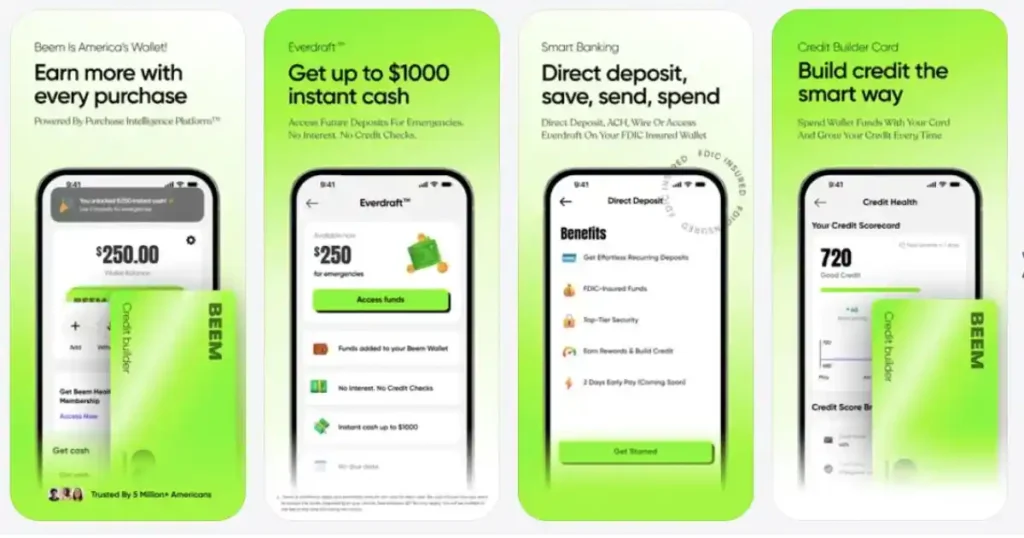
Beem‘s Everdraft feature uses this type of analysis to notify users when their balance is trending toward a problematic level, giving them time to request an advance or adjust spending before they are actually short rather than after an overdraft has already occurred. This proactive framing is what distinguishes a predictive AI system from a simple reactive approval tool that only activates after a user manually requests funds.
4. Instant Decisioning and Transfer
The speed advantage of AI-based systems is most visible at the decisioning stage. A human underwriter reviewing a loan application might take hours or days. An AI model evaluating the same dataset evaluates it in under one second and returns a decision before the user has finished reading the app screen. This speed, combined with direct bank integrations for fund transfer, is what allows these apps to deliver money within minutes of approval rather than within business days.
5. Fraud Prevention and Data Security
AI-based fraud detection runs continuously in the background rather than as a one-time check at application. Machine learning models monitor each transaction for patterns inconsistent with the user’s established behavior, flag unusual activity in real time, and block suspicious transfers before funds move.
This continuous monitoring approach reduces fraud losses, which is a major reason AI-enabled platforms offer lower or zero fees compared to products that absorb higher fraud costs and pass them to users through elevated pricing.
The Human Problem AI Is Solving
Behind every cash advance request is a concrete timing problem: the bill is due Thursday, the paycheck arrives Friday, and the overdraft or late fee that results from that 24-hour gap costs $30 to $35 per occurrence. Multiply that by 12 months and the annual cost of a single day’s timing gap leads to $360 to $420 in avoidable fees.
AI does not solve structural income insufficiency. What it does solve is the timing gap problem for people who have the income to cover their expenses but not always on the exact schedule their bills demand. For this specific problem, which affects tens of millions of Americans regardless of income level, an AI-based cash advance that delivers funds in minutes with no fees and no credit check is a materially better tool than any alternative currently available through traditional banking. The value is not in creating access to money that would not otherwise exist, but in bridging the gap between when money exists in one form and when it needs to exist in another.
AI-Powered Cash Advance Apps Compared
The apps below represent the main AI-enabled cash advance products available to US consumers in 2026. Each uses AI at different points in the approval and delivery process.
| App | Max Advance | AI Mechanism | Monthly Fee | Credit Check | Delivery |
| Beem Everdraft | $1,000 | Income verification plus cash flow prediction | None | No | Instant |
| EarnIn | $750/period | Wage verification via direct deposit analysis | None (optional tip) | No | 1 to 3 days or instant fee |
| Dave ExtraCash | $500 | Deposit pattern analysis | $1 | No | 1 to 3 days or instant fee |
| Brigit | $500 | Predictive balance monitoring, auto-deposit | $8.99 to $15.99 | No | Free or express fee |
Beem’s Everdraft uses bank account analysis to verify income and forecast cash flow, reaching up to $1,000 with no advance fee and instant delivery after approval. EarnIn verifies wages by connecting to your direct deposit history and advances funds you have already earned, up to $750 per pay period with no mandatory fee. Brigit uses predictive monitoring to track your balance against upcoming bills and can deposit an advance automatically before your balance reaches zero, with plans ranging from $8.99 to $15.99 per month.
How AI-Powered Cash Advances Differ from Traditional Payday Loans
The comparison between AI-powered cash advance apps and traditional payday loans is not just about cost, though the cost difference is significant. Payday lenders typically charge $15 to $30 per $100 borrowed, which translates to APRs of 200% to 400% on a two-week loan. AI-based apps charge nothing or a small flat subscription fee regardless of the advance amount.
The structural difference runs deeper. Payday lenders use a fixed repayment model that requires the full amount plus fees to be paid on a specific date, regardless of whether the borrower’s paycheck actually arrives on that date. Most AI-based cash advance apps use automatic repayment tied to the next qualifying deposit, meaning repayment happens when funds are actually available rather than on an externally imposed date. This structural alignment between repayment and income is a reason why AI-based products produce fewer debt cycles than payday loans.
The Broader Impact: AI as a Driver of Financial Stability
The greatest contribution of AI in this product category is not just that it speeds up approvals. It is that it makes short-term financial products accurate enough to be genuinely useful for people with non-standard income profiles without exposing them to the cost structures that have historically made those products harmful.
Predictive cash flow insights reduce overdraft fees and late payment penalties by giving users information before a crisis rather than after. AI approval systems serve gig workers, freelancers, and people between jobs who were effectively excluded from the short-term lending market under traditional underwriting. And the fee transparency that AI-enabled platforms can sustain, because they are not absorbing the fraud and default costs that traditional lenders must price into their rates, means users get more of the value of the advance and less disappears into fees.
The Future of AI in Cash Advances
The AI capabilities in cash advance products will continue expanding. Hyper-personalization will eventually allow apps to tailor advance amounts and repayment timing to individual income cycles rather than applying standard terms to all users. Predictive lending ecosystems will link cash advance access to savings tools, credit building products, and insurance. Voice and conversational interfaces will make the advance request process faster for users who find app navigation cumbersome.
The clearest trend already visible in 2026 is that AI is moving cash advance products from reactive tools, available after a crisis has started, toward proactive tools that identify and address shortfalls before they become emergencies.
Why Cash Advance Apps Skip the Hard Credit Pull
Traditional lenders rely on FICO scores because they extend credit over months or years, where historical data is critical to assessing risk. In contrast, AI-powered advance apps provide short-term funds for just a few weeks against a verified, immediate income stream. Because these apps assess your ability to repay from an incoming deposit in the very near future, traditional credit scores are largely irrelevant to the actual risk. Instead, the AI focuses on current cash flow patterns to ensure the advance can be safely repaid.
Common Disqualifiers: Why You Might Be Declined
While these apps are more accessible than traditional loans, they aren’t guaranteed approvals. If you are declined, it is often due to the “income story” the app sees in your bank account history. Common reasons for rejection include:
- Frequent overdrafts in the 60-90 days before your application.
- Bank accounts that are too new (typically under 60 days of history).
- Income that is deposited into an account separate from the one linked to the app, making it invisible to the AI’s verification process.
Strategic Use Cases: When an Advance is the Right Tool
To get the most value from these products, it is important to understand when they are a smart financial tool and not a risky one.
- These apps work best for true timing mismatches, such as travel emergencies, medical expenses, or bill-pay timing gaps—where the need is immediate, and you have a definitive, upcoming paycheck to cover the repayment.
- You should avoid using these products to cover ongoing structural income insufficiency, such as consistently living beyond your means. Taking multiple advances in sequence can create a difficult cycle of debt that these tools are not designed to solve.
Frequently Asked Questions
How does AI actually decide whether to approve a cash advance?
AI approval systems analyze your bank account history, specifically deposit frequency, deposit amounts, balance patterns, and repayment history on prior advances. The decision typically completes in under one second and reflects your actual current financial behavior rather than a historical credit score. No credit check is performed on any of the apps in this comparison.
Do AI cash advance apps share my bank account data with third parties?
Reputable apps connect to your bank through secure read-only links provided by financial data aggregators. This lets the app read your transaction history but cannot initiate transfers without your explicit approval. The data is used for eligibility assessment and fraud monitoring. Review each app’s privacy policy to confirm how your data is stored and whether it is shared with any partners.
Are AI cash advance apps available to gig workers and freelancers?
Yes. Most AI-based cash advance apps evaluate deposit patterns rather than employer payroll records, so gig platform payments, freelance transfers, and irregular income deposits all qualify for analysis. Some apps set minimum deposit thresholds or require minimum account history, but traditional employment is generally not a requirement on any of the apps in this comparison.
Is an AI cash advance better than a payday loan?
For most users facing a short-term timing gap, yes. AI cash advance apps typically charge no interest, use automatic repayment tied to your next deposit, and do not require a credit check. Payday loans typically charge 200% to 400% APR and require repayment on a specific date regardless of cash flow, which can trap borrowers in rollover cycles when the full amount is not available on the due date.
Conclusion
AI has shifted the cash advance product from a reactive emergency tool into a proactive financial buffer. By analyzing income patterns, predicting shortfalls, and delivering funds in minutes rather than days, AI-based systems address the core timing problem that causes most short-term financial stress for working adults.
The practical difference this creates is access. Users who would have been declined under a credit-based system, gig workers, freelancers, people with thin files, and people between jobs, can qualify based on their actual financial behavior. The cost difference compared to payday loans is substantial, but the access difference, being approved based on behavior rather than a credit score, is what makes these products genuinely different.
Beem’s Everdraft, EarnIn, and Brigit all represent this model in different configurations. The right choice depends on your advance amount need, how quickly you need the funds, and what ongoing cost structure fits your usage pattern.