
Key Summary
Losing a job creates financial pressure almost immediately.
Rent does not pause because someone lost employment. Utility bills still arrive. Grocery expenses continue. Car payments, insurance premiums, medical bills, and credit card balances can quickly pile up even during temporary unemployment.
For many Americans, the biggest challenge is not long-term recovery. It is surviving the next few weeks.
That is why searches for instant cash advance options for unemployed individuals continue to rise. People often need quick access to emergency funds while waiting for unemployment benefits, freelance income, new job opportunities, or financial assistance programs.
The problem is that traditional lenders rarely make borrowing easy for unemployed borrowers.
Banks usually want stable employment verification, strong credit history, and predictable monthly income before approving loans. Payday lenders may approve applicants more easily, but their high fees and short repayment periods can create even bigger financial problems later.
Fortunately, newer financial apps and alternative cash advance platforms are changing how short-term emergency funding works.
Today, unemployed individuals may still qualify for certain cash advance options depending on unemployment benefits, gig income, side hustles, savings activity, direct deposits, or alternative income sources.
The key is understanding which options are realistic, which are risky, and how to borrow responsibly during financial uncertainty.
Can Unemployed Individuals Get a Cash Advance?
Yes, in some situations unemployed individuals can still qualify for cash advances.
However, approval depends heavily on how the lender or app evaluates income and repayment ability.
Traditional lenders usually focus on stable employment, but many modern cash advance apps use a broader view of financial activity. Instead of relying only on full-time employment verification, some platforms review:
- Unemployment benefits
- Gig work income
- Freelance earnings
- Government assistance deposits
- Side hustle income
- Regular bank deposits
- Spending habits
- Account balance history
This shift has opened more opportunities for borrowers who may not have traditional jobs but still receive consistent cash flow.
For example, someone receiving unemployment payments every two weeks may still qualify for certain advance products if the app detects recurring deposits and healthy account activity.
Similarly, freelancers, rideshare drivers, delivery workers, and self-employed individuals without fixed salaries may still qualify through alternative income verification systems.
The important thing to understand is that unemployed borrowers generally face stricter approval limits, smaller advance amounts, and closer account monitoring compared to traditionally employed users.
Why Traditional Loans Are Harder During Unemployment
Traditional loans are built around predictable income.
Banks and major lenders want confidence that borrowers can repay debt on schedule. Employment history gives them a measurable way to estimate repayment risk.
Without a job, lenders often see higher risk because income may be unstable or temporary.
This becomes even more difficult for borrowers with:
- Low credit scores
- Existing debt
- Missed payments
- Limited savings
- High monthly expenses
As a result, many unemployed individuals get denied for personal loans, credit cards, or traditional financing during periods of financial instability.
That is one reason cash advance apps have become more popular in recent years. Many platforms now rely less on credit scores and more on real-time banking activity.
Instead of asking whether someone has a full-time job, some apps ask different questions:
- Are deposits arriving consistently?
- Does the user manage balances responsibly?
- Are bills being paid regularly?
- Is there evidence of future repayment ability?
This creates more flexibility for unemployed users who still maintain some form of incoming cash flow.
The Difference Between Cash Advances and Payday Loans
Many unemployed borrowers confuse cash advance apps with payday loans, but they work very differently.
Payday loans are usually high-interest short-term loans with extremely aggressive repayment terms. Borrowers often face triple-digit APRs, rollover fees, and heavy penalties for missed payments.
Cash advance apps typically operate with smaller advance amounts and lower overall costs.
Most modern cash advance apps:
- Avoid traditional interest rates
- Skip hard credit checks
- Offer smaller advances
- Use direct repayment systems
- Include budgeting tools
- Charge lower fees overall
While cash advance apps are generally safer than payday lenders, they still require careful use.
Repeated borrowing can still create long-term cash flow problems if expenses continue exceeding income.
Why Many Unemployed Individuals Turn to Cash Advance Apps
Cash advance apps solve one major problem: speed.
Traditional loan applications can take days or even weeks. Emergency expenses usually cannot wait that long.
Cash advance apps often provide:
- Faster approvals
- Simplified applications
- Smaller borrowing amounts
- Direct mobile access
- Faster deposits
- Flexible qualification systems
For someone dealing with temporary unemployment, this convenience matters.
Many borrowers only need enough money to cover immediate survival expenses like:
- Groceries
- Gas
- Utility bills
- Phone bills
- Transportation
- Prescription medications
- Childcare expenses
Smaller advances can sometimes prevent bigger financial emergencies later.
For example, paying a utility bill on time may avoid service shutoffs and reconnection fees. Covering gas expenses may help someone continue attending job interviews or gig work opportunities.
Used responsibly, small emergency advances can provide short-term breathing room during unstable periods.
How Beem Helps During Financial Emergencies
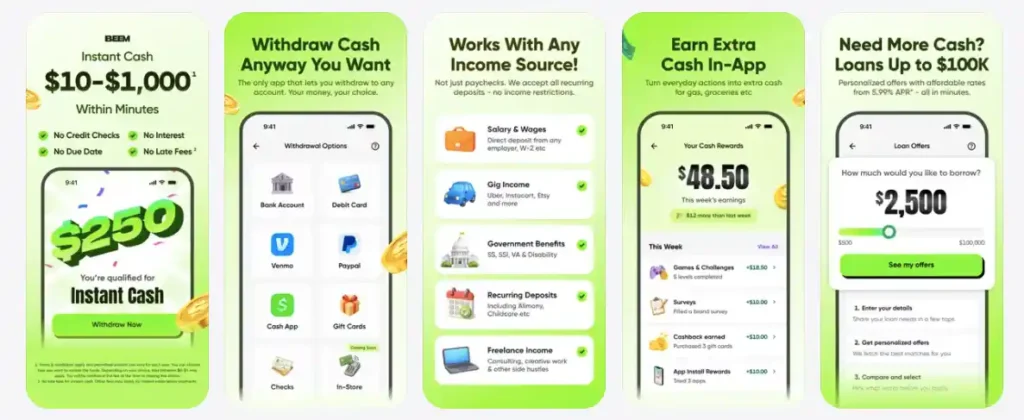
For unemployed individuals facing short-term financial pressure, Beem offers a more flexible financial wellness approach than many traditional lenders.
Instead of focusing only on employment status, Beem supports users through emergency cash access combined with budgeting tools, financial tracking, and AI-powered money management support.
This matters because unemployment often creates more than one financial problem at a time.
Many borrowers are not only struggling with cash shortages. They are also trying to:
- Reduce expenses
- Stretch savings longer
- Compare bills
- Manage debt
- Find side income opportunities
- Improve budgeting habits
Beem helps users approach financial stress more holistically instead of relying only on borrowing.
The platform also includes financial wellness tools that may help users make smarter money decisions during difficult periods.
For individuals dealing with temporary unemployment, having both emergency cash support and budgeting assistance can be more valuable than borrowing alone.
The Emotional Side of Financial Stress
Financial instability affects more than bank balances.
Unemployment often creates emotional pressure that impacts decision-making, confidence, and mental health.
Many people facing financial emergencies experience:
- Anxiety
- Sleep disruption
- Relationship stress
- Shame around borrowing
- Panic spending
- Difficulty planning ahead
Under stress, people often make faster financial decisions without fully reviewing fees, repayment terms, or long-term consequences.
That is one reason payday lenders continue attracting desperate borrowers despite extremely high costs.
When someone feels trapped, fast money can appear more important than smart money.
This is why responsible borrowing matters so much during unemployment.
The goal should not simply be getting money quickly. The goal should be solving immediate financial problems without creating even larger ones later.
Warning Signs of Risky Borrowing
Some borrowing situations become dangerous quickly.
Unemployed borrowers should be cautious if they find themselves:
- Taking advances every week
- Using one app to repay another
- Missing rent repeatedly
- Borrowing for nonessential spending
- Paying large instant transfer fees frequently
- Rolling over payday loans
- Struggling to cover minimum debt payments
These patterns often signal deeper financial instability.
In these situations, reducing expenses, increasing income sources, or seeking financial counseling may become more important than continued borrowing.
Cash advances should ideally remain temporary tools, not permanent income replacements.
Read: Does Beem Work With Cash App for Emergency Cash Transfers in 2026?
How Financial Apps Are Changing Access to Emergency Cash
The financial industry is evolving quickly.
In the past, unemployed individuals often had very few borrowing options outside payday lenders or personal loans.
Today, many fintech platforms use alternative underwriting systems that analyze real-time financial behavior instead of relying entirely on credit scores or employment history.
This creates more flexibility for people with nontraditional income patterns.
As financial technology continues improving, access to emergency cash may become even more personalized and accessible for users navigating temporary unemployment or income instability.
Still, responsible borrowing habits will remain essential regardless of how advanced financial apps become.
Final Thoughts
Unemployment can create immediate financial pressure, especially when emergency expenses appear unexpectedly.
While traditional loans may become harder to access without stable employment, some cash advance apps now offer more flexible qualification systems that consider unemployment benefits, gig work income, freelance earnings, and other recurring deposits.
For many borrowers, short-term cash advances can provide temporary relief during difficult periods. However, borrowing should always be approached carefully and responsibly.
Apps like Beem help users go beyond short-term borrowing by combining emergency cash access with budgeting support, financial wellness tools, and smarter money management features.
The most important goal is not simply accessing fast cash. It is protecting long-term financial stability while navigating temporary financial hardship.
Check out Beem for on-point financial insights and recommendations to spend, save, plan and protect your money like an expert. Download the Beem app today!
People Also Ask
Can unemployed individuals get instant cash advances?
Yes, some cash advance apps may approve unemployed individuals if they receive recurring deposits such as unemployment benefits, gig income, freelance payments, or government assistance.
Do cash advance apps check employment status?
Many modern cash advance apps focus more on bank activity and recurring deposits than traditional employment verification.
Are cash advances better than payday loans?
In many cases, yes. Cash advance apps usually have lower fees, more flexible repayment terms, and fewer penalties compared to traditional payday loans.
What is the easiest cash advance option for unemployed individuals?
Apps with flexible income verification systems, such as Beem, may work better for users with nontraditional income sources or temporary unemployment.
Can unemployment benefits help qualify for cash advances?
In some cases, yes. Certain apps may consider recurring unemployment benefit deposits when reviewing eligibility.