
Key Summary
Brigit built its reputation on predictive overdraft protection, a credit-builder program, and advances up to $500 with no interest and no late fees. It works well for a specific type of user: someone who wants automated balance monitoring and is comfortable paying a monthly subscription for that protection. But the $500 cap, the subscription requirement, and the express delivery fee push some users to look elsewhere for an app that fits their situation.
If you need a higher advance limit, want to avoid a monthly fee, or prefer a different combination of tools alongside the advance, there are strong alternatives worth comparing in detail. According to the Consumer Financial Protection Bureau (CFPB), overdraft and cash advance-related complaints are among the most commonly filed financial complaints in the United States, reflecting how much the specifics of cost, limit, and delivery speed matter in practice.
This guide on Cash Advance Apps Like Brigit covers core features first, then walks through 7 alternatives with enough detail to make a real comparison before you download anything.
What Is Brigit and Who Is It Best For?
Brigit is a fintech cash advance app that offers advances from $25 to $500 at 0% interest with no credit check and no late fees. Users connect their bank account, and Brigit monitors spending patterns, predicts upcoming cash shortages, and can deposit an advance automatically before a balance drops to zero. That predictive deposit feature is Brigit’s most distinctive capability and the main reason its users stay loyal across subscription tiers.
Brigit operates on a tiered subscription model. The Basic plan is free but provides only alerts and insights, not advances. Paid plans range from $8.99 to $15.99 per month and unlock cash advances, credit building, budgeting tools, identity theft protection, and real-time bank balance alerts. At the higher tier, the subscription cost begins to rival what some users pay monthly in overdraft fees, which is the calculation Brigit is hoping you make when you sign up.
The Credit Builder product is a genuine standout. It is a small installment loan with no hard credit pull, no security deposit, and no interest. Payments can start at $1 per month and are reported to all three major credit bureaus: Experian, Equifax, and TransUnion. Any extra money above the minimum payment is returned to the user when the loan is paid off. For users working to repair or establish credit, this is a meaningful benefit that most cash advance apps do not offer.
Standard delivery is free via ACH and takes one to three business days. Express delivery to a debit card is faster but carries a fee. Maine residents are capped at $250 regardless of account history. The app integrates with over 15,000 financial institutions including Chase, Bank of America, Wells Fargo, and Chime.
Brigit is best suited for users who need automated overdraft prevention, want a structured credit-building product alongside the advance, and will use the budgeting and monitoring tools consistently enough to make the monthly subscription worth it. For users who only need an occasional advance and have no interest in the financial health extras, the subscription cost creates a higher effective cost per advance than most alternatives on this list.
Best Alternatives to Brigit
The eight apps below vary in advance limits, costing, delivery speed, and additional features. Each section focuses on what makes the app genuinely different from Brigit rather than just listing features side by side. The right fit depends on your advance amount, your tolerance for subscription costs, and whether you want financial health tools alongside the advance or just the advance itself.
Beem
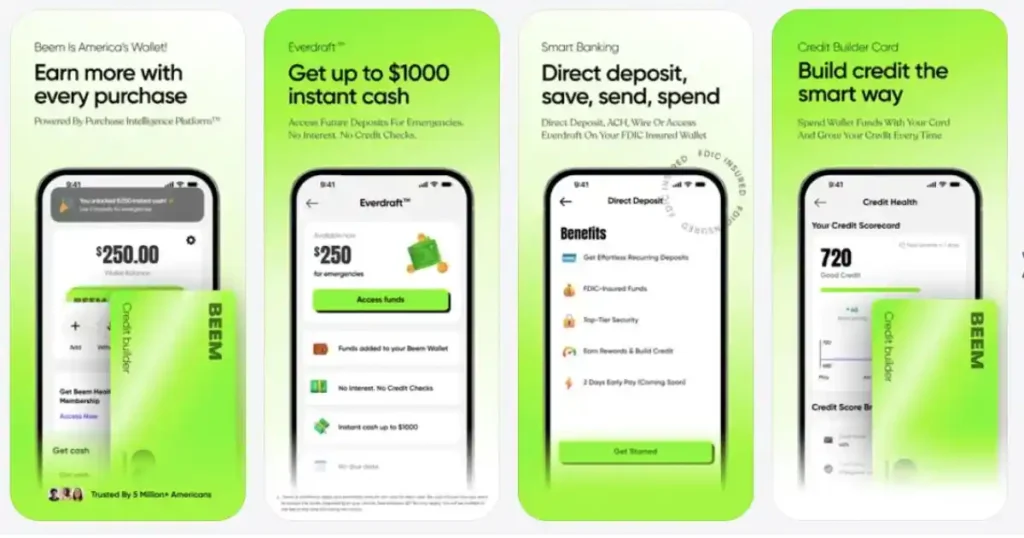
Beem‘s Everdraft feature offers advances up to $1,000 with no fee, no credit check, and no subscription requirement. Repayment is automatic from your next paycheck. The app also includes a budget planner, spending insights, and credit monitoring alongside the advance, giving a similar financial health toolkit to Brigit without a monthly subscription attached to the advance feature.
The main practical difference from Brigit is the advance ceiling and cost structure. Brigit caps at $500 and requires a paid subscription of $8.99 to $15.99 per month. Beem reaches $1,000 with no advance fee and no mandatory subscription. New users typically start with a lower approved limit that increases with account history. After approval, delivery is instant, which is faster than Brigit’s free standard ACH delivery.
EarnIn
EarnIn gives you access to wages you have already earned, up to $150 per day and $750 per pay period. There are no mandatory fees. The optional tip model means the total cost is entirely within your control. Instant delivery is available for a small fee; free standard delivery takes one to three business days.
EarnIn works best for salaried and hourly employees who receive consistent direct deposits from a single employer. Gig workers and freelancers often do not qualify because EarnIn requires a regular, verifiable direct deposit pattern. Balance Shield, EarnIn’s automatic transfer feature triggered when your account balance drops below a set threshold, mirrors Brigit’s predictive deposit capability without a subscription requirement.
MoneyLion
MoneyLion‘s Instacash feature offers advances up to $500 at 0% APR with no mandatory fees and no credit check. Users who set up qualifying recurring direct deposit into a RoarMoney account can unlock up to $1,000. Like Brigit, MoneyLion packages financial health tools alongside the advance, including credit builder loans that report to all three bureaus, investment accounts, and early direct deposit.
Standard delivery to an external bank account takes one to five business days. An optional Turbo Fee speeds up delivery for same-day needs. The all-in-one design makes MoneyLion a strong fit for users who want Brigit’s financial health ecosystem but need a higher advance ceiling.
The Turbo Fee is the most common complaint in user reviews, since the platform markets itself as having no mandatory fee.
Empower
Empower offers advances up to $250 based on your banking history and average account balance. No credit check, no interest, and no late fees apply. The app also includes AI-powered spending advice, automated savings tools, a cashback debit card, and customizable spending goals. No mandatory subscription is required for the advance feature.
Empower’s advance limit is lower than Brigit’s $500 ceiling, which is its main limitation. For users whose typical shortfall is under $250 and who want built-in savings automation without a monthly cost, it covers the need cleanly. The AI-driven spending analysis and automated savings tools give it a financial health toolkit comparable to Brigit’s budgeting features at a lower recurring cost.
Cleo
Cleo offers advances up to $250 through its Cleo Plus subscription at $14.99 per month. The app is distinctive for its conversational AI interface, which delivers financial insights and spending nudges in a casual, direct tone that feels different from most financial apps. Cleo monitors your spending across linked accounts and can flag problematic patterns before they create a shortfall.
The subscription cost is higher than Brigit’s entry-level paid plan, and the advance limit is lower at $250. Cleo is best suited for users who engage with the AI budgeting features daily and value the interface. For users who only want the advance, the cost to benefit ratio is less favorable than most alternatives on this list.
Klover
Klover offers advances from $25 to $750 with no credit check, no interest, and no mandatory fees. The average advance for users is around $170. A points system lets users earn a higher advance limit over time by completing surveys, watching ads, and uploading receipts. That data-for-value model is the central trade-off: Klover explicitly monetizes anonymized user data in exchange for app access and higher advance limits.
Standard delivery is free. Instant delivery carries a small express fee. For users comfortable with the data-sharing arrangement, Klover offers a higher advance limit than Brigit without a monthly subscription cost.
Also Read: Best Instant Cash Advance Apps with No Interest Fees
Comparison Table: Brigit vs Top Alternatives
| App | Max Advance | Monthly Fee | Credit Check | Delivery | Credit Builder |
| Brigit | $500 | $8.99 to $15.99 | No | Free ACH or express fee | Yes |
| Beem (Everdraft) | $1,000 | None | No | Instant, no fee | Yes |
| EarnIn | $750/period | None (optional tip) | No | 1 to 3 days free or instant fee | No |
| MoneyLion | $500 to $1,000 | None mandatory | No | 1 to 5 days or Turbo Fee | Yes |
| Empower | $250 | None for advance | No | 1 to 3 days or instant fee | No |
| Cleo | $250 | $14.99 | No | Instant with subscription | No |
| Klover | $750 | None | No | Free or small express fee | No |
Bank Compatibility & Requirements Check: Will Your Account Qualify?
One of the most frustrating experiences with cash advance apps is spending 10 minutes setting up a profile, linking your bank, and picking an advance amount, only to hit a sudden disqualification screen. Because these platforms don’t run traditional credit checks, they rely heavily on automated rules to evaluate your bank account.
Before you spend time downloading and configuring a new app, run through these three core criteria to make sure your account qualifies:
1. Aggregator Support (Plaid, Akoya, or MX)
Almost every app on this list uses secure third-party data aggregators like Plaid or Akoya to view your transaction history. While these systems support over 12,000 financial institutions, including national giants like Chase, Bank of America, and Wells Fargo, they occasionally struggle with smaller local credit unions, online-only prepaid accounts, or specialized digital banks. If your bank doesn’t support Plaid connections, the app won’t be able to read your income history.
2. Deposit Consistency and History
Instead of checking your credit score, these apps evaluate your deposit habits to determine your limit. Most require:
• At least 2 to 3 consecutive direct deposits into the same checking account over the past 30–60 days.
• An electronic payroll source (standard ACH direct deposits from an employer).
• Deposits made directly into a checking account. Savings accounts, physical check deposits, and peer-to-peer transfers (like Venmo or Zelle) rarely qualify.
3. Payroll Structure: W-2 Employees vs. Freelancers & Gig Workers
How you earn your money matters just as much as how much you earn:
• Salaried & Hourly W-2 Employees: This is the baseline profile every app is built for. You will face the fewest friction points regardless of which app you choose.
• Gig Workers & Freelancers (DoorDash, Uber, Upwork): Apps like EarnIn rely heavily on predictable pay schedules or fixed workplace tracking, making them harder to use if your income fluctuates week to week. On the other hand, apps like Klover and Empower look at overall cash flow patterns and ending balances rather than rigid paystub schedules, making them far better options for independent contractors.
Quick Tip: Keep your account balance positive in the days leading up to your advance request. The algorithms review your recent account activity for overdraft fees and Non-Sufficient Funds (NSF) charges. Too many recent negative balance warnings can cause the app to lower your maximum approved limit or pause access entirely.
Safety, Privacy, and Data Security: What Happens When You Link Your Account?
Handing over read-only access to your primary checking account is a big ask, and it’s smart to question how these platforms handle your information. Understanding the technology behind account linking and the privacy trade-offs involved helps you make an informed choice about which app deserves a spot on your phone.
How These Apps Protect Your Financial Data
Cash advance platforms do not see or store your actual bank login credentials on their servers. Here is how the security layer works in practice:
• Read-Only Tokens: When you enter your bank credentials during setup, you are typing them into a secure portal hosted by an aggregator like Plaid, not the cash advance app itself. Once your bank verifies your identity, it generates an encrypted, read-only token for the app. This allows the app to view deposit dates and account balances without sharing the authority to alter your password, send money, or manage your bank account.
• Encryption Standards: Data sent between your phone, the app, and your bank is protected using Transport Layer Security (TLS). Stored account information is protected by 256-bit AES encryption, the same security protocol utilized by major commercial banks and government agencies.
The Privacy Trade-Off: How Cash Advance Apps Monetize
No app operates for free, and how a platform makes its money directly impacts your data privacy:
• Subscription & Tip Models (Brigit, EarnIn): Apps that charge a monthly subscription fee or ask for voluntary tips generally rely on those payments to fund their business. As a result, they typically restrict their data usage strictly to verifying your income and processing advances.
• Data-Exchange Models (Klover): Apps that offer higher advance limits without subscription costs often fund their platform by monetizing consumer insights. Klover, for example, allows users to earn points toward higher advance limits by taking surveys, watching video ads, and uploading store receipts. While your personal identity is stripped away to keep the data anonymized, your spending habits and receipt data are aggregated for market research.
Bottom Line: If data privacy is your top priority, subscription-based or tip-supported apps offer a cleaner arrangement where your transaction data stays strictly between you and the platform. If your priority is avoiding monthly costs entirely, data-exchange platforms are a viable alternative—as long as you are comfortable trading anonymized spending insights for fee-free advances.
What to Look for in a Brigit Alternative
The right choice depends on which specific aspect of Brigit is not working for your situation. Running through these four decision points takes two minutes and narrows the list significantly before you spend time reading individual app reviews.
If the monthly subscription cost is the issue, EarnIn, Beem, Empower, and Klover all offer advances without a mandatory subscription. EarnIn uses an optional tip model. Beem and Empower charge nothing for the advance itself. Klover exchanges data engagement for access instead of a monthly fee.
If the $500 advance limit is not enough, Beem reaches $1,000 with no subscription and no fees. MoneyLion reaches $1,000 with qualifying direct deposit. Klover reaches $750 through its points system. EarnIn reaches $750 per pay period with no mandatory fees attached.
If you want credit-building tools alongside the advance, Brigit’s Credit Builder is the most structured option here, but MoneyLion also offers a credit builder loan that reports to all three bureaus. Beem includes credit monitoring and score tracking. For users who want the advance and active credit building together, Brigit and MoneyLion are the strongest fits.
If automated overdraft prevention is the primary need, Brigit’s predictive deposit feature is the most proactive in this category. EarnIn’s Balance Shield is a strong alternative for existing EarnIn users. Empower also monitors your account balance and can trigger a transfer before you go negative.
- If you need $500+ immediately: Beem or MoneyLion
- If you want zero monthly fees & work a standard job: EarnIn
- If you want to actively build your credit score: Brigit or MoneyLion
- If you prefer conversational AI budgeting: Cleo
FAQs: Cash Advance Apps Like Brigit
What is the best alternative to Brigit for a higher advance limit?
Beem’s Everdraft reaches $1,000 with no subscription and no fees on the advance. MoneyLion’s Instacash reaches $1,000 for users with qualifying RoarMoney direct deposit. EarnIn reaches $750 per pay period with no mandatory fees. All three exceed Brigit’s $500 cap by a meaningful margin.
Do Brigit alternatives require a monthly subscription?
Some do and some do not. Cleo charges $14.99 per month. EarnIn and Beem have no mandatory subscription for the advance feature. Klover and Empower also offer advances without a subscription. Always check the full cost including express delivery fees before committing to any app.
Can I use multiple cash advance apps at the same time?
Technically yes, but each advance gets paid back from your next paycheck. Running two or three simultaneous advances can leave your paycheck nearly empty, creating another shortfall the following cycle. Most experienced users stick to one app at a time, repay in full before requesting again, and only use a second app when the first cannot cover the full amount needed.
Do these apps check your credit score?
None of the apps in this comparison perform a hard credit check for the advance feature. Approval is based on your linked bank account activity and income deposit history. A low credit score, thin file, or no credit history has no bearing on your eligibility for the advance on any of these platforms.
How do cash advance apps make money if they charge no fees?
Subscription-based apps earn from monthly membership fees regardless of the amount of advance. Tip-based apps like EarnIn rely on voluntary tips. Data-exchange apps like Klover monetize anonymized user data. Some apps also earn from credit-builder products, partner loan referrals, and debit card interchange fees on everyday purchases made through the app.
Can I switch from Brigit to another app without losing my repayment history?
Yes. Repayment history on Brigit does not transfer to a new app. Each platform evaluates your eligibility independently based on its own review of your bank account activity. Your advance limit on a new app typically starts lower and increases over time as the app builds confidence in your repayment pattern through its own data.
What happens if I cannot repay a cash advance on my next payday?
Contact the app before your repayment date, not after. Most apps, including Brigit and EarnIn allow at least one free extension or date shift per advance cycle. A proactive message before the due date almost always gives a better outcome than waiting until after a missed repayment, which may pause your access to future advances.
Which App Fits What You Actually Need
Brigit is a well-built product for users who want automated overdraft prevention and a structured credit builder in one place and are comfortable paying a monthly subscription for the full feature set. If the cost or the $500 limit does not work for your situation, the alternatives above cover the full range without requiring any single app to do everything.
EarnIn is the lowest-cost option with no meaningful subscription. Beem reaches the highest fee-free advance limit at $1,000. MoneyLion and Beem both include credit-building tools. Klover and Empower give access without a subscription if you are comfortable with their respective trade-offs. The right app is the one that covers your actual advance amount at the lowest real cost for how often you plan to use it.