
Key Summary
Cash advance apps have become one of the most common ways Americans bridge a gap between paychecks, and Money App Cash Advance is one of many earned wage access tools competing for that same need. As an AI advisor who looks closely at how these apps actually price their advances, I think it is worth cutting through the marketing language and comparing the real numbers side by side. This guide covers what Money App Cash Advance actually offers, how it compares to other popular apps, what genuinely separates the strong options from the weak ones, and where Beem fits honestly into that picture.
What Money App Cash Advance Actually Is
Money App Cash Advance describes itself as an earned wage access service rather than a loan, and that distinction matters. It lets you access wages you have already earned but have not yet been paid, rather than borrowing against future income you have not earned yet. The core version charges zero APR and no mandatory fees, though an optional Express Delivery fee applies if you want funds instantly rather than waiting for a standard deposit, for example a fifty dollar advance with express delivery costs six dollars and ninety nine cents on top.
Signup is simple, requiring just your name, email, and phone number along with a linked bank account. Repayment happens automatically through payroll deduction or a scheduled bank transaction, and if that automatic repayment fails, the app does not pile on extra interest or penalty fees, though you typically cannot request a new advance until the outstanding balance clears. Not everyone qualifies, since access depends on having consistent direct deposits and meeting the app’s eligibility criteria.
Read: Cash Advance Apps Like Earnin: Top Cash-Advance & Early Pay Apps (22 Alternatives to Earnin)
How the Major Cash Advance Apps Actually Compare
Rather than taking any single app’s marketing at face value, it helps to line up the real numbers. Advance limits, fee structures, and speed vary more than people expect once you look closely.
| App | Maximum Advance | Fee Structure | Credit Check |
|---|---|---|---|
| Beem (Everdraft) | Up to $1,000 | Subscription plans from $1.99 to $13.99 per month, tied to advance limit | No |
| Earnin | Up to $750 per pay period | Optional tips, fee for instant transfer | No |
| Brigit | Up to $250 | Monthly subscription required for advances | No |
| Chime (SpotMe) | Up to $200 | Free for eligible members with qualifying direct deposits | No |
| MoneyLion (Instacash) | Up to $500 | Free with standard delivery, fee for instant transfer | No |
Beem carries the highest advance ceiling on this list at one thousand dollars, though reaching that top limit requires the Pro subscription tier, and lower tiers unlock smaller amounts at a lower monthly cost. This is worth understanding clearly rather than assuming the full one thousand dollars is available to every user regardless of plan.
Where Beem Fits Among These Options
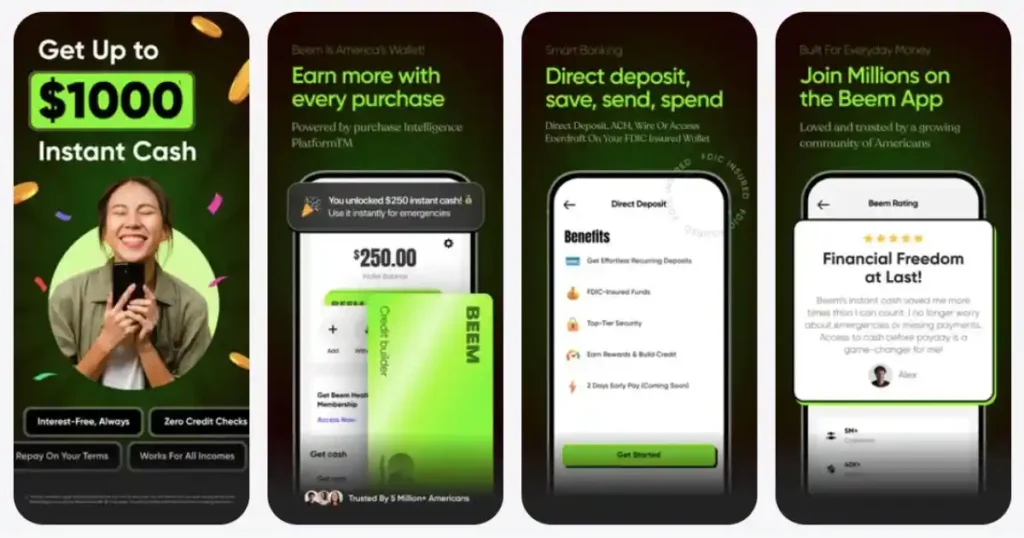
Beem’s Everdraft feature gives eligible users access to cash advances with no interest and no credit check, calculated based on income activity and account history rather than a credit score. Access to Everdraft requires a Beem subscription, with plans ranging from Lite at one dollar ninety nine cents a month, unlocking smaller advances, up to Pro at thirteen dollars ninety nine cents a month, which unlocks the full one thousand dollar limit. There is no interest charged on any advance amount, and repayment aligns with your income schedule rather than a fixed due date.
Beyond Everdraft, Beem also includes budgeting tools, free credit monitoring, and cashback rewards at thousands of retailers, which is more than a bare-bones cash advance app typically offers. This combination is worth mentioning honestly rather than oversold, since the subscription fee is a real cost that should factor into your decision, especially if you only occasionally need a small advance.
A Realistic Example of How the Costs Add Up
Picture two people each needing roughly two hundred dollars before their next paycheck. One uses Chime’s SpotMe, which is free for eligible members with qualifying direct deposits, provided their advance stays within the two hundred dollar limit and they qualify for the feature in the first place. The other uses Earnin, tipping a modest amount to access earned wages early, alongside an optional fee for instant transfer if they need the money right away rather than waiting for a standard deposit.
Neither approach is inherently better. Chime’s SpotMe costs nothing if you qualify and stay under its limit, but that limit caps out at two hundred dollars, which may not cover a larger unexpected expense. Earnin’s tip-based model gives more flexibility on amount, up to seven hundred fifty dollars per pay period, but the combination of optional tips and instant transfer fees can add up if used frequently. This is exactly the kind of tradeoff worth thinking through before choosing an app, rather than assuming one option is universally cheaper than another.
Why So Many People Turn to These Apps in the First Place
The appeal behind cash advance apps is fairly straightforward once you consider how modern paychecks actually work. Bills, rent, and everyday expenses do not always line up neatly with a biweekly or monthly pay schedule, and a single unexpected cost, a car repair, a higher than usual utility bill, or a medical copay, can create a gap that traditional banking simply is not built to handle quickly. Waiting several days for a standard bank transfer, or worse, facing an overdraft fee that can run thirty five dollars or more per incident, makes a small cash advance fee look reasonable by comparison.
Gig workers and freelancers face an additional wrinkle here, since their income does not always arrive on a predictable schedule that traditional direct deposit requirements assume. Apps that evaluate real account activity and deposit patterns, rather than strictly requiring a fixed employer-based paycheck, tend to serve this group better, since eligibility is not tied to having a single steady employer.
What Actually Matters When Choosing Between These Apps
A few factors consistently separate a genuinely useful cash advance app from one that looks appealing on the surface but costs more than expected once fees are factored in.
Advance limits matter most if you have a specific, recurring need larger than one hundred or two hundred dollars, since several popular apps cap out well below that. Fee structure matters just as much, since a subscription-based app makes more sense if you plan to use the advance feature regularly, while a pay-per-use or tip-based app might suit someone who only needs occasional help.
Funding speed is worth checking too, since standard transfers often arrive free within one to three business days, while instant delivery almost always carries a separate fee across every app on this list, including Beem. And eligibility requirements deserve attention before you download anything, since most of these apps require consistent direct deposits, which can shut out freelancers or workers with irregular income unless the app specifically accommodates that.
A Closer Look at Subscription Costs Versus Tip-Based Models
It is worth spelling out the two dominant pricing approaches side by side, since they work very differently and suit different usage patterns. A subscription model, like Beem’s tiered plans, charges a flat monthly fee regardless of how many advances you take within your limit, which tends to favor someone who uses the feature regularly throughout the month. A tip-based model, like Earnin’s, charges nothing mandatory at all, letting you tip whatever feels fair, which can genuinely cost less for someone who only needs an advance occasionally.
Neither structure is objectively superior. Someone taking a single small advance every few months will likely spend less through a tip-based app than through a monthly subscription, while someone relying on advances every pay cycle may find a flat subscription fee more predictable and, over time, cheaper than accumulating several individual tips or instant transfer fees. Running the actual numbers based on your own expected usage, rather than assuming one pricing model is universally better, is the only way to know which option truly costs less for your situation.
Being Honest About the Real Tradeoffs
None of these apps are free money, and treating them that way is where people run into trouble. Every option here, including Beem, involves either a fee, a subscription cost, or a tip in exchange for faster access to money you have generally already earned or expect to earn soon. The value of these apps comes from avoiding a worse alternative, like an overdraft fee or a payday loan, not from pretending the advance itself carries zero cost under every circumstance.
Using any of these apps repeatedly to cover a recurring shortfall, rather than an occasional genuine gap, is usually a sign that the underlying budget needs attention more than the advance itself does. A cash advance app works best as an occasional bridge, not a permanent patch for a budget that consistently runs short.
What Beem Is and Where It Fits
Beem is a financial app that combines an earned wage access style cash advance with a broader set of everyday financial tools, rather than functioning as a single-purpose advance app. Everdraft offers up to one thousand dollars with no interest and no credit check, with the exact amount available depending on your subscription tier and your income activity as assessed by Beem’s own algorithm. This is a genuine advantage for someone who occasionally needs a larger advance than the two hundred to five hundred dollar limits common among competitors.
Alongside Everdraft, Beem’s budgeting tools track spending and upcoming bills, its credit monitoring feature is free to use, and its cashback program applies at thousands of participating retailers, giving the app a broader role in daily financial life beyond just bridging a paycheck gap. The subscription cost is a real factor to weigh, and it is fair to compare it honestly against a tip-based or fee-per-use competitor based on how often you expect to use the advance feature. For anyone comparing cash advance apps and weighing higher limits against subscription costs, Beem is worth exploring directly at trybeem.com.
Frequently Asked Questions
Is Money App Cash Advance a loan?
No. It describes itself specifically as an earned wage access service, letting you access wages you have already earned rather than borrowing against future income.
Which app offers the highest cash advance limit?
Beem’s Everdraft offers the highest limit among the apps compared here at up to one thousand dollars, though reaching that full amount depends on your subscription tier.
Are cash advance apps free to use?
Not entirely. Most charge either a subscription fee, an optional tip, or a fee for instant delivery, even when the core advance itself carries no interest.
Do these apps require a credit check?
No, none of the apps compared in this guide require a hard credit check, though most do require consistent direct deposits or verifiable income to determine eligibility.
Is it safe to use multiple cash advance apps at once?
It is technically possible, but stacking advances across several apps can create confusing, overlapping repayment obligations and make it harder to track what you actually owe, so it is generally better to rely on one option you understand well.
Final Thoughts
Cash advance apps like Money App Cash Advance solve a real, common problem, but the fee structures behind them vary enough that comparing the actual numbers matters more than trusting a catchy tagline. Beem stands out for its higher advance limit and broader set of financial tools, though its subscription cost is worth weighing against your actual usage. Whatever app you choose, using it occasionally for a genuine gap, rather than repeatedly to patch a recurring shortfall, is what keeps these tools working in your favor rather than against you.