
Key Summary
Choosing a credit-building banking app is not just about picking the one with the most features. It is about finding an app that reports to the right bureaus, charges fees you can justify, and fits the way you actually manage money. The wrong app costs you time and money without moving your score in any meaningful direction.
According to the CFPB, payment history is the single largest factor in most credit scoring models, accounting for around 35% of a FICO score. An app that automates on-time payments and reports correctly to all three major bureaus can produce measurable score improvement within six to twelve months of consistent use. This guide covers the five features that separate apps that actually build credit from those that just look good in the app store, along with a comparison table and practical tips for getting real results.
1. A True Credit-Building Mechanism
The most important feature in any credit-building app is whether it reports your activity to the bureaus in a way that actually improves your score. Many apps claim to help build credit, but the mechanism they use and which bureaus they report to both matter significantly for how broadly your credit history appears when a lender checks your file.
An app that reports to only one bureau gives you a partial credit history. Lenders pulling from a bureau you have not been reported to will see no record of your activity at all. To build a credit profile that holds up to different lenders and loan types, you need an app that reports to Experian, Equifax, and TransUnion.
The type of account reported also matters. A secured credit card reports monthly balances and payments, building payment history and utilization records. A credit builder loan reports installment payment history. Either type, used consistently, contributes to your score. An app that offers only spending tracking with no reported account is not building your credit regardless of what its marketing says.
On-time payment tracking is the practical mechanism behind all of this. Apps that automate recurring payments or link bill payments to your reported account make it structurally easier to maintain a clean payment record. A single missed payment can drop a score by 50 to 100 points and stays on your credit file for seven years, which is why automation matters more than most people realize when they first sign up.
Also Read: How the Beem Card Builds Credit Every Transaction
2. Transparent and Affordable Fees
Hidden fees are the most common reason credit-building apps fail to deliver real value. An app that charges $15 per month for a credit builder account costs $180 per year. If the credit improvement does not translate into better loan rates or approvals you otherwise would not have received, the annual cost does not justify the benefit.
The fee structure to check includes the monthly subscription or membership fee, any origination or setup fee on a credit builder loan, instant transfer fees if the app includes a cash advance, and any interest rate on a secured line of credit. Each of these is a real cost that should be compared against the actual credit benefit you expect from consistent use over 12-24 months.
The ideal app discloses all costs clearly before you enter any payment information. Low or zero interest on the credit-building product itself is worth prioritizing. A secured card with no interest, or a credit builder loan at 0% APR, ensures the product costs you nothing beyond the subscription fee, making it easier to commit to the consistent use that produces real score results.
3. Automated Tools and AI Assistance
Automation separates a credit-building app from a spreadsheet. The behavioral changes required to build credit are easier to maintain when the app handles most of the work in the background rather than requiring manual action every month for an extended time period.
Automatic payment scheduling is the most valuable automation feature available. If your app links to your bills and schedules payment before each due date, you remove the human risk that causes most missed payments. This matters especially for users with variable income or irregular pay schedules where tracking multiple due dates creates real friction month after month.
Credit monitoring and alerts add a second layer of protection. An app that notifies you when your score changes, when a new account appears on your file, or when your utilization crosses a threshold gives you time to respond before the issue grows. Spending insights that automatically categorize transactions help you understand where money is going and identify categories where reducing spending would free up cash for on-time bill payments.
4. Financial Flexibility and Tools Beyond Credit
A credit-building app that serves only credit-building purposes has limited value during a month of limited cash flow. The best apps combine the credit-building mechanism with tools that help you stay financially stable between paydays, which indirectly protects your credit from missed payment events caused by timing gaps.
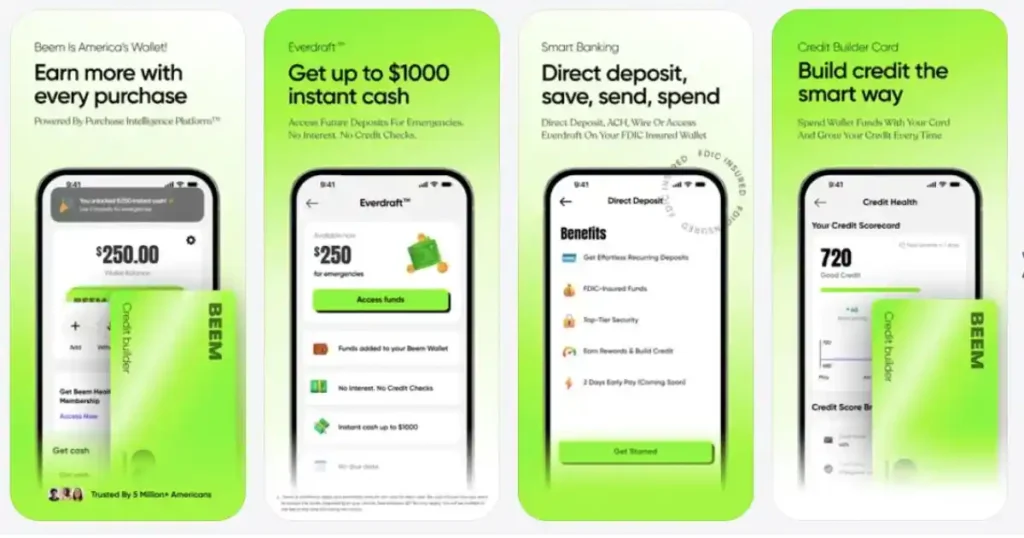
Short-term cash access addresses a specific but common problem: missing a payment because your paycheck landed two days after the due date. Beem‘s Everdraft feature provides access to up to $1,000 with no fees and no credit check, which can prevent a late payment from appearing on your credit file during a tight month. It is not a long-term solution, but it addresses the timing gap that causes most avoidable late payments for people with otherwise good financial habits.
Budgeting tools that set spending limits by category and track progress in real time support the same outcome from a different angle. When you can see that you are approaching your entertainment budget for the month, you can adjust before running out of cash before bills are due. Rewards or cashback programs tied to the credit-building product add incremental value without requiring any behavior change beyond using the account you already have.
5. User-Friendly Interface and Security
The best credit-building mechanism is ineffective if the app is frustrating to use consistently over months. Interface quality directly affects how often you engage with the app, and engagement affects results. An app that requires too many steps to check your credit score or buries payment scheduling in a submenu will have weaker outcomes than a cleaner alternative used by the same person.
The interface elements that matter most for sustained credit building are a visible credit score display on the home screen, clear payment reminders with one-tap confirmation, easy access to spending history and current utilization data, and straightforward navigation between the credit builder product and any linked accounts. These are usability basics, but many apps get them wrong, and it shows up clearly in user reviews.
Security is non-negotiable given that the app holds access to your bank account data and credit information. Look for 256-bit encryption, biometric login options including fingerprint or face ID, two-factor authentication as a default rather than an optional setting, and clear disclosure of how your data is shared with third parties. FDIC insurance on any deposit accounts within the app protects your funds up to applicable limits.
Bonus: App Reviews and Customer Support
User reviews on the iOS App Store and Google Play surface information that no product page will ever include. Consistent complaints about late transfers, unexpected charges, or unresponsive support are patterns worth identifying before you commit to an app for several months of credit building. Look for recurring themes across at least fifty reviews rather than reacting to individual outliers in either direction.
Customer support quality matters specifically when something goes wrong with a payment or a reported account entry. An app that offers only email support with a multi-day response window is not equipped to fix a missed payment report before it gets registered on your credit file. Live chat or phone support with reasonable wait times is worth prioritizing for any app that will be your primary credit-building tool over the next year.
Red Flags: 4 Features to Avoid in a Credit-Building App
Unfortunately, because the financial wellness market is crowded, plenty of apps rely on clever marketing to mask expensive, useless features. Before you hand over your personal info or link your bank account, keep an eye out for these four big red flags:
- 1. “Soft” or Internal-Only Score Reporting
Some apps advertise that they “help build your financial standing,” but when you look closely at the fine print, they’re only calculating a proprietary internal score. That might unlock minor perks inside their ecosystem, but it does zero heavy lifting for your real FICO or VantageScore. If an app doesn’t explicitly name Experian, Equifax, or TransUnion as direct reporting partners, it’s not building your real-world credit. Period. - 2. Outrageous Instant Transfer Fees
This is one of the sneaky ways “free” or low-cost apps make their money. They offer you credit-building tools or short-term cash access, but if you want your funds in minutes instead of waiting three business days, they hit you with a $5 to $15 “expedited fee.” If you end up using that feature once or twice a month, you’re quietly dropping over $100 a year just to access your own money. - 3. Guilt-Driven “Tips” and Hidden Upgrades
Watch out for apps that claim to be 100% free, but nudge you to leave a voluntary “tip” every time you use a feature. Studies show these tips often translate to effective interest rates that rival traditional payday loans. Similarly, be sceptical if the base version of an app looks free, but actual reporting to all three bureaus requires “upgrading” to an expensive monthly tier hidden three submenus deep. - 4. High Credit Limits Without Built-In Guardrails
It sounds great when an app gives you a high limit right off the bat, but without automated tools, it can easily backfire. If an app gives you plenty of room to spend, but makes it tricky to set up auto-pay or check your credit utilization ratio, it’s setting you up for a fall. A high balance sitting on your report right before statement closing day will knock your score down fast, regardless of how good your intentions were.
Top Credit-Building Banking Apps Compared
The apps below vary in fee structure, credit bureau coverage, and what additional tools they include alongside the credit-building product. Use this table to narrow down your options before looking at each app in detail.
| App | Bureau Reporting | Monthly Fee | Credit Builder Type | Cash Access | Best For |
| Beem | All three | None (credit builder) | Debit-linked credit card | Up to $1,000 (Everdraft) | Credit building plus short-term cash access |
| Chime Credit Builder | All three | None | Secured credit card | Overdraft up to $200 | Beginners, no annual fee |
| Self | All three | $25 setup fee | Credit builder loan | No | Installment-based credit building |
| Kikoff | All three | $5/month | Small revolving credit line | No | Thin file or no credit history |
| Grow Credit | All three | Free or $8.99/month | Subscription payment reporting | No | Building credit via existing subscriptions |
Beem differentiates itself by offering a debit-linked credit card that reports to all three bureaus and provides access to up to $1,000 in short-term cash through its Everdraft feature.
Chime‘s Credit Builder secured card charges no interest and reports to all three bureaus. It requires a Chime checking account with qualifying direct deposit to activate.
Self offers a credit builder loan where monthly payments accumulate in a savings account and are returned to you at the end of the term, building installment payment history along the way.
Kikoff provides a small revolving credit line used to pay a Kikoff subscription, reported to all three bureaus for $5 per month.
Grow Credit reports actual subscription payments for streaming services and other recurring bills you are already paying, making it one of the most passive credit-building options available.
How to Maximize Credit Growth With a Credit-Building App?
Choosing the right app is the first step. Using it correctly over a sustained period is what actually moves your score. These habits apply regardless of which specific app you select and are more important than any single feature any app offers.
- Pay on time, every time. A single missed payment can reduce a score by 50 to 100 points and remains on your file for seven years. Automated payment scheduling removes the manual effort and eliminates the risk of forgetting during a busy or financially stressful period. Set this up the day you open the account rather than leaving it for later when life gets busy.
- Keep credit utilisation below 30%. On a $500 credit line, that means keeping your balance below $150 when the issuer reports to the bureaus. Paying your balance down before your statement date closes helps keep this figure consistently low. Monitoring your current utilization weekly takes under two minutes and prevents unnecessary score damage from balances not paid down before the reporting date.
- Track your credit score monthly. Most credit-building apps include score monitoring as a core feature. Watching your score change month over month confirms the app’s reporting is working correctly and gives you early warning if something unexpected appears on your file. Check your full credit report at annualcreditreport.com at least once per year to verify accuracy.
- Avoid closing the account too quickly. Credit history length is a meaningful scoring factor. An account opened today contributes to your average account age starting from day one. Keeping a credit builder account open and active for at 12-24 months produces more meaningful long-term results than cycling through multiple short-term accounts in search of faster gains.
What Happens to Your Credit Score After 6 Months of App Use?
Building credit with an app isn’t an overnight fix. It’s a compounding process. While exact score changes vary based on where you start, here is what a typical 6-month timeline looks like when you use a reporting app consistently with zero missed payments:
- Months 1–2 (The Setup Phase): The app reports your new line of credit or installment account to Experian, Equifax, and TransUnion. You might see a temporary 2 to 5 points dip due to the new account opening, which is completely normal.
- Months 3–4 (The Payment History Lift): On-time payments begin reflecting on your credit files. If you started with a “thin file” (little to no credit history), this is usually when your first official FICO or VantageScore appears, often landing in the mid-600s.
- Months 5–6 (The Utilization Dividend): By keeping your balance or utilization below 10% and automating monthly payments, you start building a clean track record. Users starting from scratch or rebuilding subprime credit often see a 25 to 50+ point increase within six months of consistent reporting.
Frequently Asked Questions
Do credit-building apps actually improve your credit score?
Yes, when used consistently and when the app reports to all three major credit bureaus. Improvement depends on your starting score, how consistently you make on-time payments, and how long you maintain the account. Most users see measurable improvement within six to twelve months of consistent on-time use with an app that reports to all three bureaus.
What is the fastest way to build credit with an app?
The fastest approach combines a secured card or credit builder loan reporting to all three bureaus with utilization below 10% and zero missed payments. Apps that automate payment scheduling reduce the risk of human error. Most credit profiles show visible score improvement within six months of consistent on-time payments when starting from a thin or subprime file.
Do credit-building apps require a credit check to get started?
Most credit builder apps do not require a hard credit check to open a credit-builder account. Self and Kikoff do not pull your credit to get started. A hard inquiry only applies if the app offers an unsecured credit card or personal loan, which are separate products from the credit builder account itself and have different eligibility criteria.
Is a credit-builder loan or a secured card better for building credit?
Both work well. A secured card builds revolving credit history and directly affects your utilization ratio. A credit-builder loan builds payment history. Having both types on your credit file improves your credit mix factor. If you are starting from zero, either product delivers results within 6-12 months of consistent on-time payments.
How does credit utilization affect my score, and how do I lower it quickly?
Credit utilization is your current balance divided by your total available credit. Keeping it below 30% is the standard guidance, but below 10% yields stronger scores. The fastest way to lower it is to pay down balances before your statement date closes, since that is when most card issuers report your balance to the bureaus.
What is the difference between a FICO score and a VantageScore?
Both are credit-scoring models used by lenders but weight factors differently. Most mortgage lenders use FICO. Many credit monitoring apps report VantageScore. A gap between scores you see in different places is completely normal. Check which specific model your target lender uses before applying for any major loan or line of credit.
How long does negative information stay on my credit report?
Most negative items, including missed payments, collections, and charge-offs, remain on your credit file for seven years from the date of first delinquency. Bankruptcies can remain for seven to ten years depending on the type filed. Positive accounts typically stay on your file for up to ten years after they are closed.
Can you use multiple credit-building apps at the same time?
Yes, you can use more than one credit-building app simultaneously, and doing so can actually diversify your “credit mix”; a factor that accounts for 10% of your FICO score. For example, pairing a secured card app (revolving credit) with a credit-builder loan app (installment credit) builds two types of payment history. However, make sure the combined monthly subscription fees fit comfortably in your budget, as missing a payment on any app will harm your score.
Picking the Right App for Your Credit Goals
A credit-building banking app is only useful if it matches your starting point and goal. No credit history means a secured card or credit-builder loan that reports to all three bureaus is the core tool. A thin file benefits from adding a subscription-reporting product like Grow Credit. High utilization on existing accounts calls for an app with budgeting tools and spending alerts rather than simply adding a new credit product.
Fee structure, bureau coverage, automation quality, and whether the app includes cash access tools all affect which option fits best. Beem’s credit builder card reports to all three bureaus. It additionally includes overdraft access for short-term cash needs, addressing both the credit-building goal and the financial stability that protects your credit during unexpectedly tight months.