
Key Summary
Five hundred dollars is one of the most common amounts people search for when an unexpected expense collides with a paycheck that is still a few days away. Cash advance apps have made borrowing this kind of amount faster and more accessible than ever, but not every app charges the same way. Some rely on a recurring monthly subscription regardless of whether you actually use an advance that month, while others charge only when you actually borrow, with no subscription fee attached at all.
If you are weighing whether to borrow $500 through a cash advance app with no subscription fees, this guide breaks down the real risks and rewards involved, how this model compares to subscription-based alternatives, and what to check before you request an advance.
Why Subscription-Free Matters More Than It Seems
The Hidden Cost of a Subscription Model
A subscription-based cash advance app charges you a recurring fee, often monthly, simply for access to the service, regardless of whether you actually request an advance that billing cycle. If you only need to borrow occasionally, say once every few months, you could end up paying for months of access you never use, quietly adding up to more than the cost of the advance itself.
How a No-Subscription Model Works Differently
An app with no subscription fee only charges you when you actually use the service, typically through a flat fee attached to the specific advance you request, or in some cases no fee at all beyond an optional instant transfer charge. This structure means your total cost is tied directly to your actual borrowing, not to simply having the app installed on your phone.
The Rewards of Borrowing $500 With No Subscription Fees
You Only Pay for What You Actually Use
The clearest reward of a no-subscription model is straightforward: if you do not need to borrow, you do not pay anything. This matters most for people who only occasionally need a cash advance, since a subscription model would have them paying every month regardless of need.
Lower Total Cost for Infrequent Borrowers
If you might need $500 once or twice a year rather than every single pay cycle, a subscription model can end up costing more over time than a pay-per-use structure, even if the subscription fee itself looks small on a monthly basis. Doing the math on your actual expected usage frequency is worth it before committing to either model.
Easier to Understand the True Cost
A flat, one-time fee tied to a specific $500 advance is simpler to evaluate than a recurring subscription layered with additional per-advance costs, since you can see exactly what borrowing $500 costs you in a single number rather than trying to calculate a blended cost across months of subscription payments.
No Ongoing Commitment
Without a subscription, there is no recurring charge to remember to cancel if you decide to stop using the app. You simply stop requesting advances, and there is no lingering monthly fee still being deducted from your account after you have moved on.
The Risks of Borrowing $500 With No Subscription Fees
Instant Transfer Fees Can Still Add Up
Even apps with no subscription fee often charge extra for instant transfer, meaning getting your $500 within minutes rather than waiting a day or more can still carry a cost. If you consistently choose instant transfer, this per-transaction fee can approach or exceed what a subscription model might have cost over the same period, so it is worth comparing your actual usage pattern honestly.
Lower Advance Limits for New Users
Apps without a subscription model sometimes start new users at a lower available limit, since there is less of an ongoing relationship or verified track record to base a larger advance on. If you need the full $500 immediately as a first-time user, confirm the app’s starting limit actually supports that amount before assuming approval.
Repayment Is Usually Automatic and Immediate
Since these apps typically repay themselves automatically from your next paycheck or linked deposit, borrowing $500 means your next paycheck will arrive $500 lighter, plus any fee. If your budget is already tight, this automatic deduction can create a new shortfall if you have not planned for the reduced deposit.
The Convenience Can Encourage Repeated Borrowing
Because a no-subscription, pay-per-use app makes borrowing feel low-commitment, some users find themselves requesting advances more frequently than they originally intended, simply because there is no subscription fee acting as a natural deterrent. Over time, frequent small fees from repeated borrowing can add up similarly to what a subscription would have cost, undermining the original cost advantage.
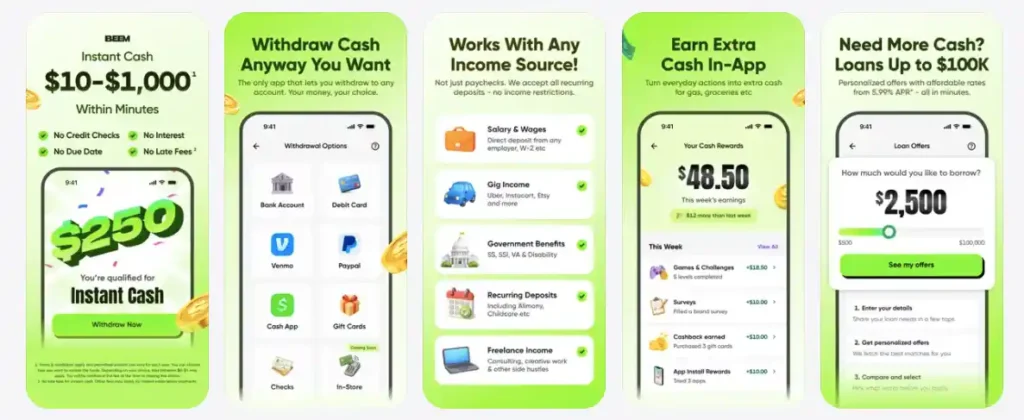
How Beem’s Everdraft™ Fits This Model
Beem’s Everdraft™ cash advance feature allows eligible users to access up to $1,000, more than covering a $500 need, with no mandatory subscription and no mandatory tipping. Standard transfer is available at low or no cost, while instant transfer carries a separate, clearly disclosed fee if you need funds within minutes rather than waiting a day or more.
Beem also does not restrict eligibility based on income type, meaning gig income, freelance earnings, and government benefits like SSI, SSDI, unemployment, and VA benefits all qualify, which is a meaningful advantage if a subscription-free competitor still limits you based on how your income arrives.
Comparing Subscription and No-Subscription Cash Advance Models
| Factor | No-Subscription Model | Subscription Model |
| Monthly cost if unused | None | Recurring fee regardless of use |
| Cost per advance | Flat fee or free, plus optional instant transfer fee | Often included in subscription, sometimes with add-on fees |
| Best for | Occasional borrowers | Frequent, regular borrowers |
| Total cost predictability | Easy to calculate per advance | Requires estimating monthly usage value |
| Risk of overpaying | Lower for infrequent use | Higher if advances are used rarely |
How to Calculate Whether No-Subscription Actually Saves You Money
Estimate Your Realistic Borrowing Frequency
Be honest about how often you actually expect to need a $500 advance. If it is genuinely rare, a no-subscription model is very likely the cheaper option. If you anticipate needing an advance almost every pay cycle, a subscription model’s flat monthly cost might actually work out cheaper than paying a per-advance fee repeatedly.
Add Up the Total Cost of Your Expected Usage
Multiply the per-advance fee by how many times you realistically expect to borrow over a set period, such as six months, and compare that total against six months of a subscription fee for a comparable competing app. Whichever total is lower for your specific expected usage pattern is the better fit financially.
Factor In Instant Transfer Costs Honestly
If speed matters to you every time you borrow, include the instant transfer fee in your calculation rather than assuming you will always choose the free standard transfer option, since your actual behavior, not your intentions, determines your real total cost.
Questions to Ask Before Borrowing $500 This Way
What Is the Total Cost If I Need Funds Instantly?
Confirm both the base fee, if any, and the instant transfer fee together, since assuming only the advertised base cost applies can understate what you will actually pay if timing matters.
Will Repaying $500 Create a New Shortfall Next Paycheck?
Since repayment is usually automatic, confirm that your next paycheck can absorb a $500 reduction, plus any fee, without immediately creating another gap you will need to cover.
Does This App Support My Specific Income Type?
If your income comes from gig work, freelancing, or government benefits, confirm the app you are considering actually evaluates that income type fully rather than assuming a no-subscription structure automatically means broader eligibility.
Is $500 the Actual Amount I Am Eligible For?
Check your specific available limit within the app before assuming approval for the full $500, since new users in particular may start at a lower amount that grows with continued responsible use.
Making Sure You Are Borrowing Responsibly
Only Borrow What You Actually Need
Even without a subscription fee acting as a deterrent, borrowing more than you actually need for the specific expense in front of you increases the size of the deduction from your next paycheck, which can create unnecessary strain later.
Avoid Stacking Multiple Advances at Once
If you find yourself considering advances from more than one app simultaneously to reach $500, this is often a sign that a single provider’s limit does not currently match your need, and combining several small advances can make tracking repayment across multiple automatic deductions more complicated than necessary.
Treat It as an Occasional Tool, Not a Routine Habit
The genuine reward of a no-subscription model is best realized when advances are used occasionally for real, unpredictable gaps, rather than becoming a routine substitute for a budget shortfall that recurs every single pay cycle. If you notice you need an advance almost every cycle, it may be worth examining your broader budget rather than relying on repeated borrowing as the primary fix.
Final Thoughts
Borrowing $500 through a cash advance app with no subscription fees genuinely rewards occasional borrowers by tying your cost directly to your actual use, avoiding the recurring charge of a subscription model you might rarely tap into. The real risks are less about the company and more about how you use the tool: instant transfer fees that quietly add up, automatic repayment creating a new shortfall if unplanned, and the low-friction convenience potentially encouraging more frequent borrowing than originally intended.
Weighing your realistic borrowing frequency, calculating the true total cost including instant transfer, and confirming the app actually supports your income type are the key steps to making sure this model works in your favor rather than against it.
Check out Beem for on-point financial insights and recommendations to spend, save, plan and protect your money like an expert. Download the Beem app today!
FAQs
Is it actually cheaper to use a no-subscription cash advance app for $500?
For occasional borrowing, a no-subscription model is generally cheaper since you only pay when you actually request an advance, while frequent borrowers might find a subscription model’s flat monthly cost comparable or even lower depending on usage.
Does borrowing $500 through a cash advance app affect my credit score?
Most cash advance apps, including Beem’s Everdraft™, do not perform a credit check, so borrowing $500 typically does not directly affect your credit score.
What is the biggest risk of using a no-subscription cash advance app?
The biggest risks are instant transfer fees adding up if used repeatedly, and the convenience of low-commitment borrowing potentially encouraging more frequent use than originally intended, which can offset the cost savings over time.
Can I get $500 through Beem’s Everdraft™ with no subscription fee?
Yes, Beem’s Everdraft™ allows eligible users to access up to $1,000, including $500, with no mandatory subscription fee and no mandatory tipping, though an optional instant transfer fee applies if you choose expedited delivery.
How do I know if a subscription or no-subscription cash advance app is better for me?
Estimate how often you realistically expect to need an advance over the next several months, then compare the total cost of a per-advance fee model against a subscription model’s flat recurring cost for that same usage pattern to see which is actually cheaper for your situation.