

Key Summary
Buy Now, Pay Later for rent sounds like a practical solution when your paycheck does not align with your due date. But applying a shopping payment tool to your most essential monthly expense introduces risks that are very different from splitting a purchase on a pair of shoes. The question is not whether BNPL for rent exists. It is whether using it makes financial sense for your specific situation.
According to the CFPB, BNPL products can lead to debt accumulation, with users more likely to carry balances on other credit products and report financial difficulty. When applied to rent, a recurring non-negotiable expense, those risks are amplified. This guide covers how BNPL for rent payments work, who offers it, when it makes sense, when it does not, and what to consider before committing.
How BNPL for Rent Works
BNPL for rent is structurally different from the retail BNPL services most people are familiar with. Platforms like Klarna and Afterpay are built for one-time purchases at online retailers.
Rent-focused BNPL is a separate product category with its own eligibility rules, fee structures, and repayment terms. Understanding the distinction before applying matters significantly.
What Does Rent Now, Pay Later Mean?
With a rent-focused BNPL service, a third-party provider pays your full rent directly to your landlord on your due date. You then repay the provider over time in scheduled installments, typically weekly or biweekly. Some services offer a short interest-free window. Others charge a flat monthly fee or a percentage-based service charge that applies from the first installment.
The net effect is that your landlord receives full payment on time while you spread the cost over a shorter period, usually within the same calendar month or across the following four to six weeks.
Proactive Communication: The Easiest Way to Avoid Debt On Rent
Before turning to third-party financing, consider reaching out to your landlord directly. Most property managers prioritize reliable tenants and may be open to a clear, professional conversation about a temporary income mismatch.
- The Power of Transparency: Landlords typically prefer a proactive notification of a potential delay over a missed payment date. Transparency builds trust and signals that you are responsible.
- How to Approach Your Landlord: Send a brief, professional message explaining your situation. Focus on the temporary nature of the issue and your commitment to a solution.
- Negotiating Payment Plans: Ask if your landlord accepts partial payments or a split-payment schedule (e.g., paying half on the 1st and the remainder on the 15th). This can help you avoid the service fees and risks associated with third-party BNPL providers.
- Documentation: Always get any agreed-upon arrangements in writing via email or text. Having a record protects you against future late fee disputes and provides clarity on the new due dates.
Popular Rent BNPL Platforms in the US
Several fintech companies have entered the rent BNPL space with different approaches.
Flex pays your full rent upfront and lets you repay in two installments over the month, with a monthly membership fee.
Bilt offers a rent rewards credit card with payment flexibility and points on rent, though it requires landlord enrollment in many cases. Gravy focuses on credit building alongside rent payment splitting.
PayZen, originally built for medical bills, has expanded into housing cost financing.
Each platform has its own fee model, credit check approach, and landlord requirements. Some pay any landlord directly by check or ACH. Others require your landlord to be enrolled in their network before you can use the service.
Eligibility and Process
To use a rent BNPL service, you typically need to provide proof of income or employment, agree to a soft credit check or bank account review, and link a checking account for automatic repayments. Some platforms also verify your rental agreement to confirm the amount and landlord details. Approval is typically faster than a personal loan, sometimes within minutes, but the fee structure and repayment terms vary significantly across providers. Always confirm the total cost before accepting any offer.
Also Read: Cash Advances During Unexpected Expenses
Why People Use BNPL for Rent
The demand for rent BNPL has grown alongside rent prices. According to Zillow, the median rent in the United States reached $2,000 per month in 2024 and has remained elevated, meaning a single rent payment can represent 30% to 50% of many renters’ monthly income. When income is irregular or a one-time expense disrupts cash flow, the gap between available funds and the rent due date becomes a real problem.
Irregular Income or Gig Work
Gig workers, freelancers, and contract employees often face income timing mismatches. Their pay comes in batches based on project completion or client payment cycles, not on a fixed schedule aligned with rent due dates. BNPL for rent can bridge this gap by covering the due date and allowing repayment when income actually arrives, without triggering a late fee or an eviction notice from the landlord.
Emergency Situations and Unexpected Expenses
A surprise car repair, medical bill, or family emergency can drain a month’s cash reserves and leave rent short. For someone financially stable the previous month, BNPL for rent used once with a clear repayment plan is a different decision than using it because rent is structurally unaffordable. Understanding which situation you are in before applying is the most important step.
No Access to Traditional Credit
Many renters do not qualify for credit cards or personal loans that could otherwise cover a short-term gap. Rent BNPL services often have lower approval thresholds than traditional credit products, using bank account history and income patterns rather than credit score alone. For someone with a thin or damaged credit file, rent BNPL may be one of very few available options.
Pros of Using BNPL for Rent
Used correctly, rent BNPL offers a few genuine advantages over the alternatives available to renters in a short-term bind. Understanding these advantages in concrete terms helps you evaluate whether the benefit justifies the fee in your situation.
Avoiding Eviction and Late Fees
The most direct benefit is keeping your tenancy intact. A late rent payment triggers fees that typically range from 5% to 10% of the monthly rent, and repeated delays can lead to eviction proceedings that stay on your rental history and make it harder to rent in the future. BNPL for rent pays the landlord on time and transfers the repayment obligation to you on a schedule that better matches your cash flow.
Flexible Payment Scheduling
Splitting a $1,500 rent payment into two $750 installments two weeks apart is meaningfully easier for many people than producing $1,500 in one transaction on the first of the month. The flexibility is most useful for gig workers and freelancers whose income arrives in irregular batches, where the total monthly income is sufficient but the timing does not align with the payment due date.
Potential Credit Building
Some rent BNPL platforms report on-time payments to credit bureaus, which can benefit renters with thin or damaged credit files. Traditional rent payments are not automatically reported to credit bureaus in most cases, so a platform that adds positive payment history to your credit file provides value beyond the immediate cash flow relief. Confirm the reporting policy of any platform before using it, since practices differ significantly across providers.
The Risks and Downsides of Using BNPL for Rent
The CFPB has specifically flagged BNPL products as posing risks of debt accumulation and financial overextension, and rent is where those risks are most consequential. Missing a retail BNPL payment is inconvenient. Missing a rent BNPL repayment affects your housing stability and credit together.
It Is Still Debt, Packaged Differently
Every BNPL arrangement creates a repayment obligation regardless of how it is marketed. Unlike a one-time purchase, rent is a recurring monthly expense. Using BNPL for rent once means you are repaying last month’s rent while this month’s comes due. If income does not cover up fully, the repayment overlaps with the new obligation and creates a structural shortfall that grows each cycle.
Fees, Interest, and Late Charges
Most rent BNPL services are not free. Flat monthly membership fees, percentage-based service charges, and late payment penalties all reduce the financial benefit. A 1% monthly fee on a $1,500 rent payment costs $15 per use, or $180 per year if used every month. Late fees escalate this further. Some providers send delinquent accounts to collections if unpaid, which degrades your credit more severely than a missed credit card payment.
Dependency and the Debt Cycle
Using BNPL for rent once is very different from using it every month. Monthly use creates structural dependency: you are always a month behind on your actual rent obligation and perpetually repaying the previous month while the current one comes due. This cycle is difficult to exit without a material increase in income or a significant one-time payment to catch up. The CFPB’s research on BNPL debt accumulation is particularly relevant here, since recurring rent dependency is one of the highest-risk applications of the product category.
Missed Payments and Credit Damage
If you miss a BNPL repayment, your landlord does not bear the consequence. The BNPL provider does, and they report accordingly. A missed BNPL rent payment can appear as a delinquency on your credit file even though your landlord was paid on time. This is the reverse of the intended benefit and occurs to users who do not fully understand the repayment structure before signing up.
BNPL for Rent vs Other Financing Options
Rent BNPL is not the only way to cover a short-term rent gap. The alternatives below vary in cost, accessibility, and long-term risk. Comparing them before committing to any single option usually produces a better outcome.
| Option | Cost | Credit Required | Speed | Best For |
| Rent BNPL (e.g., Flex) | Monthly fee or 1-3% per use | Soft check | Fast | One-time timing gap |
| Personal loan | 7% to 36% APR | Yes, usually 580+ | 1 to 3 days | Larger gaps with repayment plan |
| Credit card (0% intro) | 0% if paid in period | Yes | Immediate | Good credit holders |
| Emergency rental assistance | Free | No | Varies | Income-qualified renters |
| Cash advance app | None to small fee | No | Instant | Short gaps under $1,000 |
Personal Loans and Credit Cards
Personal loans from online lenders or credit unions can cover a rent gap at rates between 7% and 36% APR with repayment terms of 12 to 60 months. For a one-month shortfall, a short-term personal loan with a defined repayment schedule may cost less than a rent BNPL service with monthly fees. Credit cards with 0% intro APR periods offer similar flexibility if you qualify. The barrier is credit score eligibility, which excludes many renters who need help most.
Emergency Rental Assistance Programs
Federal and state emergency rental assistance programs exist specifically for renters facing short-term housing instability. These programs, funded through HUD and administered at the state and local level, provide direct payments to landlords on the renter’s behalf, often at no cost to the renter. Many programs are underused because renters are unaware of their existence. Search benefits.gov or contact your local community action agency before turning to a paid BNPL service for the same problem.
Cash Advance Apps as a Bridging Tool
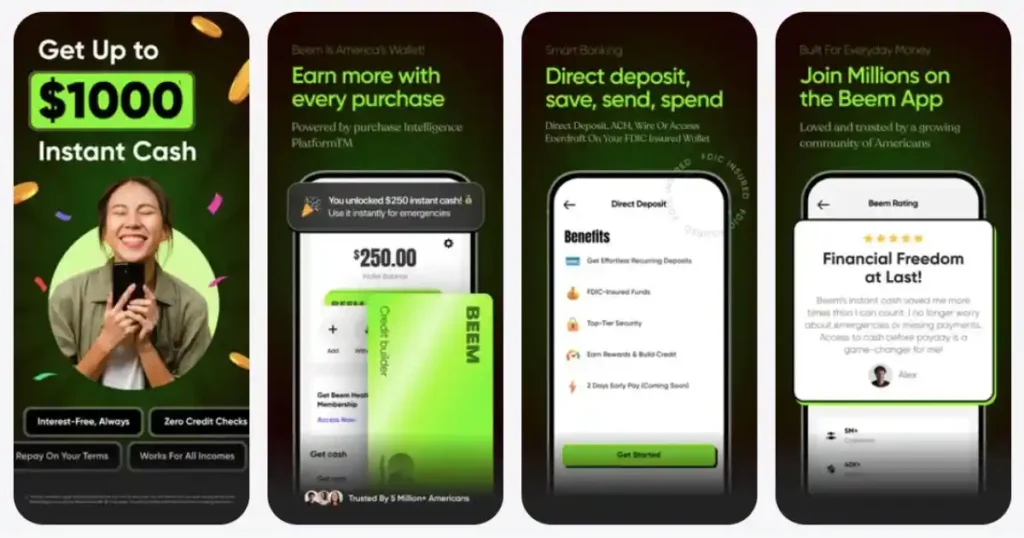
For smaller gaps, a no-fee cash advance can cover the difference without creating a BNPL obligation. Beem’s Everdraft feature provides up to $1,000 with no fees and no credit check, repaid automatically from the next qualifying deposit. If your shortfall is a few hundred dollars and you expect income within the week, a cash advance may cover the gap at lower total cost than a rent BNPL service with a monthly membership fee.
Why Beem’s Everdraft May Be a Better Alternative to BNPL
When facing a short-term cash flow gap, Beem’s Everdraft feature can be a cost-effective alternative to rent BNPL services.
Beem offers up to $1,000 with no fees and no credit check, whereas rent BNPL services typically involve monthly membership fees or service charges.
Since Everdraft is repaid automatically from your next qualifying deposit, it avoids the recurring repayment obligations and fee cycles that can lead to debt accumulation when using BNPL for essential, recurring expenses like rent.
When BNPL for Rent Might Make Sense
Rent BNPL is not appropriate for ongoing use. In a narrow set of circumstances, it is a reasonable short-term tool. It may make sense if the shortfall is a one-time event due to a specific non-recurring expense. It may work if you qualify for an interest-free plan and can repay on the installment schedule without strain. It may be appropriate if you are between contracts and expect income within the repayment window. It may also serve as a bridge while emergency rental assistance is being processed and you need the landlord paid immediately. In all of these cases, the defining condition is a clear and realistic repayment path.
When You Should Avoid BNPL for Rent
Avoid rent BNPL if you have no clear repayment plan for the installments. Avoid it if your rent already consumes more than 40% to 50% of your monthly income, since adding repayment obligations on top creates structural overextension. Avoid it if you used it the previous month and did not fully exit the cycle before the next payment came due. Avoid it if the fees are not clearly disclosed upfront. If BNPL has become a monthly habit rather than an occasional bridge, the underlying issue is affordability, not timing, and BNPL cannot solve an affordability problem.
FAQs: BNPL for Rent Payments
Can I use Klarna or Afterpay to pay rent?
No. Klarna and Afterpay are retail BNPL services designed for purchases at enrolled merchants. They do not support rent payments. Rent-specific platforms like Flex and Gravy handle housing payments directly with landlords. Always confirm that any BNPL platform you are considering actually supports rent payments before linking your account or providing your landlord’s details.
Is BNPL for rent considered debt?
Yes. Regardless of how the product is marketed, BNPL for rent creates a repayment obligation that is a type of short-term debt. Some platforms charge interest. All carry fees or late payment penalties. The CFPB has noted that BNPL users are more likely to carry balances on other credit products. This is the broader debt accumulation risk associated with these products.
Will using a rent BNPL service affect my credit score?
It depends on the platform. Some report on-time payments to credit bureaus, which can benefit your score if you pay consistently. Missed or late repayments are also reported by many platforms and can damage your credit score. Confirm the reporting policy of any platform before using it, since credit impact varies significantly across providers in this space.
What are the typical fees on rent BNPL platforms?
Fee structures vary. Common charges include flat monthly membership fees ranging from $3 to $14.99 per month, percentage-based service fees of 1% to 3% of the rent amount per use, and late payment penalties. Always calculate the total annual cost before committing, especially if you plan to use the service more than once in the same year.
Conclusion
The CFPB’s concerns about BNPL debt accumulation apply most directly to recurring, essential expenses like rent. Before committing, exhaust the lower-cost alternatives: emergency rental assistance programs, direct negotiation with your landlord, and short-term cash advances for smaller gaps. If the shortfall is a few hundred dollars and your next paycheck covers it, a no-fee cash advance from a tool like Beem’s Everdraft may cost you nothing, while a rent BNPL service charges a monthly fee for the same outcome. Know your numbers before choosing a path.