
Key Summary
Building an emergency fund feels impossible when you are already stretched thin between bills, rent, and everyday expenses. But starting small is more effective than waiting until you can save large amounts, and cash advance apps can actually help bridge the gap while you build that buffer.
According to the CFPB, nearly 40% of American adults would struggle to cover a $400 emergency without borrowing or selling something. If that describes your situation, you are not alone, and the path forward does not require a windfall. It requires a consistent system. This guide on how to build an emergency fund walks through exactly how to use cash advance apps as part of that system.
Why Emergency Funds Matter More Than Ever?
Financial emergencies do not arrive on a schedule. A car repair, a missed shift, a medical bill, or a delayed paycheck can each create a domino effect that takes weeks to recover from without a buffer in place.
Rising costs have made this harder. Rent, groceries, fuel, and healthcare have all increased faster than wages for many households, leaving less room at the end of each paycheck for savings. The result is that most people dip into whatever is available when something goes wrong, whether it’s credit cards, payday loans, or borrowing from family.
An emergency fund changes that dynamic entirely. Even $300 to $500 saved separately creates a cushion that stops one bad week from becoming a bad month. It also reduces the psychological stress that comes from knowing you are one flat tyre away from a financial crisis.
- Prevents debt cycles: A small fund covers minor emergencies without triggering high-interest borrowing.
- Reduces financial stress: Knowing you have a buffer shifts your relationship with money from reactive to planned.
- Improves long-term stability: Each time you handle an emergency from savings rather than borrowing, the habit compounds.
Can You Really Build Savings with a Cash Advance App?
The assumption is that cash advance apps exist purely as a short-term fix. That is partly true, but it is not the full picture. Several apps now include savings tools, budget tracking, and spending analysis alongside the cash advance feature. The advance is a bridge that stops you from going into high-interest debt, while the savings tools help you build a buffer so you need the advance less over time.
The key is intention. Using a cash advance to cover rent when your paycheck is three days late is a legitimate use. Using it to cover discretionary spending while your savings account sits at zero is how people get stuck. The difference is whether you treat the advance as a tool with a specific role or as a substitute for money management.
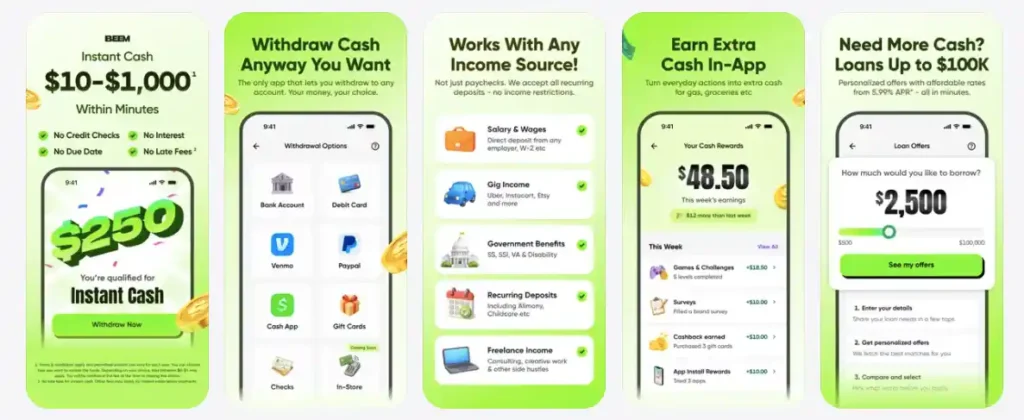
Apps like Brigit, and EarnIn include budget tracking and spending alerts alongside their cash advance features. Beem includes a budget planner tool and spending insights in the same app as the Everdraft advance feature. These extras exist precisely to help users move from borrowing to saving over time.
Cash Advance Apps Compared: What Each Offers Beyond the Advance
Before choosing an app, it helps to know what tools each one actually provides for saving and budgeting, not just borrowing.
| App | Max Advance | Monthly Fee | Budget Tools | Savings Feature | Credit Check |
| Beem (Everdraft) | Upto $1,000 | None | Yes (Budget Planner) | Yes (HYSA access) | No |
| Brigit | Upto $250 | $9.99 | Yes | No | No |
| EarnIn | Up to $1,000/period ($150/day max) | None | Limited | No | No |
For users specifically trying to build a savings habit alongside accessing advances, Beem offers the most relevant tools at the lowest cost. Brigit’s higher monthly fee makes it harder to justify whether savings-building is the primary goal.
Step-by-Step: Building an Emergency Fund Using Cash Advance Apps
The process does not require a large income or perfect financial discipline. It requires a clear sequence and consistent follow-through on small actions. Here is how to structure it.
Step 1: Handle Immediate Emergencies Without Going Into High-Cost Debt
When an emergency hits, the first priority is covering it without triggering a worse problem. Payday loans charge $15 to $30 per $100 borrowed, which translates to an APR often exceeding 300%. A cash advance app with no interest and no fees is a significantly cheaper option for the same short-term need.
Only borrow what the specific expense requires. If the repair costs $180, request $180. Borrowing more than you need increases your automatic repayment on payday and leaves you with less for the following week. Look for apps that charge no interest and no subscription fee. Beem’s Everdraft feature covers up to $1,000 with no fees, no credit check, and automatic repayment from your next paycheck.
Step 2: Track Your Spending and Find the Savings Gap
You cannot build a savings habit without understanding where your money currently goes. Most people are surprised by how much they spend on subscriptions, food delivery, and small recurring charges that add up to $50 to $150 per month.
Spend one week tracking every transaction. Most banking apps will categorise this automatically. If you use Beem, the budget planner tool does this in real time with spending breakdowns and weekly summaries. Identify two to three categories where you can reduce spending by $10 to $20 per week. That margin is where your emergency fund starts.
Step 3: Automate a Small Transfer to a Separate Account Every Payday
Once you have identified a weekly savings margin, automate it. Set up a recurring transfer of $15 to $25 per paycheck to a separate savings account, ideally a high-yield savings account (HYSA) earning 4% to 5% APY rather than a standard account earning near zero.
The separate account matters. Money that sits in your everyday checking account gets spent. Money that moves to a separate account on payday, before you have a chance to spend it, accumulates. Within three months of saving $20 per week, you have $260. Within six months, you have $520. That covers the majority of minor emergencies most people face.
How the “3-6-9 Rule” Dictates Your Ultimate Savings Target
Once you cross your initial starter baseline of $500, your next long-term milestones should be guided by a core financial planning framework known as the 3-6-9 Rule. This system scales your final target based on your specific employment stability and household vulnerabilities rather than forcing a generic calculation:
- The 3-Month Anchor: If you are single, have a steady, predictable W-2 salary income, and carry zero dependents, a fund covering 3 months of essential living expenses (rent, food, utility baselines) provides an adequate cushion to navigate typical market friction.
- The 6-Month Standard: If you live in a dual-income household, have children, or carry fixed, multi-year obligations like a mortgage or an active car note, you should scale your separate HYSA balance to cover a full 6 months of baseline expenses to cushion your family properly.
- The 9-Month Shield: If you are self-employed, a freelance contractor, an agency owner, or work entirely on a fluctuating commission structure, your income velocity is naturally volatile. You require a minimum of 9 months of essential expenses parked in liquid reserves to sustain cash flow during prolonged dry spells or macro contractions without turning to high-cost credit.
What to Avoid While Building an Emergency Fund
Progress on an emergency fund is fragile in the early stages. A few common mistakes can reset months of momentum. Knowing what to avoid is as useful as knowing what to do.
- Using multiple cash advance apps at the same time. Each advance is repaid from your next paycheck. Two simultaneous advances can leave your paycheck nearly empty, creating the need for another advance on the following cycle. Use one app at a time and repay fully before taking another advance.
- Borrowing for non-essential expenses. An advance for a car repair that gets you to work is a tool. An advance for takeout, entertainment, or shopping is a pattern that prevents savings from ever building. Before requesting any advance, ask whether the expense is genuinely urgent or whether it can wait.
- Keeping emergency savings in your main spending account. Money in your everyday account gets spent. The moment your emergency fund lives in the same account as your daily spending, it stops being an emergency fund and becomes a buffer you draw from regularly. Move it to a separate account and treat it as untouchable unless an emergency arises.
- Skipping savings during a good paycheck. When a paycheck is larger than usual due to overtime or a bonus, the temptation is to spend the extra rather than save it. A larger paycheck is the best time to make an above-average contribution to your fund.
- Ignoring high-yield savings options. A standard savings account earning 0.01% APY on $500 earns you less than $1 per year. A HYSA at 4.5% APY earns $22.50 on the same balance. The difference compounds as your balance grows.
The Graduation Target: How to Stop Relying on Cash Advances and Payday Loans?
The ultimate metric of financial resilience is reaching your “Graduation Point.” This occurs when your separate high-yield savings account reaches a balance that covers your recurring monthly advance habits.
If you find yourself consistently advancing $200 every two weeks to bridge your cash flow gaps, your immediate operational target is a $400 permanent savings anchor. Once your separate HYSA sustains that balance, you can effectively act as your own lender—withdrawing from your own reserves and “repaying” yourself on payday rather than relying on third-party mobile applications.
Read: I Need $1000 Now: Emergency Funding & Instant Cash Solutions
How Beem Helps You Build Financial Resilience
Beem is designed for the overlap between short-term cash needs and longer-term financial stability. It is not just an advanced tool. It includes tools that address both sides of the problem.
- Everdraft advance feature: Up to $1,000 with no fees, no interest, and no credit check. Repayment is automatic from your next paycheck. This covers urgent needs without creating a debt cycle.
- Budget Planner tool: Real-time spending breakdown by category. Weekly summaries show where your money went and where adjustments are possible. This is the tool that reveals the savings margin most people did not know they had.
- HYSA access: Beem helps users identify and access high-yield savings accounts suited to their financial profile. This gives your emergency fund a place to grow rather than sit idle.
- Credit-building tools: For users working to improve their credit score alongside building savings, Beem includes optional credit-building features that report positive payment history over time.
Frequently Asked Questions
Can I build an emergency fund while still using cash advance features?
Yes, but your long-term operational target should be reducing your advance frequency month over month. Use the app’s budget planner to track whether your reliance on advances is dropping as your high-yield savings account grows. If your borrowing remains flat or increases, use the app’s automated tracking to pinpoint where your recurring monthly deficit is happening.
Can I build savings while still using a cash advance app regularly?
Yes, but the goal should be to use advances less frequently over time, not more. Set up a small automatic savings transfer each payday and track whether your advance usage decreases month by month. If it stays the same or increases, review your budget to find where the recurring shortfall is coming from.
How much should I save in an emergency fund to start?
Start with $300 to $500. That amount covers the most common emergencies: a car repair, a medical co-pay, a missed shift, or a utility bill. Once you reach $500, set a new target of one month’s essential expenses. Work toward three months of expenses over time, but do not wait until the final goal feels within reach before you start.
Do cash advance apps charge interest on borrowed money?
Most charge either a subscription fee, an optional tip, or an express delivery fee rather than interest. A few charge nothing for standard delivery. Beem’s Everdraft charges no fees on the advance itself. Always check the total cost, including monthly fees and instant delivery fees, before using any app regularly.
Is it better to pay off debt or build an emergency fund first?
Both matter, but prioritise a small emergency fund first. Without any buffer, every unexpected expense goes straight onto a credit card, adding to the debt you are trying to pay down. Save $300 to $500, then redirect your margin toward debt repayment. Once high-interest debt is cleared, increase your savings contributions.
How do high-yield savings accounts work, and which ones have no minimums?
A HYSA pays significantly more interest than a standard savings account, typically 4% to 5% APY compared to under 0.5% at most traditional banks. Many online banks offer HYSAs with no minimum balance requirements. Opening one takes about 10 minutes and can be linked to any existing bank account for automatic transfers.
What is the difference between a cash advance app and a payday loan?
Payday loans charge fees equivalent to 300% or higher APR and often require full repayment plus fees on a fixed date. Cash advance apps charge little to nothing for the advance itself and automatically repay from your next paycheck. The structure prevents the rollover trap that payday loans create.
How can I improve my credit score while building an emergency fund?
The two goals are compatible. Paying existing bills on time, keeping credit card balances low, and avoiding new hard inquiries all improve your score. Some apps, including Beem, offer credit-building tools that report positive payment behaviour to the credit bureaus. Start with on-time payments and low utilisation before adding any new credit products.
Start Small, Stay Consistent
Building an emergency fund when money is tight is not about saving large amounts quickly. It is about building a system that keeps a small amount growing on every paycheck, using the tools available to you, and reducing your reliance on short-term borrowing over time.
Cash advance apps are a legitimate part of that system when used correctly. They cover genuine emergencies at low cost, buying you time to build a buffer rather than forcing you into high-interest debt. The budget and savings tools that come with apps like Beem make the second half of that equation possible, too.
If you need access to up to $1,000 with no fees and no credit check while you build your savings habit, download Beem and access funds through the Everdraft feature today. Repayment is automatic from your next paycheck, and the Budget Planner helps you find the savings margin to make sure you need it less next time.