
Key Summary
San Francisco is one of the hardest places in the country to absorb a surprise expense. A rent gap, parking ticket, transit refill, medical copay, or emergency repair can throw off an entire month, especially when your paycheck timing does not line up with your bills.
That is why cash advance apps have become such a common tool in San Francisco. Used well, they can help cover a short-term gap without the heavy cost and debt risk of a traditional payday loan. Used badly, they can become another recurring pressure point. The difference usually comes down to choosing the right app, borrowing the right amount, and knowing when a cash advance is the right fix and when it is not.
This guide on cash advance in San Fransisco walks through all of that. It explains how cash advances work, why San Francisco residents rely on them, which apps stand out in 2026, why Beem remains the strongest all-around option, and how to decide what fits your situation.
Why Cash Gaps Hit Harder in San Francisco
San Francisco has the kind of cost structure that makes small disruptions feel big fast. Housing eats up a large part of income, and even routine expenses such as groceries, rideshare trips, tolls, parking, gas, and utility bills can stack up faster than expected. In a lower-cost city, a $200 surprise might be annoying. In San Francisco, it can be the difference between staying current and falling behind.
The problem is not always that people do not earn enough. Often, it is timing. A paycheck clears on Friday, rent is due on Wednesday, and an unexpected expense lands on Monday. Someone may be financially stable on paper and still run short for three days. That is the exact gap cash advance apps are designed to cover.
This is especially true for renters, gig workers, contract workers, students, early-career professionals, and anyone managing variable income. In a city where the margin for error is already thin, emergency cash is less about convenience and more about staying functional.
Common San Francisco Cash Crunch Triggers
Some financial gaps happen because of major emergencies. Many happen because city life is expensive in very ordinary ways.
Common triggers include:
- Rent due before the next paycheck clears.
- Utility or internet bills landing in the same week.
- Car repairs for commuters or rideshare drivers.
- Higher-than-expected grocery costs.
- Transit, gas, toll, or parking expenses.
- Medical copays or prescription refills.
- Slower freelance or contract payments.
- Avoiding an overdraft before payday.
None of those situations are unusual. That is what makes the category so relevant in San Francisco. The need is often not for a huge loan. It is for a short bridge that keeps a manageable problem from becoming a costly one.
What a Cash Advance Actually Is
A cash advance is a short-term advance on expected income or incoming deposits. Unlike a traditional personal loan, it is usually smaller, faster, and tied more closely to your recent account activity than to your credit score.
Most cash advance apps look at your linked bank account, deposit history, spending patterns, and repayment behavior instead of running a traditional credit-based underwriting model. That is one reason they appeal to people who need money quickly. The process is lighter, the amount is smaller, and the approval decision is usually faster.
The simplest way to think about it is this: a cash advance helps you access money before your next deposit arrives. It is not meant to fund a major long-term purchase. It is meant to help with a short timing mismatch.
How It Is Different From a Payday Loan
This distinction matters. Payday loans are often structured with high fees, short repayment windows, and rollover risks that can trap borrowers in repeat borrowing cycles. Many people hear “cash advance” and assume it means the same thing. It does not.
The better cash advance apps in 2026 are positioned differently. They tend to be app-based, easier to compare, clearer about terms, and less likely to rely on punitive fee structures. That does not mean every app is automatically a good deal. It means the category gives users better tools than old storefront payday lending ever did.
Still, the same principle applies: short-term money should solve a short-term problem. If the gap is structural and recurring every month, the answer may be bigger than a cash advance.
How Cash Advance Apps Work
The user experience is straightforward. You download an app, create an account, link a checking account, and allow the app to review recent income and transaction activity. Based on that information, the app decides whether you are eligible and what advance amount you can access.
If approved, you choose how much to withdraw up to your limit. Depending on the app, the money may arrive instantly or in a standard transfer window. Repayment is usually automated and happens when your next paycheck or qualifying deposit lands.
The appeal is obvious. No branch visit. No long application. No waiting around for manual review. That makes these apps especially useful when the need is immediate and the amount is modest.
The Basic Flow
Most apps follow this pattern:
- Download the app.
- Create a profile.
- Link your bank account.
- Verify account activity and deposits.
- See your eligible advance amount.
- Transfer the funds.
- Repay automatically from your next deposit.
What changes from app to app is the maximum amount, whether instant transfer costs extra, whether there is a membership fee, whether gig income counts, and whether the app includes extra tools like budgeting, alerts, or credit tracking.
Why San Francisco Residents Use Cash Advance Apps
People in San Francisco are not turning to cash advance apps because they want more debt. They use them because the city compresses financial flexibility. Rent is high, surprise costs are common, and even good earners can face short-term timing problems.
A person might use a cash advance to:
- Avoid a bank overdraft.
- Cover groceries until payday.
- Handle an emergency repair.
- Refill transit or gas for commuting.
- Manage a utility bill that cannot wait.
- Cover part of rent while a deposit is pending.
- Bridge a gap between freelance invoices.
That last point matters. San Francisco has a high concentration of freelance, contract, and project-based income. Many residents are not paid on a strict biweekly cycle. For them, a cash advance is often not about overspending. It is about smoothing uneven cash flow.
Why Timing Matters More Than Amount
In many cases, the need is not for $5,000. It is for $100, $250, or $600 today instead of four days from now. The cost of not having that cash can be larger than the amount itself. A missed utility payment can trigger fees. An overdraft can snowball. A delayed repair can interrupt work. A late rent payment can create stress out of proportion to the original shortfall.
That is why cash advance apps have found such a strong audience in expensive urban markets. They solve a timing problem that standard banking products often ignore.
Why Beem Is the Strongest Option in 2026
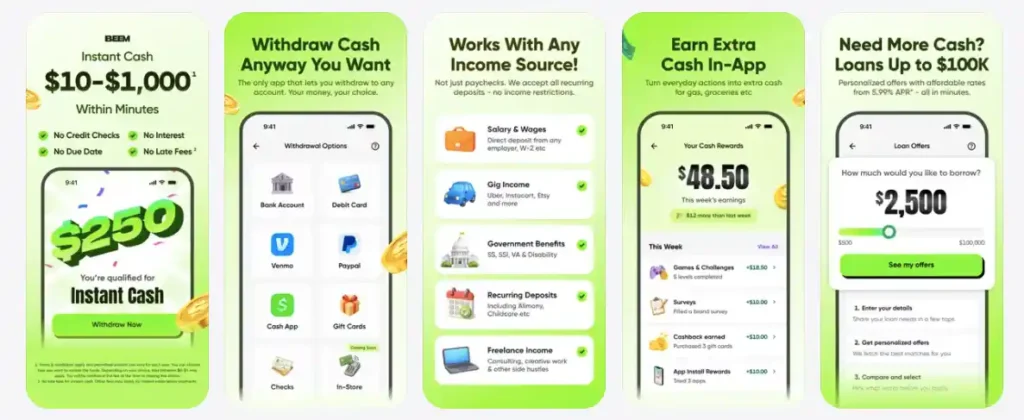
Among the major cash advance apps available to San Francisco users, Beem stands out because it solves the core problem more fully than most of its competitors. Through Everdraft, eligible users can access up to $1,000 instantly, with no credit check, no interest, and no hidden fees.
That combination matters. Many competing apps top out at $250 or $500, which can help with groceries or small utility bills but may not be enough for a larger short-term issue in San Francisco. A city with high rent and high everyday costs often requires a larger safety valve. Beem provides that.
It also fits the way modern users actually earn. Whether income comes from a regular paycheck or from variable deposits, Beem is designed for real-world cash flow stress rather than idealized payroll stability.
How Beem Works
Using Beem is simple:
Download and Create an Account
The app is available on mobile, and setup is straightforward. You enter basic details, build your profile, and begin the account connection process.
Link Your Bank Account
Beem uses the connected account to review income patterns and transaction history. This allows it to assess eligibility without requiring a traditional credit check.
Check Your Everdraft Eligibility
Once the account is linked, eligible users can see how much they can access. The available amount depends on account behavior and history.
Request the Advance
You choose the amount you need up to your available limit. If approved, the funds can arrive quickly, which is the main point of the product.
Repay Automatically
Repayment is tied to your next deposit cycle, which keeps the process simple and reduces the risk of missing a due date manually.
Why Beem Feels Better Matched to San Francisco
Beem is especially well suited to San Francisco because the city’s financial pain points are often larger than the tiny-gap model some micro-advance apps are built for. A $50 or $100 advance has its place, but it may not solve the actual problem when someone is dealing with a partial rent gap, a utility pileup, or a repair cost.
Beem also offers more than just the advance itself. Budgeting visibility, financial tracking, and related tools make it feel less like a one-tap emergency patch and more like part of a broader money management system. That matters for users trying not only to survive this week, but to build more stability into next month.
Top Cash Advance Apps in San Francisco
Beem may be the strongest overall choice, but it is not the only one worth knowing. Different users need different things. Some people need the highest possible limit. Others need a very small advance with the lightest setup. Others care about extra features such as budgeting, rewards, or credit tools.
Here is a deeper look at the leading options.
Beem
Beem is the best all-around cash advance app for San Francisco users because it combines the highest limit in this group with a clean value proposition. Eligible users can access up to $1,000 through Everdraft, which makes it strong enough for more than just micro-emergencies.
Best For
- Larger short-term cash gaps.
- Rent timing issues.
- Emergency bills.
- Users who want more than just a one-off advance.
Strengths
- Up to $1,000.
- No credit check.
- No interest.
- No hidden fees.
- Fast access.
- Repayment aligned with the next deposit.
- Helpful money-management tools.
Tradeoffs
- Requires linked bank activity.
- Limit can vary based on user profile and history.
- Best experience is inside the app ecosystem.
MoneyLion
MoneyLion appeals to users who want a broader financial app rather than a single-purpose emergency tool. Its Instacash feature can help with short-term gaps, but the broader value is in the ecosystem of banking, credit-building, and financial wellness tools.
Best For
- Users who want an all-in-one finance app.
- People interested in credit-building features.
- Moderate cash gaps.
Strengths
- Up to $500.
- Broader financial features.
- Strong app ecosystem.
- Suitable for users who want multiple tools in one place.
Tradeoffs
- Can feel more complex than a pure cash advance app.
- Some features may sit behind membership or account requirements.
- Lower cap than Beem.
FloatMe
FloatMe is built for very small gaps. It works best when the need is modest and immediate, such as a grocery run, transit refill, or avoiding a small overdraft.
Best For
- Tiny emergencies.
- Low-risk short borrowing.
- Users who only need micro-advances.
Strengths
- Easy setup.
- Fast for small amounts.
- Useful for keeping a small problem from getting worse.
Tradeoffs
- Very low advance limit.
- Not suitable for rent or major bills.
- Narrower use case than the bigger apps.
Klover
Klover is often appealing to gig workers and freelancers because it focuses on income patterns rather than traditional credit logic. That makes it relevant in a city with so much flexible and project-based work.
Best For
- Freelancers.
- App workers.
- People with irregular but recurring income.
Strengths
- No credit check.
- Income-based access.
- Useful for nontraditional earners.
Tradeoffs
- Smaller advance amounts.
- May not fully solve larger city-cost emergencies.
- Not as comprehensive as Beem.
Tilt Cash Advance
Tilt is for users who want a very straightforward experience. It focuses on speed and simplicity rather than layering in a lot of extra financial tools.
Best For
- Emergency-only users.
- People who want a clean, fast process.
- Smaller, urgent borrowing.
Strengths
- Simple approval flow.
- Fast access.
- Easy to understand.
Tradeoffs
- Lower limits.
- Fewer supporting features.
- Less helpful for users trying to manage overall financial habits.
Super.com
Super.com blends short-term cash access with savings and rewards functionality. It may appeal to users who want added value beyond emergency borrowing.
Best For
- Everyday users who also want rewards.
- Mid-range advances.
- Users who like one app doing multiple jobs.
Strengths
- Combined savings and cash features.
- Broader day-to-day utility.
- Reasonable option for moderate needs.
Tradeoffs
- Can be less direct than a dedicated advance app.
- Best value may depend on frequent use.
- Not necessarily the fastest-feeling option for urgent needs.
True Finance
True Finance is a straightforward option for people who want short-term funding without too much complexity. It is not the flashiest app in the category, but that simplicity can be a selling point.
Best For
- Users who want a clean, plain-language borrowing option.
- Predictable short-term needs.
- Smaller emergency gaps.
Strengths
- Clear structure.
- Fast verification.
- Good for short-term use.
Tradeoffs
- Lower cap than Beem.
- Fewer extra financial tools.
- Better for contained issues than major gaps.
Vansi Cash Advance
Vansi is often positioned as a simple entry-level option. It can be helpful for first-time users who want a basic experience without a lot of clutter.
Best For
- New cash advance users.
- Smaller, temporary borrowing.
- Backup use.
Strengths
- Easy to understand.
- Quick setup.
- Low-friction experience.
Tradeoffs
- Lower borrowing ceiling.
- Fewer extra features.
- More limited than the category leaders.
Grid Money
Grid Money combines smaller cash advances with financial tracking tools. That makes it more interesting for users who want budgeting support alongside short-term access.
Best For
- Users who want visibility into spending.
- Smaller recurring shortfalls.
- Budget-minded borrowers.
Strengths
- Mix of advance access and financial insight.
- Useful for recurring expense awareness.
- Simple automated structure.
Tradeoffs
- Smaller limit.
- Less suitable for larger emergencies.
- More valuable as a habit tool than a major emergency tool.
Side-by-Side Comparison
| App | Max Advance | Best For | Main Strength | Main Limitation |
| Beem | Up to $1,000 | Larger cash gaps | Highest limit with fast access | Limit varies by eligibility |
| MoneyLion | Up to $500 | Broader financial tools | Ecosystem features | Can feel more complex |
| FloatMe | Up to $50–$100 | Micro emergencies | Small quick bridge | Too small for bigger needs |
| Klover | Up to $200 | Freelancers and gig workers | Income-based logic | Smaller cap |
| Tilt | Up to $250 | Fast emergency use | Simplicity | Fewer features |
| Super.com | Up to $500 | Cash plus rewards | Added value features | Less direct for urgent use |
| True Finance | Up to $400 | Simple short-term funding | Straightforward process | Lower ceiling |
| Vansi | Up to $300 | First-time users | Low-friction setup | Limited depth |
| Grid Money | Up to $250 | Budget-minded users | Tracking plus access | Smaller advance size |
How to Choose the Right App
The right app depends less on brand recognition and more on your exact cash problem. Start by asking four questions.
1. How Much Do You Actually Need?
If the shortfall is $60 for groceries or transit, a micro-advance app may be enough. If the problem is a $700 rent gap or a repair bill, the smaller apps will not solve it. That is where Beem’s larger ceiling matters.
2. How Fast Do You Need It?
Some apps offer standard delivery for free and charge extra for instant transfer. Others position speed as a core part of the product. If the bill is due today, that difference matters more than feature lists.
3. Are You Solving a One-Time Problem or a Pattern?
If this is a one-time cash mismatch, any solid app with fair terms may be enough. If this happens every month, the better app is the one that also gives you visibility into spending and helps reduce repeat dependence.
4. Is Your Income Traditional or Irregular?
Workers with payroll deposits may fit almost any app. Freelancers, contractors, and gig workers need products that recognize nontraditional deposit patterns. That is one reason not every popular cash advance app is equally useful for San Francisco users.

When a Cash Advance Is the Wrong Fix
A good blog on this topic should say this clearly: not every money problem should be solved with a cash advance. If the issue is larger than your next paycheck can realistically absorb, borrowing against that paycheck may just create pressure on the other side.
A cash advance is a good fit when:
- The need is temporary.
- Repayment will be manageable on the next deposit.
- The cash prevents a worse fee or disruption.
- The amount is moderate and specific.
A cash advance is a weaker fit when:
- Rent is unaffordable every month.
- Multiple debts are already stacked.
- You are borrowing repeatedly with no recovery period.
- The emergency amount is larger than your next deposit can comfortably absorb.
In those cases, the right move may be a different tool entirely, such as a hardship arrangement, utility extension, negotiated payment plan, or broader budgeting reset.
Smarter Ways to Use a Cash Advance
The safest way to use a cash advance is not “borrow as little as possible” in every case. It is “borrow only what solves the problem and nothing beyond that.” Too little can force you back into the app two days later. Too much can make the next deposit feel crushed.
Here is the smarter rule:
- Name the exact bill or gap.
- Borrow the amount that covers it.
- Avoid adding extra “just in case” money.
- Know when repayment will hit.
- Plan the next seven days around that repayment.
This makes the advance a bridge instead of a trap.
Good Use Cases
- Covering groceries until payday.
- Avoiding an overdraft fee.
- Paying a utility bill before a late fee.
- Keeping transportation available for work.
- Handling a one-time urgent expense.
Weak Use Cases
- Shopping or impulse spending.
- Covering a recurring lifestyle gap with no plan.
- Stacking multiple advances from different apps.
- Borrowing because the available limit feels tempting.
A Better San Francisco Strategy
For San Francisco residents, the strongest approach is not just downloading a cash advance app and hoping for the best. It is building a tiered response.
First Layer: Short-Term Access
Have one reliable app that can get money quickly when needed. For most people in this market, that should be Beem because it provides the broadest useful range.
Second Layer: Expense Awareness
Know which bills hit before payday and which ones can create penalties. Transit, phone, utilities, rent, and subscriptions often create the most predictable pressure.
Third Layer: Cash Flow Adjustment
If the same week of the month keeps breaking your budget, the problem is not random. That is the point where tracking tools and spending visibility start to matter as much as the advance itself.
This is where Beem’s broader positioning helps. The best emergency app in a high-cost city should not only give access to money. It should help users need emergency access less often over time.
Frequently Asked Questions
Is a cash advance the same as a payday loan?
No. A cash advance app is typically app-based, faster, smaller, and structured around bank activity rather than storefront payday lending. The better apps are clearer and less fee-heavy than traditional payday loans.
Can I get a cash advance in San Francisco without a credit check?
Yes. Most of the major apps in this category base eligibility on linked bank account activity and incoming deposits rather than a traditional hard credit check.
What is the best cash advance app in San Francisco?
For most users, Beem is the strongest option because it combines a higher advance limit with fast access, no credit check, and no hidden fees. That makes it more useful for real San Francisco-sized shortfalls.
Which app gives the highest amount?
Beem offers up to $1,000, which is higher than most competing apps in this comparison. Many other apps top out between $100 and $500.
Are cash advance apps good for freelancers and gig workers?
Some are. Apps that rely on bank deposit patterns instead of employer verification are usually better for variable-income workers. That is an important distinction in a city with so much contract and gig work.
How fast can I get the money?
That depends on the app and transfer method. Some offer instant access, while others provide free standard delivery that can take longer. Speed matters most when the bill is due the same day.
Should I use more than one app?
Usually not at the same time. Stacking multiple advances can create repayment stress all at once when the next deposit lands. One well-chosen app is safer than several overlapping ones.
Final Thoughts
Cash advance apps have become a practical financial tool in San Francisco because city life creates timing gaps that traditional banking products do not solve well. The right app can help you get through a rent mismatch, avoid a fee, handle an emergency bill, or stay on top of essentials without turning to high-cost payday lending.
Among the major options in 2026, Beem remains the best overall choice for San Francisco users because it offers the strongest mix of limit, speed, clarity, and usefulness. Its Everdraft feature is better matched to the actual size of urban cash shortfalls, and its broader financial tools make it more helpful than a bare-bones emergency advance app.
The best use of any cash advance is targeted, temporary, and deliberate. In a city this expensive, the smartest financial tools are not the ones that promise the most. They are the ones that solve the problem cleanly and let you move forward.