

Key Summary
Banks like MoneyKey serve a specific segment of borrowers: people who need fast cash, have below-prime credit scores, and cannot qualify for conventional bank loans or credit union products.
MoneyKey is one of several online lenders that operate in this space, offering installment loans and lines of credit to borrowers who are typically excluded from mainstream lending channels.
If you have used MoneyKey before and are looking for alternatives, or if MoneyKey does not serve your state and you need a comparable option, this guide covers every major lender in the same category.
Understanding how banks and lenders like MoneyKey work, how they differ from each other on rates and terms, what risks to watch for, and what alternatives exist that may cost you significantly less is the foundation of making a smart borrowing decision when your credit options are limited. This guide covers all of it.
What Is MoneyKey and Who Does It Serve?
MoneyKey is an online consumer lender that offers installment loans and lines of credit to borrowers with poor or limited credit histories. The company operates in a select number of states and positions itself as an alternative to payday loans by offering longer repayment terms and structured monthly or biweekly payments rather than a lump-sum repayment at the end of a two-week cycle.
MoneyKey’s loan amounts, rates, and available products vary significantly by state due to differing state lending regulations. In some states, MoneyKey operates as a direct lender. In others, it operates through a bank partnership model where the loan is technically originated by a partner bank and then serviced by MoneyKey. This structure, sometimes called a rent-a-bank arrangement, allows MoneyKey to offer products in states where its own lending license would otherwise be restricted.
How MoneyKey Loans Work
MoneyKey offers installment loans with fixed payment schedules and lines of credit that allow repeated draws up to a set limit. Installment loan amounts typically range from a few hundred dollars to several thousand dollars depending on the state, and repayment terms generally run from a few months to two years. Interest rates on MoneyKey products are high by conventional standards, often ranging from 100 percent to over 300 percent APR depending on the state and product type.
Payments are scheduled automatically from the borrower’s linked bank account, either monthly or biweekly. Applications are completed entirely online and decisions are typically made within minutes. Funding, once approved, arrives in the borrower’s bank account within one to two business days in most cases.
Who Typically Uses MoneyKey and Lenders Like It
The typical MoneyKey borrower has a credit score below 600, limited access to traditional credit products, an immediate or urgent cash need that cannot wait for a bank underwriting process, and has either been declined by conventional lenders or knows their credit profile would not qualify. Common use cases include car repairs, medical bills, utility catch-up payments, rent shortfalls, and other non-deferrable expenses that arise between paychecks.
The borrower profile that uses banks like MoneyKey is not defined by financial irresponsibility. It is defined by limited access to the credit products that most Americans with prime scores take for granted. Understanding this context is important when evaluating alternatives, because the right alternative is not always the cheapest product in the market but the one that is actually accessible to a specific borrower’s credit profile and serves the underlying need effectively.
Best Banks and Lenders Like MoneyKey for Fast Cash
The following lenders operate in the same segment as MoneyKey and serve borrowers with poor to fair credit who need fast access to installment loan funds. Each has a distinct product structure, rate range, and eligibility profile.
OppFi (OppLoans)
OppFi, which offers loans under the OppLoans brand, is one of the most direct competitors to MoneyKey in the subprime installment lending space. OppFi operates through bank partnerships in most states and offers installment loans ranging from $500 to $4,000 with repayment terms of nine to 24 months. APRs typically range from 59 percent to 160 percent depending on the state and borrower profile, which represents a meaningfully lower ceiling than many other subprime lenders including MoneyKey. OppFi reports payment activity to all three major credit bureaus, which provides a credit-building benefit that not all lenders in this category offer. The platform does not require a minimum credit score and evaluates applicants primarily based on income and banking history.
NetCredit
NetCredit is an established subprime installment lender owned by Enova International that offers personal loans from $1,000 to $10,000 in most states where it operates. Repayment terms run from six to 60 months, giving borrowers more flexibility in structuring their monthly payment than shorter-term alternatives. NetCredit’s APR range is wide, starting at approximately 34 percent and reaching well over 100 percent for borrowers with the weakest credit profiles. The platform’s CreditBuilderPlus program rewards consistent on-time payments with the potential to refinance at a lower rate, which distinguishes it from many direct competitors. State availability is limited, and NetCredit does not operate in numerous states that cap interest rates below its minimum viable pricing.
Avant
Avant occupies a slightly higher credit tier than MoneyKey and its closest competitors, targeting borrowers with credit scores in the 580 to 700 range. Loan amounts run from $2,000 to $35,000 with repayment terms of 24 to 60 months and APRs ranging from approximately 9 percent to 35 percent. For borrowers whose credit profile puts them at the upper edge of the subprime segment, Avant can offer significantly better rates than MoneyKey-category lenders. Avant charges an administration fee of up to 9.99 percent, which reduces the net loan amount received. Same-day funding is available in some cases, making it competitive on speed alongside its better rate positioning.
Rise Credit
Rise Credit is a subprime installment lender that operates through a bank partnership model in several states. It offers loans from $500 to $5,000 with repayment terms of four to 26 months and APRs that vary significantly by state, ranging from around 60 percent to over 300 percent. Rise’s defining feature is its rate reduction pathway, which allows borrowers who make on-time payments to qualify for lower rates on future loans. The platform also provides free credit score monitoring to borrowers and reports payment activity to the credit bureaus, making it a slightly more consumer-friendly option than some competitors in the high-rate installment segment. Rise is not available in all states.
Possible Finance
Possible Finance offers small installment loans typically ranging from $50 to $500, making it one of the better options for borrowers who need a smaller amount and want a structured repayment plan rather than a single lump-sum payday loan. Repayment is spread over two to four biweekly installments. Possible Finance reports payment history to the credit bureaus, which is a meaningful advantage for borrowers trying to build credit while managing short-term cash needs. The app-based platform makes the application and management process entirely mobile. Loan availability and limits vary by state.
Oportun
Oportun is a mission-driven lender that specifically targets borrowers with no credit history or limited credit files, including recent immigrants and others who are underserved by traditional credit scoring. It offers personal loans from $300 to $10,000 with repayment terms of 12 to 48 months and APRs that, while still higher than prime lenders, are generally more moderate than many direct competitors in the subprime space. Oportun is licensed in over 30 states and operates both online and through physical branch locations in some markets. It reports to all three major credit bureaus, making credit building an explicit part of the product’s value proposition.
How Banks Like MoneyKey Compare on Rates and Terms
When evaluating banks and lenders like MoneyKey side by side, three dimensions matter most: the APR range, the loan amounts and terms available, and the credit score requirements for approval.
APR Ranges Across MoneyKey Alternatives
APR ranges in the subprime installment lending segment vary widely. Avant sits at the lower end with rates starting near 9 percent for the most qualified applicants in this group. OppFi and Oportun represent a mid-tier, with maximum APRs generally below 200 percent. NetCredit, Rise Credit, and MoneyKey itself can reach APRs above 200 percent in states without rate caps. Possible Finance is harder to compare directly on APR due to its small loan size and short term structure, but its effective annualized rates are high.
The practical implication of this range is significant. A borrower who qualifies for Avant at 25 percent APR on a $3,000 loan will pay far less than a borrower who takes the same amount from MoneyKey or a similar lender at 200 percent APR. Comparing pre-qualified offers from multiple lenders before committing to any one of them is the most powerful action a subprime borrower can take to reduce total borrowing cost.
Loan Amounts and Repayment Terms Compared
Loan amounts across MoneyKey alternatives range from as low as $50 at Possible Finance to as high as $35,000 at Avant. For borrowers who need a larger loan amount, NetCredit (up to $10,000) and Avant (up to $35,000) offer the most room. For smaller emergency amounts, Possible Finance and OppFi’s lower tier are more appropriate.
Repayment terms also vary significantly. Possible Finance structures repayment in biweekly installments over a few weeks to months, while Avant and NetCredit offer terms up to 60 months for larger loans. A longer repayment term reduces the monthly payment but increases total interest paid over the life of the loan. Choosing the shortest term your budget can sustain is almost always the lower-cost approach.
Credit Score Requirements at MoneyKey and Similar Lenders
MoneyKey and most lenders in this category do not enforce a strict minimum FICO score cutoff. Instead, they use proprietary underwriting models that consider income, banking history, and existing debt obligations alongside credit score data. Oportun explicitly targets borrowers with no credit history. OppFi and Possible Finance are accessible to borrowers with scores in the 400 to 580 range. Avant typically targets the 580 to 700 range. NetCredit’s effective floor is around 550 based on consumer data, though offers for applicants below 580 come with rates at the high end of the platform’s range.
What to Look for When Choosing Banks Like MoneyKey
Not all lenders in this category are equally consumer-friendly. These criteria help distinguish the better options from the ones that should be avoided.
Transparent Fee Structures and Full APR Disclosure
Legitimate lenders in this segment disclose their full APR upfront, before you commit to any loan agreement, and do not hide fees in fine print. The total cost of the loan, including all interest and any administrative fees, should be clearly stated in the loan agreement before signing. If a lender is evasive about its APR or presents rates in a way that obscures the true annual cost, treat that as a significant warning sign.
Credit Bureau Reporting for Credit-Building Benefit
For borrowers who are already paying high rates due to a damaged credit history, choosing a lender that reports your on-time payments to the credit bureaus at least provides a secondary benefit: credit improvement. OppFi, Oportun, Rise Credit, Possible Finance, and NetCredit all report to the credit bureaus. A borrower who consistently makes on-time payments on one of these loans while working on other aspects of their credit profile can emerge from the loan term with a meaningfully higher score than when they started.
State Licensing and Regulatory Compliance
Any lender operating in the consumer loan market should hold valid lending licenses in the states where it offers products. You can verify a lender’s licensing status through your state’s financial regulatory authority website. Unlicensed lenders operating in states where they do not hold a valid license cannot legally enforce their loan agreements, and borrowers dealing with unlicensed lenders have limited legal recourse in the event of disputes. Stick to lenders that clearly disclose their licensing information and can be verified through official state records.
Customer Reviews and Complaint History
Checking a lender’s complaint history with the Consumer Financial Protection Bureau (CFPB) complaint database and its rating with the Better Business Bureau provides meaningful insight into how the company treats borrowers when problems arise. A high volume of unresolved complaints related to billing practices, customer service failures, or deceptive terms is a meaningful negative signal even if the lender’s advertised rates and terms look competitive.
How to Qualify for a Loan From Banks Like MoneyKey
Qualifying for loans from MoneyKey competitors follows a consistent set of criteria across most lenders in this segment. Understanding what is required and how to strengthen your application improves your approval odds and the rate you are offered.
Income and Bank Account Requirements
Every lender in this category requires a verifiable, consistent income source and an active checking account that can receive electronic deposits and from which automatic repayments can be deducted. The income does not need to come from traditional employment. Gig work, self-employment, Social Security, disability payments, and other regular income sources are generally acceptable as long as they can be verified through bank account history or documentation. Most lenders in this segment review 30 to 90 days of bank account transaction history as part of their underwriting process.
Tips to Improve Approval Odds Before Applying
Several practical steps improve your odds of approval and the rate you receive when applying to lenders like MoneyKey. Ensuring your bank account has not gone negative in the 30 days before applying is one of the strongest signals of financial stability these lenders can assess. Having at least 60 to 90 days of consistent income deposits in your linked account strengthens the income verification component. Paying down any existing small debts to reduce your monthly obligations improves your debt-to-income ratio. Using pre-qualification tools that rely on soft credit inquiries to compare offers from multiple lenders before submitting any full application prevents multiple hard inquiries from compounding on your credit report.
Risks of Using Banks Like MoneyKey
Lenders in the MoneyKey category provide a genuine service to borrowers who have limited access to conventional credit, but they also carry significant risks that borrowers must understand before committing to any product.
High Interest Rates and Total Cost of Borrowing
The defining risk of MoneyKey-category lenders is cost. An installment loan at 150 percent APR does not feel expensive when you focus on the monthly payment, but the total repayment amount over a 12 or 24-month term can be two to three times the original loan amount. A borrower who takes $1,500 at 200 percent APR over 12 months may repay close to $3,000. Before accepting any offer in this rate range, calculate the total repayment amount by multiplying the monthly payment by the number of payments, and confirm that figure is a cost you are genuinely willing to absorb for the benefit you receive.
Debt Cycle Risk With Repeated High-Rate Borrowing
One of the most significant risks associated with MoneyKey-category lenders is the debt cycle. A borrower who takes a high-rate installment loan to cover a cash shortfall and then finds that the repayment obligation itself creates a new recurring cash shortfall each month may turn to another loan to fill that gap. Each successive loan at high rates deepens the financial pressure rather than resolving it. Subprime installment loans are most safely used for genuine one-time emergencies where the underlying financial situation is expected to stabilize, not as a recurring income supplement.
Predatory Lending Patterns to Watch For
Not every lender in this space operates with the same level of transparency and consumer respect. Predatory patterns in this category include obscuring the true APR by advertising a monthly rate or a flat fee rather than an annualized rate, charging high origination fees that reduce the net loan amount while inflating the principal you repay, offering loan renewals that roll the remaining balance into a new loan rather than paying it down, and targeting borrowers through aggressive marketing at vulnerable moments with insufficient disclosure of costs. Being able to identify these patterns before signing any agreement is essential protection.
Smarter Alternatives to Banks Like MoneyKey
For borrowers who need fast cash or emergency funding but want to avoid the high rates and risks associated with MoneyKey-category lenders, these alternatives address the same underlying needs with meaningfully different cost structures.
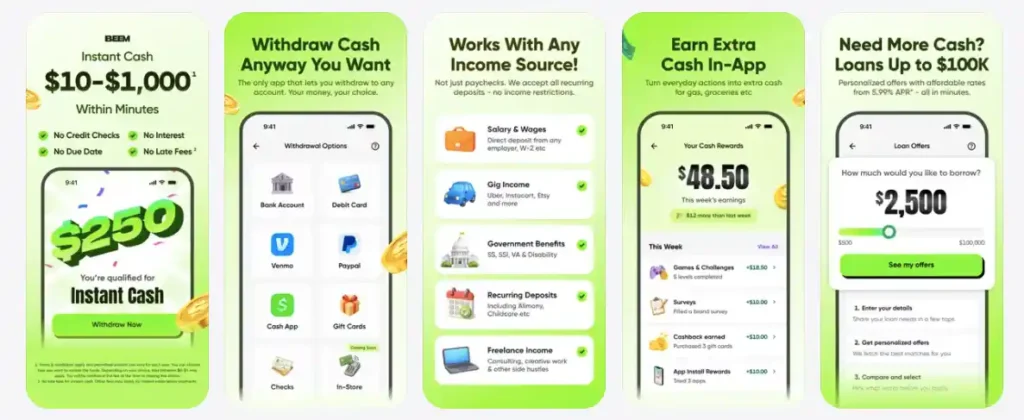
Beem Instant Cash Advance for Low-Cost Emergency Funds
For borrowers whose cash need falls within the advance amount range, Beem’s instant cash advance is one of the most cost-effective emergency funding options available regardless of credit score. Beem evaluates eligibility based on bank account history and income patterns rather than credit score, making it accessible to borrowers in the same credit profile range that MoneyKey serves. The critical difference is cost: Beem does not charge interest on advances, does not require a subscription, and does not expose borrowers to the APR rates that define MoneyKey-category lending. For short-term cash gaps before payday, this is a structurally cheaper solution. Visit trybeem.com/get-instant-cash-advance to get started.
Beem Personal Loans for Larger Borrowing Needs
If your borrowing need is larger than what an advance can cover, Beem connects users with personal loan options across a range of credit profiles. Including Beem in your lender comparison before committing to a MoneyKey-category product ensures you are not leaving a better-priced option on the table. Beem’s approach to personal lending prioritizes transparent terms and financial wellness rather than maximum rate extraction, making it a practical comparison point alongside higher-rate alternatives. Explore personal loan options at trybeem.com/personal-loan.
Beem Credit Builder Card to Exit the High-Rate Borrowing Cycle
The most powerful long-term move for any borrower who currently depends on MoneyKey-category lenders is to build their credit score to the point where lower-rate options become available. The Beem Credit Builder Card reports your payment activity to the major credit bureaus on a consistent basis, building a positive credit history that raises your FICO score over time. As your score improves, you gain access to lenders like Avant, and eventually to prime lenders, where rates are a fraction of what MoneyKey and its category charge. Breaking out of the high-rate borrowing cycle permanently starts with building the credit that qualifies you for something better. Learn more at trybeem.com/credit-builder-card.
Frequently Asked Questions About Banks Like MoneyKey
What Is the Best Alternative to MoneyKey?
The best alternative to MoneyKey depends on your credit profile and borrowing need. For borrowers with credit scores above 580 who need a longer-term loan, OppFi, Oportun, or Avant offer better rates than MoneyKey in most cases. For borrowers who need a smaller, short-term amount and want to avoid high-rate installment debt entirely, Beem’s instant cash advance provides emergency funds without interest charges. For borrowers who want to improve their credit while managing current financial needs, the Beem Credit Builder Card combined with a cash advance addresses both the immediate and long-term challenge simultaneously.
Do Banks Like MoneyKey Check Your Credit?
Most lenders in the MoneyKey category do check your credit, but they do so differently than prime lenders. Many use a soft credit inquiry during a pre-qualification stage, which does not affect your score, followed by a hard inquiry if you proceed to a full application. These lenders also rely heavily on proprietary underwriting models that weigh income, bank account history, and debt-to-income ratio alongside your traditional credit score. A low FICO score does not automatically result in a decline the way it might with a conventional bank loan application.
Can I Get a Loan Like MoneyKey With Bad Credit?
Yes. Lenders like MoneyKey are specifically designed for borrowers with bad or limited credit. OppFi, Possible Finance, and Oportun all serve borrowers with very low or nonexistent credit scores. The trade-off is cost: loans offered to borrowers with bad credit in this segment come with high APRs that reflect the lender’s elevated risk. Borrowers with bad credit who use these products should do so with a clear plan for the repayment schedule and a commitment to building their credit profile so that future borrowing is available at better rates.
How Fast Can I Get Money From Banks Like MoneyKey?
Most lenders in this category can deliver funds within one to two business days of application approval. Some, including OppFi and Rise Credit, offer same-day or next-day funding under certain conditions. The application and decision process is typically completed within minutes for pre-qualification and within one business day for full approval. If you need money within hours rather than days, a cash advance app like Beem with express delivery is faster than any installment lender in this segment.
Are Lenders Like MoneyKey Safe to Use?
Established lenders in this category, including MoneyKey, OppFi, NetCredit, Avant, Rise Credit, Possible Finance, and Oportun, are legitimate businesses that comply with applicable state and federal lending regulations and use secure data handling practices. They are safe to use in the sense that they are not scams and will deliver the funds they promise under the terms disclosed. However, safe to use does not mean cost-effective or appropriate for every financial situation. The high rates charged by lenders in this segment can cause genuine financial harm to borrowers who do not have a realistic plan for repayment or who use repeated high-rate loans as a primary financial management strategy.
Banks like MoneyKey fill a real gap in the consumer lending market by providing structured installment loans to borrowers who cannot access conventional credit products. Knowing which lenders operate in this space, how they compare on rates and terms, what risks to manage, and when alternatives like Beem’s instant cash advance or personal loan options offer a better fit gives you the information needed to make the most financially sound decision for your specific situation. The goal is not just to solve the immediate cash need but to solve it in a way that does not make the next financial challenge harder to navigate.