Key Summary
If you have used FloatMe before, you already know the drill: small advances, a flat monthly fee, and a quick way to avoid an overdraft when your balance runs low before payday.
But FloatMe’s advance limits are famously small, often starting around $20 for new users and capping out at around $100 even for longtime members, which offers little help when facing a larger shortfall. That is why many users search for cash advance apps like FloatMe that offer higher limits, different fee structures, or additional financial tools.
This guide walks through what FloatMe offers, what to look for in an alternative, and how several other cash advance apps—including Beem—compare when you need more flexibility than a $50 float can provide.
What Is FloatMe and How Does It Work
FloatMe is a subscription-based cash advance app that connects to your bank account and analyzes your balance history and recurring deposits to determine how much you can borrow. Membership requires a flat monthly fee, which applies whether or not you request an advance.
New users typically start with a small limit—often between $10 and $50. While some long-term members report their limit approaching $100 over time with consistent repayment, this increase is not guaranteed for everyone.
FloatMe does not charge interest or conduct hard credit checks, placing it in the same general category as most modern cash advance apps. Repayment is usually automatic, pulled from your linked bank account on an agreed date (typically your next payday). Instant delivery is available for an extra fee, while standard delivery is free but slower.
Read: Best Instant Cash Advance Apps with No Interest Fees
Why People Look for Alternatives to FloatMe
FloatMe works well for a narrow use case: occasional shortfalls where a $20-$50 buffer is enough. However, several common factors lead users to seek alternatives.
Low Advance Limits
A cap of $50 to $100 is often insufficient to cover rent, car repairs, or larger bills. For expenses beyond a minor overdraft gap, FloatMe’s limits may feel more like a formality than meaningful help.
Subscription Fee Regardless of Use
Because the monthly fee applies regardless of use, you still pay during months when you do not request an advance. Over the course of a year, these fees add up even with occasional use.
Slower Growth in Limits
Increasing your available limit with FloatMe takes time and a consistent repayment history. Even then, growth remains relatively low compared to competing apps.
Read: Best Cash Advance Apps in Minneapolis, MN in 2026
What to Look for in a Cash Advance App
If you are moving away from FloatMe, understanding what distinguishes a strong alternative from an app with similar limitations can guide your choice.
Higher Advance Limits
Look for an app that can realistically cover your typical expenses rather than offering a minor buffer. Advance limits that scale meaningfully with your income and account history provide far greater long-term value than a low, flat cap.
No Interest and No Hard Credit Check
While this practice is standard across reputable cash advance apps, it is always worth confirming before linking your bank account.
Fee Structure That Matches How You Use It
Some apps charge a flat subscription regardless of use, similar to FloatMe. Others charge only when you take an advance or offer a free tier with optional paid features like instant delivery. Consider your expected usage frequency before selecting a fee model.
Additional Financial Tools
Budgeting tools, credit-building features, and spending insights can make a larger long-term impact than the advance feature itself—especially if you regularly run short before payday.
Best Cash Advance Apps Like FloatMe
Here is how several well-known alternatives compare.
Beem
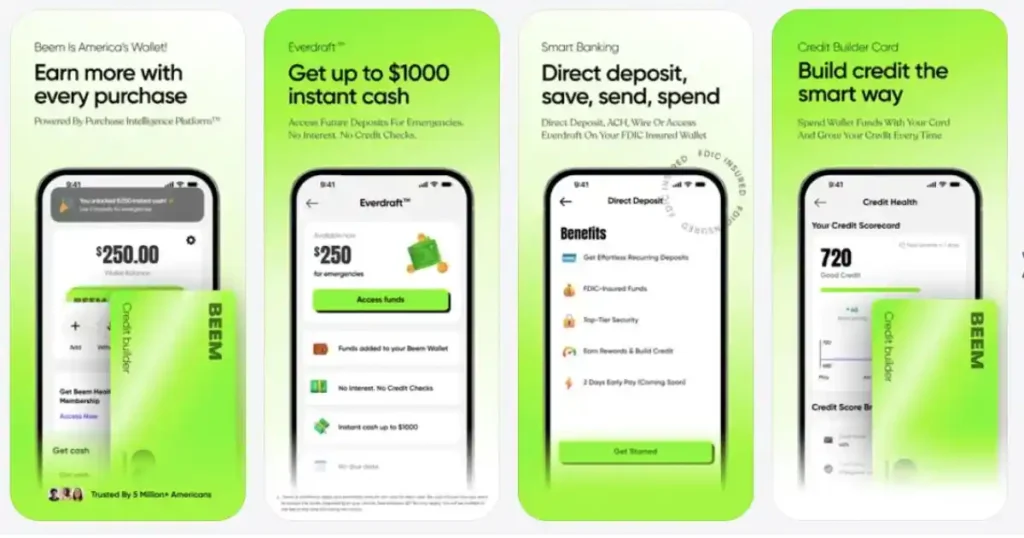
Beem’s Everdraft feature offers a significantly higher ceiling than FloatMe, allowing eligible users to access up to $1,000 compared to FloatMe’s $100 cap. It involves no interest or credit checks, and funds are typically delivered quickly upon approval.
Unlike FloatMe’s flat monthly fee model, Beem also offers Beem Boost—a feature enabling eligible users to unlock extra funds on top of their standard Everdraft amount by maintaining on-time payments, avoiding overdrafts, and managing spending.
Beyond advances, Beem includes budgeting tools and a credit-builder card, offering a broader toolkit than single-purpose float apps. For users who have outgrown FloatMe’s low limits, this combination of higher borrowing caps and comprehensive financial tools is a major draw.
Dave
Dave offers small-to-moderate cash advances tied to income and banking activity, generally with a higher ceiling than FloatMe. It operates on a membership model with built-in budgeting features—similar in structure to FloatMe but typically offering greater borrowing capacity. As with any platform in this space, check Dave’s current fee and limit structure directly, as details can shift over time.
EarnIn
EarnIn takes a different approach, letting users access money earned based on hours worked rather than relying on a subscription model. It avoids mandatory fees in favor of optional tips, with daily and pay-period limits that scale with verified income. For users with steady work schedules, EarnIn’s limits tend to run considerably higher than FloatMe’s.
Brigit
Brigit combines cash advances with budgeting and financial health tools. Although its subscription price is higher than FloatMe’s, it offers meaningfully higher advance limits. Select tiers also include credit-building features, which FloatMe lacks.
Klover
Klover offers cash advances alongside a rewards-style points system that can be redeemed for gift cards or account credits. Unlike FloatMe’s required subscription, Klover generally provides a free tier, though actual advance amounts depend on account verification and usage history.
Super.com Cash Advance
Super.com bundles a cash advance feature into a broader membership that includes travel discounts and a credit-builder card. Its advance limit is typically higher than FloatMe’s. Still, the membership fee is also higher, making it important to evaluate whether you will use the bundled perks enough to justify the cost.
Read: Cash Advance in San Francisco: Best Apps, Smartest Uses, and What to Know in 2026
Beem vs FloatMe at a Glance
When comparing Beem and FloatMe, key differences quickly stand out. FloatMe’s advance ceiling tops out near $100 for long-time members, whereas Beem’s Everdraft offers eligible users up to $1,000—a substantially higher amount for covering larger expenses.
Furthermore, FloatMe charges a flat monthly fee regardless of use, whereas Beem’s Everdraft does not tie a recurring fee purely to advance access.
Both apps skip interest charges and hard credit checks. However, Beem’s addition of Beem Boost, budgeting tools, and a credit-builder card provides a broader suite of features designed to foster long-term financial stability rather than just covering short-term gaps.
How to Choose Between FloatMe and an Alternative
The right choice depends on your month-to-month financial needs.
If your shortfalls are small, predictable (usually under $50), and occasional, FloatMe’s simplicity may meet your needs. Its flat fee and straightforward approach appeal to users who prefer to avoid extra features.
If you regularly require more than FloatMe allows or want a path toward higher limits as your account activity grows, an app like Beem is generally a better fit. The ability to unlock extra funds through Beem Boost, combined with a much higher base limit, makes it far more effective for managing substantial financial gaps. Download the app now.
It is also worth considering long-term benefits. Apps that pair cash advances with budgeting and credit-building tools offer greater ongoing support than those focused solely on short-term fixes.
Common Questions When Switching From FloatMe
If you are transitioning from FloatMe to a new cash advance app, keep a few key steps in mind before committing.
Be sure to cancel your FloatMe membership directly through the app’s settings rather than simply uninstalling it, as deleting the app does not stop recurring charges. Review the eligibility requirements of any new platform carefully; while most apps examine account history and direct deposit patterns, specific criteria vary.
Finally, allow a full pay cycle or two to evaluate whether the new app’s limits and fees suit your budget, as many platforms start new users with lower limits that grow over time.
Read: Cash Advance Boston: 9 Best Apps for Instant Funds
FAQs
What is the best alternative to FloatMe?
The best alternative depends on how much you need to borrow. For users who have outgrown FloatMe’s low limits, Beem’s Everdraft feature offers a significantly higher ceiling of up to $1,000 with no interest or credit check, along with Beem Boost for additional funds when needed.
Does FloatMe check your credit?
No. FloatMe does not conduct hard credit checks to determine eligibility. Instead, it evaluates your bank account history and recurring deposits, which is standard practice across most cash advance apps.
How much can you get from FloatMe?
FloatMe’s advances typically range from $10 to $50 for new users, with select long-term members reporting limits of up to $100 over time. This is significantly lower than higher-limit alternatives like Beem, which offers eligible users up to $1,000.
Is FloatMe worth the monthly fee?
Whether FloatMe’s flat monthly fee is worth it depends on how frequently you use the advance feature, as charges apply regardless of activity. If you only need occasional small advances, it can be a good fit. However, if you require larger or more frequent advances, an app with higher limits may provide better overall value.
Are cash advance apps like FloatMe safe to use?
Reputable cash advance apps use bank-level security and maintain transparent terms and fee structures. Nevertheless, review an app’s current terms and cancellation policy before linking your bank account.
What is the highest cash advance app limit compared to FloatMe?
Limits vary by platform and individual eligibility. Beem’s Everdraft offers eligible users up to $1,000, presenting a considerably higher ceiling than FloatMe’s $100 maximum and making it a popular option for users seeking higher limits.