
Key Summary
Carrying multiple debts is stressful. Credit card bills with different due dates, different interest rates, and different minimum payments make it hard to make real progress. Most people end up paying mostly interest and barely touching the actual balance.
A debt consolidation loan fixes that. You take one personal loan, pay off the smaller balances, and focus on a single fixed monthly payment. SoFi is one of the most well-known lenders for this approach. It offers large loan amounts, competitive rates, and no fees, which makes it a strong choice for borrowers with good credit who want a clear path out of debt.
What Is a SoFi Debt Consolidation Loan
A SoFi debt consolidation loan is an unsecured personal loan. You use the borrowed amount to pay off existing debts like credit cards, medical bills, or other personal loans. After that, you repay SoFi in fixed monthly installments. Because the rate is fixed, your payment stays the same every month, which makes budgeting predictable.
SoFi originally stood for Social Finance and started as a student loan refinancer. Today it is one of the largest online personal loan lenders in the United States, and debt consolidation is one of its most popular use cases.
The key difference between SoFi and many other lenders is that it charges no origination fees, no late fees, and no prepayment penalties. The rate you see is the full cost of borrowing. For borrowers comparing multiple lenders, that transparency is a real advantage.
Why Borrowers Choose Consolidation Instead of Balance Chasing
Many people do not realize how inefficient credit card repayment becomes when debt is spread across multiple accounts. One card may carry a 24% APR, another may be at 19%, and another may have a promotional rate that expires soon. Even when you are making all the minimum payments on time, the balances can feel stuck because so much of the payment goes toward interest. What looks manageable month to month can become expensive over a year or two.
Debt consolidation changes that structure. Instead of juggling different due dates and watching interest pile up across several accounts, you replace the chaos with one installment loan and one payoff timeline. That shift does not erase debt, but it can make the debt cheaper and easier to control if the new APR is lower than the blended cost of your current balances.
This is one reason SoFi appeals to borrowers with strong credit. If you qualify for a competitive fixed rate, the loan gives you a cleaner exit path than revolving debt usually does. It also removes some of the friction that causes missed payments, such as scattered due dates and changing card balances.
For borrowers who are serious about paying debt down, consolidation is often less about convenience and more about structure. The predictability of one payment and one term can create momentum that minimum-payment credit card repayment rarely provides.
How It Works Step by Step
The process starts with prequalification. SoFi offers a soft credit check, which means you can see estimated rates and terms without affecting your credit score. That is a useful first step before committing to anything.
If the offer looks good, you move to the full application. SoFi asks for personal information, income documentation like pay stubs or W-2s, and details about the debts you want to consolidate. The lender reviews your credit score, income, and debt-to-income ratio before making a decision.
Once approved, SoFi can fund your loan within a few business days, and in some cases as fast as the same day you sign. You use those funds to pay off your existing debts and then make one fixed monthly payment to SoFi until the loan is fully repaid.
Read: Reprise Debt Consolidation Loan: How to Consolidate Debt with Reprise
Who SoFi Works Best For
SoFi is built for borrowers with good to excellent credit. It works best for applicants with a credit score around 680 or higher, a stable income, and a debt-to-income ratio that shows they can handle the new loan comfortably. That makes it a strong fit for people who are paying too much in interest on credit cards and want to simplify and reduce that cost.
SoFi is not the best fit for everyone. Borrowers with poor or fair credit are unlikely to qualify, and if they do, the rates may not be as competitive as expected. If you fall outside the strong-credit range, comparing alternatives through Beem makes more sense than applying directly and risking a hard inquiry.
What to Check Before You Apply
Before applying for any debt consolidation loan, it helps to run a quick reality check on your numbers. Start with the total amount you want to consolidate, then compare that with the minimum loan size SoFi offers. Since SoFi loans start at $5,000, borrowers with smaller balances may need a different lender or a different strategy altogether.
Next, look at the average APR across the debts you want to pay off. A consolidation loan only improves your situation if the new rate is meaningfully lower or if the fixed repayment structure helps you get out of debt faster. If your current debts already carry relatively low rates, the benefit may come more from simplicity than savings. That is still valuable, but it is important to know which outcome you are really pursuing.
You should also check whether your monthly budget can handle the new payment comfortably. Lower total interest does not always mean a lower monthly payment, especially if you choose a shorter term to pay the debt off faster. Some borrowers benefit from a three-year loan that saves interest, while others need a five- or seven-year term to keep the payment manageable.
Finally, think about your post-consolidation behavior. If the loan pays off your credit cards but you continue using those cards heavily, you can end up with both loan debt and renewed revolving debt. The strongest consolidation outcomes happen when the borrower uses the loan as a reset point, not as extra room to borrow again.
Eligibility Requirements
SoFi has straightforward requirements. Here is what you generally need:
- Credit score around 680 or higher, with better scores getting better rates.
- Steady, verifiable income from employment or other documented sources.
- A debt-to-income ratio low enough to show the new payment is manageable.
- U.S. citizenship, permanent residency, or a valid visa.
- Age of majority in your state.
SoFi looks at the full picture of your finances rather than just your score. A borrower with strong income and a recent minor blemish may still qualify.
Rates and Fees
SoFi’s APRs typically range from 8.99% to 25.81%, depending on your credit profile, income, loan amount, and repayment term. Borrowers with the strongest profiles qualify for rates at the lower end of that range.
SoFi also offers a rate discount for borrowers who set up autopay. Repayment terms run from two to seven years, giving flexibility to choose a shorter term with higher payments or a longer term with lower monthly amounts.
There are no origination fees, no late fees, and no prepayment penalties. Paying early saves you interest without any extra cost.
How the Loan Term Changes the Real Cost
APR gets most of the attention, but repayment term matters just as much. Two borrowers can receive the same interest rate from SoFi and still have very different outcomes depending on whether they choose a two-year, four-year, or seven-year repayment schedule. The longer the term, the lower the monthly payment usually becomes. But that lower payment comes with a tradeoff: you stay in debt longer and pay more interest overall.
This is where debt consolidation decisions often go wrong. A borrower sees a manageable monthly payment on a long-term loan and assumes it is automatically the better deal. In reality, the best option is usually the shortest term that comfortably fits the budget. That balance matters because a payment that is too aggressive can create cash flow pressure, while a term that is too long can reduce the savings that made consolidation attractive in the first place.
For example, someone consolidating $10,000 may find that a three-year term feels tighter month to month but saves far more interest than a seven-year term. Another borrower may intentionally choose five years because the extra flexibility makes on-time payments more realistic. Neither choice is universally right. The right term is the one that reduces overall cost without creating a payment you are likely to struggle with.
When comparing offers, focus on total repayment, not just monthly affordability. The cheapest-looking monthly number is not always the cheapest loan.
Real Example: Before and After Consolidation
Imagine you have three credit card balances:
- $4,000 at 24% APR
- $3,000 at 21% APR
- $2,000 at 19% APR
That is $9,000 across three accounts, each with a different payment and a different due date. With a SoFi debt consolidation loan at 12% APR over four years, your monthly payment comes to roughly $237. You pay less in interest, track one payment instead of three, and have a clear end date. The total interest paid is significantly lower than staying on the minimum payment track across all three cards.
That is the real value of consolidation done right. It is not just simpler. It is cheaper too, if the new rate is meaningfully lower than what you were paying before.
Pros and Cons
Pros:
- No origination fees, no late fees, no prepayment penalties.
- Competitive rates for strong-credit borrowers.
- Loan amounts from $5,000 to $100,000.
- Flexible terms from two to seven years.
- Fast funding, sometimes same-day.
- Soft credit check for prequalification.
- Rate discount available with autopay.
Cons:
- Requires good to excellent credit, typically around 680 or higher.
- Not suitable for poor or fair credit borrowers.
- No secured loan option.
- Loan amounts start at $5,000, which may be more than some borrowers need.
- Rates at the higher end of the range are less competitive for weaker profiles.
Common Mistakes After Consolidation
Getting approved for a debt consolidation loan is only the first step. What happens after the loan funds often determines whether the move actually improves your finances. One of the most common mistakes is treating paid-off credit cards as available spending room again. If those balances start climbing immediately after consolidation, the borrower can end up in a worse position than before.
Another mistake is focusing only on the emotional relief of having one payment instead of paying attention to the full repayment plan. Consolidation works best when it is paired with a realistic monthly budget, a reduced reliance on credit cards, and a clear idea of when the debt will be fully gone. Without those habits, the loan can become a temporary cleanup step rather than a lasting fix.
Borrowers also sometimes overborrow. If you qualify for more than you need, it can be tempting to roll in extra expenses or take additional cash. That increases interest costs and weakens the original purpose of the loan, which is to simplify and reduce expensive debt. The strongest applications are usually the ones tied to a specific, calculated payoff amount.
That is where a tool like Beem becomes useful. Comparing lenders is important, but so is understanding what happens after funding. A consolidation loan should be part of a broader debt strategy, not a standalone action. The better your plan after approval, the more likely the loan is to produce lasting financial improvement.
What Beem Is and How It Fits
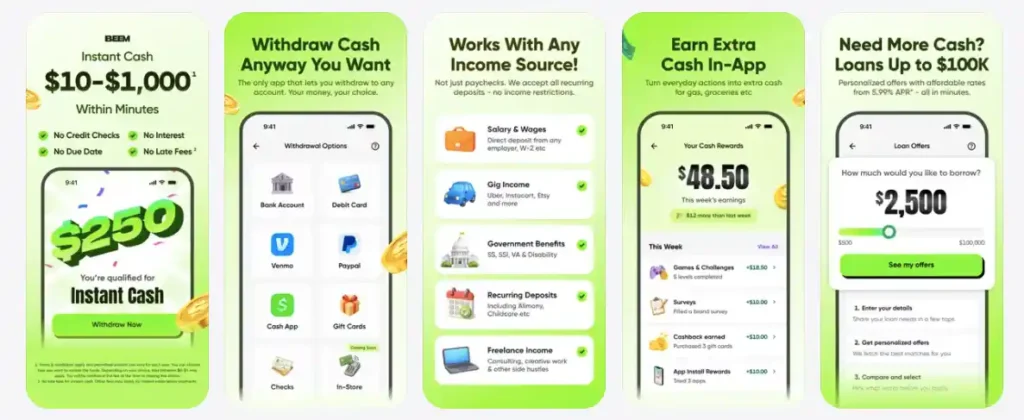
Beem is America’s Wallet, and it fits at every stage of the debt consolidation decision. SoFi is a strong lender, but whether it is the right lender depends entirely on your credit profile, loan amount, and repayment goals. Beem helps you figure that out before you apply anywhere.
The Beem Marketplace lets you compare SoFi against other lenders like Upstart, Upgrade, and LightStream in one place. You can review rates, terms, and loan amounts side by side so you are not guessing. The difference between a good and a mediocre offer on a $10,000 loan can be hundreds of dollars over the repayment period.
Everdraft gives you access to up to $1,000 instantly if you need to cover a short-term gap while waiting for loan funding or before your consolidation plan is in place. BudgetGPT helps you map your monthly budget after consolidation so you do not slip back into high-interest debt once the cards are paid off. Credit monitoring keeps you informed about how consolidation is affecting your score over time.
SoFi vs Other Lenders
| Lender | Best For | APR Range | Loan Amount | Fees |
| SoFi | Good to excellent credit | 8.99% to 25.81% | $5,000 to $100,000 | None |
| LightStream | Excellent credit | Starting around 6.99% | $5,000 to $100,000 | None |
| Upgrade | Fair credit | 9.99% to 35.99% | $1,000 to $50,000 | Origination fee |
| Upstart | Thin credit files | 7.80% to 35.99% | $1,000 to $50,000 | Origination fee |
| Avant | Fair to poor credit | Starting around 9.95% | $2,000 to $35,000 | Origination fee |
Note: All APR ranges are approximate and subject to change. Verify current rates on each lender’s official site before applying.
Tips for Borrowing Wisely
Taking a consolidation loan works only if you follow through with the right habits after signing.
- Borrow only what you need to pay off existing debts.
- Set up autopay right away to avoid missed payments and capture the rate discount.
- Keep paid-off credit card accounts open. Closing them raises your utilization ratio and can lower your score.
- Stop using the cards you just paid off. Charging them again defeats the purpose of consolidation.
- Use Beem’s BudgetGPT to set a realistic post-consolidation budget.
How Consolidation Affects Your Credit
In the short term, the hard inquiry from the full application causes a small temporary dip. Opening a new account also lowers the average age of your credit history slightly.
In the medium and long term, consolidation usually helps. Paying off revolving credit card debt reduces your utilization ratio, which is one of the fastest-moving factors in your score. Consistent on-time payments on the new loan build positive payment history. Over time, a well-managed consolidation loan typically improves your credit profile meaningfully.
Frequently Asked Questions
What credit score do I need for a SoFi debt consolidation loan?
Most approved borrowers have a credit score around 680 or higher, but SoFi considers the full financial picture including income and debt-to-income ratio. Higher scores generally qualify for better APRs. Borrowers with strong income and stable employment may still qualify even with a score slightly below 680. Unique credit profiles are reviewed individually rather than relying only on the numerical score.
Does SoFi charge any fees?
SoFi does not charge origination fees, late fees, or prepayment penalties, which is uncommon among personal lenders. The APR you see represents the full cost of borrowing with no hidden charges. This transparent fee structure makes SoFi especially competitive for borrowers comparing multiple lenders, since some competitors add 1% to 5% origination fees that increase the total cost significantly over the loan term.
How fast does SoFi fund a loan?
SoFi can fund loans as fast as the same day you sign the loan agreement, with most borrowers receiving funds within one to three business days. After approval, funding speed depends on your bank’s processing time. Once SoFi sends the funds, some banks post them immediately while others may take one additional business day to make the money available in your account.
Can I use a SoFi loan to pay off credit cards?
Yes, paying off credit card balances is one of the most common and financially beneficial uses for a SoFi personal loan. Consolidating high-interest credit card debt into a lower-rate installment loan reduces overall interest costs and simplifies repayment into a single monthly payment. SoFi even allows you to specify which creditors to pay during the application process.
Does prequalifying with SoFi hurt my credit score?
No, prequalification uses a soft credit check that does not affect your credit score at all. You can review your estimated rates and terms before committing to a full application. Only if you decide to proceed with the complete application will SoFi perform a hard inquiry, which may cause a small, temporary dip in your score of typically five points or less.
What happens if I pay off my SoFi loan early?
There is no prepayment penalty for paying off your SoFi loan early, and you save on interest since interest accrues daily on the remaining balance.你可以 make extra payments at any time without fees, or pay the entire balance off in one lump sum. This flexibility is particularly valuable if you receive a bonus, tax refund, or other unexpected income that you want to use to eliminate debt faster.
How does Beem help with a SoFi loan decision?
Beem helps you compare SoFi against other lenders through its Marketplace, showing rates from Upstart, Upgrade, LightStream, and more side by side before you apply. BudgetGPT maps your post-consolidation monthly budget to prevent slipping back into credit card debt, while credit monitoring tracks how consolidation affects your score over time. Everdraft provides up to $1,000 instantly for short-term gaps while waiting for loan funding, reducing the need for multiple loan applications.