
Key Summary
When rent is due, and your account is short, the timeline moves fast. Landlords can file eviction notices within days of a missed payment in many states, and a single eviction filing can follow you on your rental history for years. Getting the right help quickly is the priority, and you have more options than most people realize.
According to the CFPB, rent and housing costs are the single largest monthly expense for most American households, and nearly 40% of renters have experienced at least one situation in which they struggled to make rent on time. This guide covers every practical option for getting emergency cash for rent, what each one costs, and how to avoid the high-cost traps that make a short-term problem worse.
The Reality of Rent Emergencies in America
Rent emergencies do not happen only to people in financial trouble. They happen to be employed, responsible people when timing works against them. A paycheck lands two days after rent is due. A car repair wipes out the buffer saved for the first. An unexpected medical bill arrives the same week as the landlord’s notice.
Housing costs have outpaced wage growth in most US cities for the past decade. The result is that a large share of working Americans carry little to no financial cushion between paychecks. According to the Federal Reserve’s 2023 Economic Well-Being of US Households report, 37% of adults said they would struggle to cover an unexpected $400 expense from savings. For many of these households, rent is the largest single line item in their monthly budget, and any disruption in income timing creates a real risk of falling behind.
Understanding what actually happens when you miss rent, and knowing your full range of options before the situation escalates, gives you the best chance of resolving it without lasting consequences.
Read: Can Parents Use BNPL for School Expenses?
Common Causes of Rent Emergencies
• Delayed paychecks or irregular gig work income
• Unexpected expenses, including car repairs, medical bills, or school fees
• Job loss, reduced hours, or a gap between jobs
• A single large bill arriving in the same pay period as rent
Consequences of Missing Rent
• Late fees ranging from $25 to several hundred dollars, depending on lease terms
• Eviction filings, which can begin as early as one day after the due date in some states
• Eviction judgments on your public record that affect future rental applications
• Credit damage if the landlord sends the account to collections
What Happens If You Cannot Pay Rent on Time
The eviction process varies by state, but it moves faster than most tenants expect. In many states, a landlord can issue a pay-or-quit notice within one to three days of a missed payment. If rent is not paid within the notice period, they can file for eviction in court. Even if you catch up before the court date, the filing itself creates a public record that future landlords may find when checking your rental history.
Late fees compound the problem. A $50 late fee on a $1,500 rent payment represents 3.3% of the monthly rent cost. Repeated late fees over several months can add hundreds of dollars to what you owe annually. And if the landlord uses a tenant screening agency that reports to tenant screening services, even a near-miss can affect your ability to rent in the future.
Acting before the due date, or within the first 24 hours after missing it, gives you the most options and the best chance of avoiding formal eviction proceedings.
How Cash Advance Apps Can Help You Avoid Eviction
Cash advance apps are built for exactly this kind of short-term timing problem. They connect to your bank account, review your deposit history, and offer an advance against your next paycheck with no credit check and no interest. Repayment comes automatically when your next paycheck arrives. For a rent shortfall of $200 to $1,000, this is the fastest low-cost option available.
Not all apps are structured the same. Here is how the most practical options compare for a rent emergency specifically.
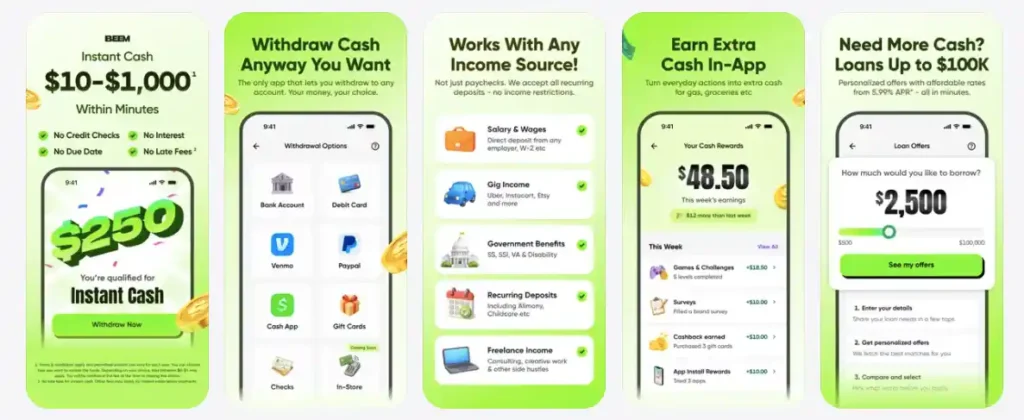
Beem‘s Everdraft feature gives you access to up to $1,000 with no fees, no credit check, and automatic repayment from your next paycheck. It is the highest fee-free limit available among cash advance apps, which matters when rent shortfalls often exceed $500. Funds arrive instantly after approval.
EarnIn provides up to $750 per pay period based on wages you have already earned. No mandatory fees apply. It works best for salaried or hourly employees with a consistent direct deposit history. Gig workers may have difficulty qualifying.
The key difference between these apps and payday loans is the absence of interest and rollover fees. You repay exactly what you borrowed. No compounding, no penalty for the following month, no debt cycle.
Emergency Rental Assistance Programs
Cash advance apps cover a timing gap. For renters facing a longer-term shortfall, government and nonprofit assistance programs can cover partial or full rent without repayment requirements. These take longer to access but carry no cost and no repayment obligation.
HUD-approved housing counseling agencies in every state can connect you with federal, state, and local rental assistance programs. Many were expanded during the COVID-19 emergency period and continue to operate with available funds. Services are free and include one-on-one counseling on your options.
211.org is the fastest way to find local emergency assistance programs by ZIP code. Enter your location and the type of help you need, and you receive a list of local programs with contact information and eligibility requirements. Most programs have income guidelines and require documentation of the specific need.
Additional resources worth contacting:
• Local nonprofit organizations: United Way chapters, Catholic Charities, Salvation Army, and similar organizations often provide one-time emergency rent assistance or utility grants.
• Community action agencies: Federally funded agencies in most counties administer emergency assistance programs and can often connect you with multiple sources of help in one call.
• State and county housing portals: Many states maintain dedicated emergency rental assistance portals that can be found through your state government’s housing department website.
Negotiating Directly with Your Landlord
Before using any borrowing option, a direct conversation with your landlord is worth attempting. Most landlords, particularly individual property owners rather than large tenant screening agencies, prefer a partial payment and a clear timeline over the cost and hassle of an eviction proceeding.
Call your landlord before the due date if possible, not after. Explain the specific situation, what caused the shortfall, and when you will have the full amount. Propose a concrete plan: a partial payment now and the balance by a specific date. Get any agreed arrangement in writing, even a text message confirming the terms.
Tenant Management companies are less flexible than individual landlords, but most have formal hardship processes. Ask specifically for a payment arrangement rather than simply explaining the situation. A documented request through formal channels is more likely to produce a usable outcome.
Options Compared by Speed and Cost
Each option below serves a different combination of urgency, amount needed, and your relationship with the people or systems involved.
| Option | Speed | Cost | Best For |
| Cash advance app (Beem, EarnIn, Dave) | Minutes to 1 hour | No fees | Shortfalls up to $1,000 needed today |
| Negotiate with the landlord | Same day | Free | Any amount, relationship with landlord intact |
| HUD-approved housing counselling | 1 to 3 days | Free | Longer-term shortfall, needs assessment |
| 211.org local programs | 1 to 5 days | Free | Partial or full rent assistance, no repayment |
| Nonprofit one-time assistance | 1 to 7 days | Free | One-time emergency, income-eligible |
| Payday loan | Same day | 300%+ APR | Not recommended |
| Credit card cash advance | Instant | 3 to 5% fee + 25 to 30% APR | Last resort only |
What to Avoid When You Need Rent Money Fast
Desperation creates vulnerability. The options below are common traps that make a short-term problem significantly worse.
Payday Loans
Payday loans in states where they are legal charge $15 to $30 per $100 borrowed. On a $500 rent shortfall, that is $75 to $150 in fees due in full on your next paycheck, alongside the $500 principal. If you cannot repay the full amount, the lender rolls the balance over with another fee. Many borrowers end up repaying two to three times the original loan before the balance clears. Cash advance apps cover the same need at no cost.
Auto-Title Loans
You risk losing your vehicle if you cannot repay. Auto-title loans carry some of the highest effective APRs of any lending product, and losing your car in a rent emergency can create an employment problem on top of a housing problem.
Unverified Apps with Vague Fee Structures
Some apps promote free advances but charge subscription fees, tip requirements, or express delivery fees that are not disclosed upfront. Always review the full cost disclosure before accepting funds from any app. Regulated apps, including Beem, EarnIn, and Dave, all disclose fees before confirmation.
Building a Rent Buffer After This Emergency
The most practical thing you can do after resolving a rent emergency is set up a small automatic transfer each payday specifically for a rent buffer. Even $20 to $30 per paycheck adds up to $480 to $720 over a year. Keeping this in a separate savings account, not your everyday checking account, prevents it from being spent before the next emergency arises.
If your budget does not currently have room for this transfer, use the emergency as a signal to review your recurring expenses. Subscriptions, memberships, and services you are not actively using represent the most recoverable spending category for most people. Cutting $30 to $50 in monthly subscriptions creates the margin for a meaningful buffer within six months.
Frequently Asked Questions
Can I use a cash advance app to pay rent?
Yes. Cash advance apps deposit funds directly to your linked bank account. You then pay your landlord through whatever method they accept, whether that is a bank transfer, online payment portal, check, or money order. The funds from a cash advance arrive in your account the same as any other deposit and can be used for rent immediately.
How fast can I get emergency cash for rent?
With instant delivery through a cash advance app, funds arrive in minutes. Beem’s Everdraft delivers instantly after approval with no additional fee. If you contact a nonprofit or government assistance program, the timeline is typically one to five business days. Act before your due date whenever possible to keep all options open.
Do I need good credit to get emergency rent help?
No. Cash advance apps, including Beem and EarnIn do not check your credit score. Approval is based on your bank account activity and income deposit history. Government and nonprofit assistance programs also have no credit requirements. A low credit score does not prevent you from accessing any of the options in this guide.
What if the cash advance is not enough to cover my full rent?
Combine options. Use a cash advance to cover part of the shortfall and negotiate a payment arrangement with your landlord for the remainder. Contact 211.org simultaneously to find local assistance programs that can cover part of the balance. Most rent emergencies can be resolved through a combination of two to three approaches rather than relying on a single source.
How do I build a rent buffer so this does not happen again?
Set up an automatic transfer of $20 to $30 per paycheck to a dedicated savings account. Even a small balance of $300 to $500 covers most rent shortfalls without borrowing. Keep this account separate from your checking account so the balance is not spent on emergencies. After six months of consistent transfers, you will have a meaningful cushion.
What should I do if my landlord has already filed for eviction?
Contact a HUD-approved housing counselor immediately. Many states have legal aid organizations that provide free assistance to tenants facing eviction. In most states, paying the full amount owed before the court hearing stops the eviction process, even after a filing. A housing counselor can help you identify assistance programs that can cover the arrears before the hearing date.
How do I find out what rental assistance programs are available in my area?
Visit 211.org and enter your ZIP code. You will see a list of local programs organized by type of assistance. You can also call 211 directly. HUD’s website at hud.gov maintains a directory of HUD-approved housing counseling agencies by state and county, many of which can coordinate multiple assistance sources for you in a single appointment.
Your Options When Rent Is Due, and Money Is Short
A rent emergency is a timing problem that most people can solve, provided they act quickly and know what options are available. The eviction process moves fast, but so do the solutions when you know where to look.
Call your landlord first. Contact 211.org at the same time to identify local assistance programs. If you need funds today, a cash advance app is the fastest and cheapest option available.
For amounts up to $1,000 with no fees and no credit check, download Beem and access funds through the Everdraft feature today. Repayment is automatic from your next paycheck, which means the shortfall is resolved without creating a new debt obligation beyond this month.
[Word count: 2,506]