

Key Summary
You are three days from payday, and your checking account is at $47. A bill is about to hit. You open your phone and search for options. One name keeps appearing: EarnIn. But is EarnIn legit? The app promises early access to your paycheck with no interest and no mandatory fees. That sounds perfect, except you have heard enough about “too good to be true” to wonder what the catch is.
This guide breaks down whether EarnIn is legit, how it actually works, what limits you will face, what it really costs, and what risks people do not talk about until after they are stuck. Then it covers who EarnIn is for, what to compare when looking at alternatives, and why some people choose Beem instead.
Is EarnIn Legit?

EarnIn is a financial technology company that provides what it calls earned wage access. That means you can get the money you have already earned at work before your official payday arrives. EarnIn is not a bank. It works with partner banks that are FDIC-insured, which means your money is protected by the FDIC.
In practical terms, EarnIn is legit. It is a real company with millions of users and a real product. It has been operating for years and is widely recognized in the cash advance and early wage access space. The confusion about whether it is legit usually comes from two places. First, the “no mandatory fees” language leads people to assume it is totally free, which isn’t quite accurate. Second, people wonder if accessing your paycheck early will hurt your credit or create legal problems. EarnIn says it does not report to credit bureaus, and it is not structured as a loan, so those specific concerns are less relevant.
The better question is not whether EarnIn is legit, but whether it is the right fit for your situation. Legit does not mean risk-free. It does not mean it will solve your money problems. It means the company is real and the service works as described, even if the details are more complicated than the marketing suggests.
How EarnIn Works
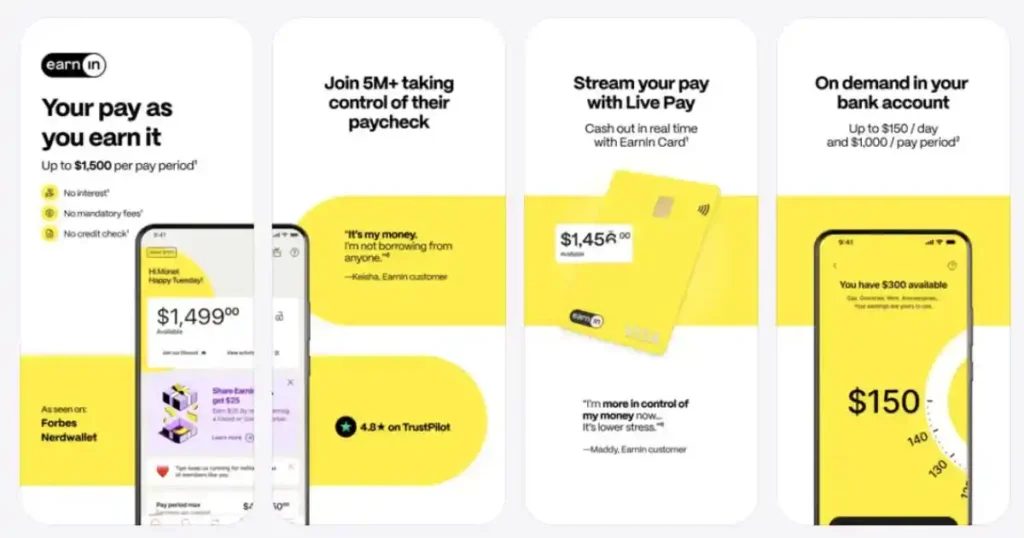
EarnIn’s main feature is called Cash Out. It lets you access money you have already earned before your paycheck is officially deposited. The way it works is simple on the surface. You connect your bank account and verify your income. EarnIn uses several methods for verification. Some users link a work email or upload timesheets. Others use GPS tracking if their job involves clocking in at a physical location. Once verification is set up, you can request an advance.
The maximum you can access is $150 per day and $1,000 per pay period. However, most new users do not start at those maximums. Many people start at around $85 per day or lower. Your limit depends on factors such as your EarnIn account history, your bank balance, your spending patterns, and other risk signals the app monitors. The limit can go up over time if you use the service consistently and pay on schedule. It can also drop to zero if the app detects something it considers risky.
When you request money through Cash Out, you have two options for how fast you get it. The standard option is free and takes one to three business days. The faster option is called Lightning Speed. Lightning Speed delivers funds to you in minutes, but it costs $2.99-$5.99 per transfer. Once your paycheck is deposited, EarnIn automatically debits your bank account for the amount you borrowed. There is no manual repayment step. The debit happens on payday, which means your take-home pay shrinks by whatever amount you accessed early.
EarnIn Limits: Daily and Pay Period
The advertised limits are up to $150 per day and up to $1,000 per pay period. Those numbers sound generous compared to some competitors, but the reality is more complicated. Most people do not get access to the full amounts right away. Your actual limit depends on multiple factors that EarnIn does not fully explain.
One factor is your EarnIngs. To qualify, you must earn at least $320 per pay period. If your income is lower than that, you will not be eligible. Another factor is consistency. EarnIn works best for people with regular pay schedules and steady direct deposits. If your income varies or your paydays shift, the app may lower your limits or cut off access entirely.
Your bank balance also affects your limit. If EarnIn sees that your balance is often low or that you are close to overdrafting, it may reduce how much you can access. The app does not want to advance money if it thinks you will not have enough funds to repay on payday. Spending patterns matter too. If the app sees unusual activity or large outflows, it may flag your account as higher risk and reduce your limit.
The frustrating part for many users is that these limits can change without much warning. You might have access to $150 one week, only to see your limit drop to $50 or even $0 the next week. That unpredictability can be a problem if you are counting on a specific amount to cover a bill.
What EarnIn Really Costs
EarnIn markets itself with the phrase “no mandatory fees.” That is technically true, but it does not mean using EarnIn is free. The cost structure is built around optional tips and speed fees, which add up faster than most people expect.
When you request a Cash Out, the app prompts you to leave a tip. The tip is optional, but the way it is presented makes it feel expected. The app suggests tip amounts, and some users report feeling pressured to tip because they worry that skipping it might affect their future limits or access. Tips can range from $13 to $14 per transaction, depending on the amount you are borrowing. If you are accessing $100 and tipping $10, that is effectively a 10 percent fee.
In addition to tips, there is the Lightning Speed fee. If you need money in minutes instead of waiting 1 to 3 business days, EarnIn charges $2.99 to $5.99 per transfer. That fee might seem small, but if you use Lightning Speed every pay period, you are paying $6 to $12 per month just for speed. Add in tips, and you could easily spend $20 or more per month on what is supposed to be a no-fee service.
Balance Shield is another feature that can come with costs. Balance Shield monitors your account for low balances and automatically transfers money from EarnIn to prevent overdrafts. It sounds helpful, but the automatic transfers can also include tip prompts. If you are not paying attention, those tips add up across multiple Balance Shield activations.
The bottom line is that EarnIn is not as free as it sounds. For someone using it occasionally with no tips and no Lightning Speed, the cost is zero. For someone using it regularly with tips and speed fees, the cost can rival or exceed a monthly subscription service.
Also Read: How Instant Cash Helps You Protect Paychecks From Surprise Expenses
Features Beyond Cash Out
Cash Out is the main feature, but EarnIn offers a few other tools. Balance Shield is the most notable. It is designed to help you avoid overdraft fees by monitoring your bank balance and automatically transferring small amounts from your EarnIn limit when your balance drops too low. Balance Shield can transfer up to $100. It is helpful if overdrafts are a frequent problem, but it also has the same repayment and tip dynamics as Cash Out.
Early Pay is another feature. If your employer offers direct deposit, EarnIn can sometimes deposit your paycheck into your account up to 2 days early. The catch is that Early Pay often requires Lightning Speed, which means paying the $2.99 fee to access it faster.
EarnIn also includes lighter features, such as credit monitoring and a savings tool called Tip Yourself. These are nice add-ons, but they are not the main reason people use the app.
Real Risks People Don’t Talk About
Repayment Cycle Trap
- Automatic debit on payday reduces your next paycheck by the borrowed amount.
- Creates a recurring problem if you were already financially stretched.
- Forces you to take another advance in the following pay period.
- Turns one-time emergency fix into a difficult-to-break pattern.
Limit Unpredictability
- Access limits can drop without a clear explanation or warning.
- No guaranteed customer service process to restore limits quickly.
- It can leave you short if you’re counting on a specific amount to cover bills.
- Creates uncertainty when planning your finances.
Bank Balance Dependency
- EarnIn debits your account regardless of actual circumstances.
- Delayed payday or a smaller-than-expected paycheck can trigger overdrafts.
- Overdraft fees defeat the purpose of using the app.
- No flexibility if your financial situation changes unexpectedly.
Tip Pressure
- Tips are technically optional, but create psychological pressure.
- Users feel obligated to tip to maintain access or good standing.
- Transforms “no-fee” service into unclear, subscription-like pricing.
- Hidden cost that varies based on perceived obligation.
Privacy Concerns
- GPS tracking is required to verify work hours for some users.
- Regular location data sharing with the app.
- Potential discomfort for privacy-conscious users.
- Ongoing monitoring of personal movements.
Psychological Risk
- Not legally a loan, but creates loan-like behavior patterns.
- Borrowing from future EarnIngs becomes a habit.
- Prevents building a financial buffer since paychecks are pre-committed.
- Normalizes living paycheck-to-paycheck rather than improving financial position.
Pros and Cons of EarnIn
EarnIn has clear strengths. It does not charge interest, which makes it a better option than payday loans. There is no credit check, so it works for people who cannot qualify for traditional credit products. Lightning Speed funding is genuinely fast, which helps in true emergencies. The maximum limits are higher than those of some competitors, especially if you can access the full $1,000 per pay period. Balance Shield can prevent costly overdraft fees if you use it carefully.
The downsides are also significant. Tips and speed fees add up quickly, and the “optional” nature of tips feels misleading. Limits are unpredictable and can change without warning, which makes it hard to rely on EarnIn for consistent help. Automatic repayment shrinks your next paycheck, which can create a borrowing cycle. The service requires regular direct deposit and stable income, so it does not work well for gig workers or people with irregular pay. Finally, using EarnIn frequently can create dependency rather than solving the underlying cash flow problem.
Who EarnIn Is For (And Who It’s Not)?
EarnIn works best for people with regular paychecks and direct deposit who need occasional help covering one-time cash gaps. If you are facing an unexpected expense and you know your next paycheck will cover it, EarnIn can be a reasonable short-term bridge. It is also useful if you are trying to avoid an overdraft fee that would cost more than the tip and speed fee combined.
EarnIn is not a good fit for people with irregular income. Gig workers, freelancers, and anyone without consistent direct deposits will struggle with eligibility and limited stability. It is also not ideal for people who need help with bill payments beyond card purchases, because Earnin does not offer the same comprehensive cash flow support that other tools do. If you are already stretched thin and barely making it from paycheck to paycheck, EarnIn can make the problem worse by locking you into a cycle where every payday is already reduced by the previous advance.
Alternatives to EarnIn: What to Compare
When you compare alternatives to EarnIn, start with fee clarity. Some apps charge subscriptions, others charge per transaction, and some use tips. Next, look at limit predictability—does your access stay stable or shift unpredictably? Coverage matters too: some apps only help with card purchases, while others cover bill payments and rent. Finally, check repayment flexibility—automatic deductions are convenient, but take control away from you.
Top EarnIn Competitors
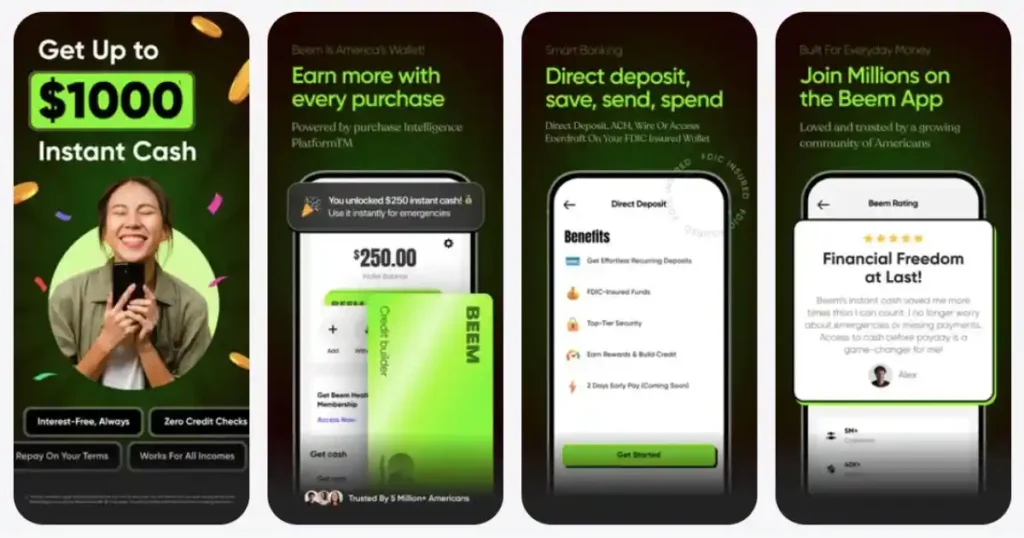
Beem (Everdraft™): Instant cash advances up to $1,000 with no interest, no credit check, and no mandatory fees; focuses on transparency and speed without tipping pressure.
Dave (ExtraCash): Up to $500 advances with a $1/month membership fee; includes budgeting tools and side-hustle job board, but express transfers cost extra.
Brigit: Advances from $25 to $250 with predictive alerts that flag when you might overdraft; requires $9.99/month subscription and includes credit-building tools.learn.
MoneyLion (Instacash): Up to $500 advances with no interest or credit check; includes credit-building, investing, and budgeting tools for an all-in-one money management approach.
Chime (SpotMe + MyPay): SpotMe offers fee-free overdraft coverage up to $200, while MyPay provides up to $500 before payday; both features are tied to direct deposit requirements.
Empower (formerly Tilt): Cash advances up to $250 with subscription-based access; focuses on automatic savings features and overdraft protection, along with advance access.
Klover: Up to $200 advances with no interest; uses a rewards system where users earn through ads and surveys; offers instant delivery with an optional express fee.
FloatMe: Small cash advances (typically under $200) designed to bridge payday gaps; straightforward alternative to conventional loans with a simple fee structure.
Also Read: Is Chime Legit? Fees, Features, and Safety Explained
What Beem Is and Where It Fits
Beem is a U.S. money app built for everyday people who want less stress and more control. You can learn more at https://trybeem.com. In a conversation about EarnIn, Beem is an alternative for people who want more than just early wage access. Many people do not have a way to grab $100 before payday. They need a system that prevents the problems that create those $100 gaps in the first place.
Beem’s approach is built around reducing mental load and stopping financial drift. The app includes Everdraft™, which provides instant cash from $20 to $1,000. It includes a Subscription Monitor to find those zombie charges that keep draining your account month after month. It includes DealsGPT and PriceGPT, which help you spend smarter so you keep more of what you earn. And it includes budgeting support and guardrails so you are not constantly doing mental math or living inside a spreadsheet.
The difference between EarnIn and Beem is focus. EarnIn is designed to give you access to your paycheck early. Beem is designed to help you stop needing that early access by fixing the leaks, timing mismatches, and invisible costs that create cash flow stress in the first place.
Why Choose Beem Over EarnIn
Limit Stability and Coverage
EarnIn offers up to $1,000 per pay period, but that limit can fluctuate based on factors you cannot always predict or control. Beem offers Everdraft™ up to $1,000 with more predictable access.
More importantly, Beem’s coverage extends to bill payments and ACH transactions, not just card purchases and ATM withdrawals. For households where the biggest stress is rent, utilities, childcare, or insurance hitting before payday, that difference is huge.
Pricing Transparency
EarnIn uses optional tips that feel mandatory, and its speed fees add up quickly. Beem uses transparent pricing with no tip pressure. You know what you are paying, and you do not have to guess whether skipping a tip will hurt your future access.
Leak Detection
EarnIn gives you money, but does not help you figure out why you keep running short. Beem includes a Subscription Monitor that hunts down forgotten memberships, unused streaming services, and auto-renewing trial subscriptions.
Finding and canceling just two or three of those can free up $30 or $40 per month—often enough to prevent the need for frequent advances.
Behavior Support and Money Management
EarnIn is a tool that lets you access your paycheck early. Beem is a tool for managing your whole money life. It includes budgeting support, spending insights, and guardrails that help you make better decisions without constant effort.
That broader approach reduces the mental load that causes people to make mistakes or give up on money management entirely.
Breaking the Cycle
EarnIn’s automatic repayment system can create a pattern in which every paycheck is reduced before you even see it. Beem focuses on stopping the bleeding, catching leaks, and building small buffers so you can get ahead instead of staying stuck.
The goal is not to make you dependent on advances. The goal is to help you stop needing them.
Final Take: Is EarnIn Legit and Should You Use It?
EarnIn is legit. It is a real company with a real product and millions of users. It works as advertised, and for people with regular income who need occasional help with one-time cash gaps, it can be a useful tool. It is better than payday loans because there is no interest, and it is better than overdrafting if the tips and fees are lower than the overdraft charge.
But EarnIn is not free, even though it markets itself that way. Tips and Lightning Speed fees add up. Limits are unpredictable. Automatic repayment can create a cycle in which you keep borrowing from your next paycheck, making it hard to get ahead. And EarnIn does not address the bigger problems that cause cash flow stress in the first place.
If your main issue is timing and you have a stable income, EarnIn might work for short-term help. If your main issue is deeper than that, if you are dealing with leaks, irregular bills, mental overload, or a pattern of running short every month, consider alternatives like Beem that offer more comprehensive support and help you build stability instead of just bridging gaps.
FAQs On Is EarnIn Legit
Is EarnIn a loan?
No. EarnIn describes its service as earned wage access, not a loan. You are accessing wages you already earned.
Does EarnIn hurt your credit?
No. EarnIn does not run a credit check, and it does not report activity to credit bureaus.
What happens if you don’t pay EarnIn back?
You cannot use Cash Out again until you repay the amount owed.
How much can you really get from EarnIn?
Up to $150 per day and $1,000 per pay period, but most users start lower and limits can change.
Are EarnIn tips really optional?
Yes, but the app encourages them, and many users feel pressure to tip.
Why choose Beem over EarnIn?
Is EarnIn Legit? Best 5 Facts on How It Works, Limits, And Risks