
Key Summary
For decades, the standard financial advice has been the same: build an emergency fund worth three to six months of living expenses and keep it in a savings account for when life throws something unexpected at you. The advice is sound in theory. In practice, for the majority of working Americans living paycheck to paycheck, it describes a financial safety net that simply does not exist. Instant cash advance apps are stepping directly into that gap, and for millions of people, they have already become the new emergency fund.
This is not a story about bad financial habits or a failure of discipline. It is a story about structural economic reality, the actual lives people are living, and how financial technology has evolved to meet people where they are rather than where a textbook says they should be. Understanding why instant cash advance apps have taken on the role that savings accounts were supposed to play is essential for anyone trying to manage their finances in the real world today.
The Traditional Emergency Fund Problem
The idea behind an emergency fund is straightforward. Set aside three to six months of expenses in a liquid account and draw on it when an unexpected cost arises. A medical bill, a car repair, a sudden job loss, or any number of unpredictable life events can be absorbed without disrupting the rest of your financial life if that fund is properly maintained.
The problem is the math. For a household spending $3,500 per month on rent, food, utilities, transportation, and other essentials, a three-month emergency fund requires $10,500 sitting in a savings account doing relatively little work. A six-month fund requires $21,000. For a household earning $50,000 a year after taxes, accumulating that level of liquid savings while also paying current bills, managing existing debt, and handling the day-to-day costs of living is an extraordinary challenge that can take years to achieve under the best circumstances.
Why Most Americans Cannot Maintain a Full Emergency Fund
Studies consistently show that a significant portion of American adults cannot cover a $400 unexpected expense from savings without borrowing or selling something. This is not a fringe statistic. It reflects the lived financial reality of a broad cross-section of working people, including salaried employees, gig workers, freelancers, parents, recent graduates, and retirees on fixed incomes.
Wages have grown more slowly than housing costs, healthcare expenses, childcare costs, and the general cost of living for decades. The math that once allowed a disciplined middle-income household to build a meaningful savings cushion has become increasingly difficult for a growing share of the population. The emergency fund, as traditionally defined, has become a realistic goal for fewer and fewer people even as the need for financial resilience has grown.
This is the gap that instant cash advance apps are filling, not because they are a perfect substitute for savings, but because they are a practical, accessible, and fast tool that delivers real support when it is needed and nothing else is available.
What Makes Instant Cash Advance Apps the New Emergency Fund
Instant cash advance apps function as on-demand financial bridges. When an unexpected expense arrives between paychecks and savings are not available, a cash advance app delivers funds in minutes rather than requiring a loan application, a credit check, or a visit to a bank branch. This speed and accessibility is precisely what emergency funds are supposed to provide, and it is what cash advance apps deliver in practice.
The parallel to a traditional emergency fund is more direct than it might first appear. A cash advance app does not eliminate the cost of an emergency. It does what an emergency fund does: it makes the money available immediately so the emergency can be addressed before it escalates into something more expensive or more damaging.
A car repair that costs $350 today, left unaddressed because the funds are not immediately available, can become a $900 repair next week when the original problem causes secondary damage. An overdue utility bill that generates a disconnection fee and reconnection charge is more expensive than the original bill would have been. An urgent care visit paid for with a cash advance costs less in total than an emergency room visit paid for after waiting because the immediate care felt financially out of reach. The emergency fund exists to prevent these cost escalations, and so does a cash advance app when used with the same intention.
Speed Is the Core Advantage Over Traditional Savings
The defining characteristic of an effective emergency fund is that it is available immediately when needed. A savings account held at your primary bank satisfies this requirement, though even bank transfers between accounts can take one to two business days in some cases.
A cash advance app satisfies this requirement more reliably and more rapidly than almost any other financial tool available to ordinary consumers. Platforms like Beem deliver funds to the Beem Wallet or a linked debit card in minutes for eligible users. This speed is not a luxury or a novelty feature. It is the core utility that makes the tool valuable in an actual emergency, where waiting even a few hours can mean the difference between a manageable situation and one that has escalated beyond easy resolution.
Why Instant Cash Advance Apps Outperform Payday Loans as Emergency Tools
Before instant cash advance apps became widely available, the most accessible short-term financial tool for people without savings was the payday loan. Payday loans provided fast access to cash but at an enormous cost. Triple-digit effective annual interest rates, rigid two-week repayment cycles, and rollover fees that compound the original obligation quickly turn a small short-term need into a sustained financial burden.
Instant cash advance apps replace the payday loan for most of the situations where people historically turned to them. They provide fast access to small amounts of money to cover immediate needs before the next paycheck arrives. But they do so without the predatory fee structures, without the rollover traps, and without the aggressive collection practices that made payday lending so damaging to the financial health of the users who relied on it.
How Cash Advance Apps Improve on the Payday Loan Model
The most significant structural improvement is the absence of interest. Platforms like Beem charge no interest on advances. Repayment equals exactly the amount borrowed, with no compounding charges and no additional penalty fees for standard repayment timing. This eliminates the mechanism through which payday loans trap users in cycles of repeated borrowing that cost far more than the original advance justified.
Repayment through platforms like Beem is tied to the user’s verified deposit cycle rather than a fixed calendar date that may not align with when income actually arrives. This means repayment happens when the money is there, which dramatically reduces the risk of a missed payment triggering fees or account complications.
The advance amounts available through modern apps also reflect real-world emergency costs more accurately than payday loans typically did. Being able to access anywhere from $10 to $1,000 through a single platform means the advance can be calibrated to the actual size of the emergency rather than being constrained to a fixed amount or pushed toward a larger loan than the situation requires.
Beem: The Best Instant Cash Advance App for Emergency Coverage
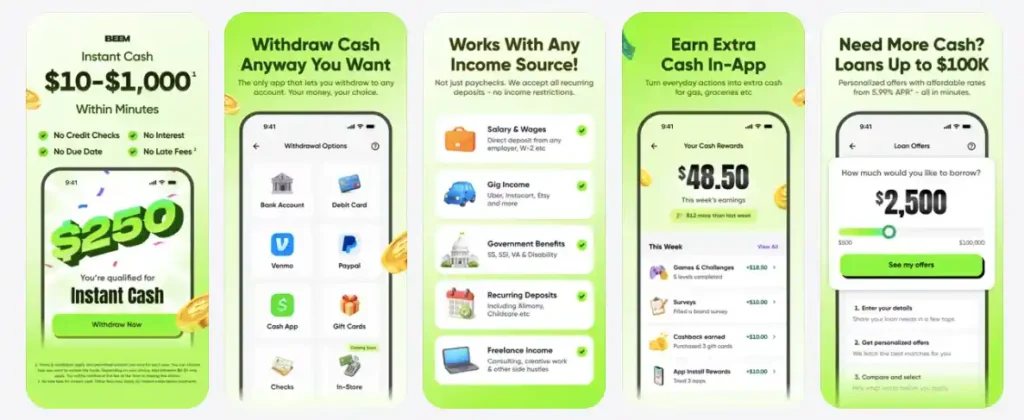
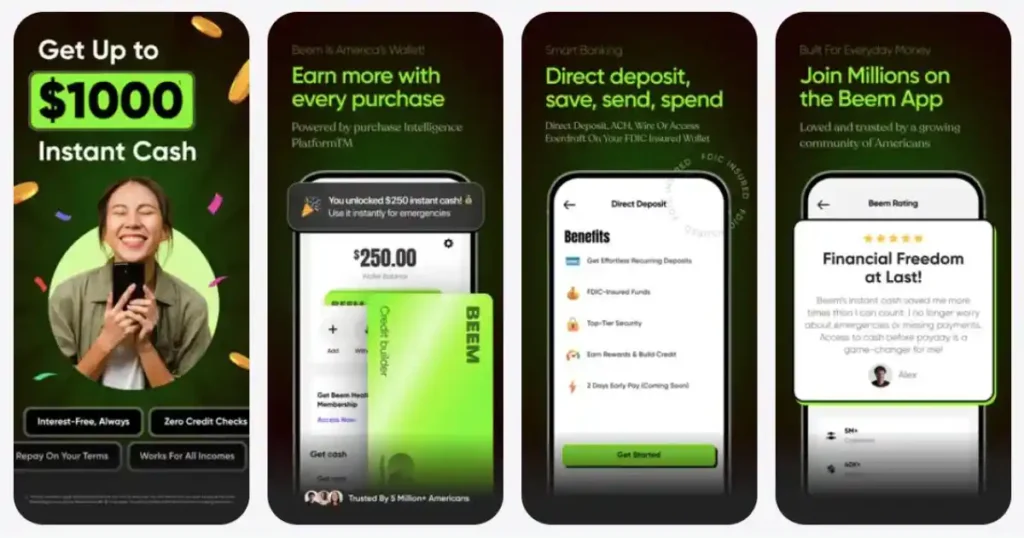
Beem stands out as the most practical instant cash advance option for users who rely on the platform as their primary financial safety net. With Everdraft, eligible users can access between $10 and $1,000 in seconds, with no interest, no credit check, and no rigid repayment deadline that creates pressure regardless of income timing.
For users whose savings account cannot absorb a sudden expense, Beem fills the emergency fund role with a level of speed, flexibility, and cost transparency that no traditional financial product can match at the same price point. Plans start at just $1.99 per month, which is the cost of maintaining access to a financial safety net that delivers up to $1,000 in emergency coverage whenever it is needed.
How Beem Delivers Emergency Cash When You Need It
When an emergency arises, the Beem process takes minutes from start to funds. Eligible users open the app, confirm the advance amount they need, select their preferred payout destination, and receive funds. The payout options include the Beem Wallet for instant access without a bank transfer delay, a linked debit card, a prepaid card, or gift cards from major retailers for users who need immediate purchasing power for a specific type of expense.
This multi-destination payout system is particularly valuable in real emergency situations where the type of payment required is not always a standard bank transfer. A grocery emergency is handled with a gift card or debit card payout. A utility payment is handled with a direct card or wallet transfer. A medical copay can be covered from any payout destination that the provider accepts. Beem’s flexibility means the advance reaches you in the form that is actually usable for the specific emergency at hand.
Beem also offers personal loan comparisons up to $100,000 for users facing larger financial emergencies that exceed what a short-term advance can cover. This gives users a path from immediate small-dollar coverage all the way to substantial structured borrowing through a single platform, which is exactly the range an emergency fund is meant to address across different scales of financial disruption.
Instant Cash Advance Apps vs Savings Accounts: A Real World Comparison
It is worth being direct about what instant cash advance apps are and are not in comparison to a traditional savings account. They are not identical tools, and understanding the distinctions helps users deploy them most effectively.
A savings account, when adequately funded, costs nothing to access and carries no repayment obligation. Every dollar withdrawn is yours, earned and saved in advance. This is the ideal emergency fund scenario and represents the strongest possible financial position. If you have a fully funded emergency savings account, you should use it for emergencies and treat a cash advance app as a secondary backup rather than a primary resource.
The reality for most users, however, is that the savings account is either underfunded, empty, or nonexistent. In that scenario, the comparison shifts. Between an underfunded savings account and a Beem advance at $1.99 per month with no interest and same-day delivery, the cash advance app provides more practical emergency coverage at a lower total cost than most of the alternatives that were historically available to users without savings.
Building Savings and Using Cash Advance Apps Together
The most financially healthy approach is not to choose between building savings and using a cash advance app. It is to do both simultaneously. A cash advance app covers immediate needs while you build toward a savings buffer that will eventually make advance borrowing unnecessary for smaller emergencies.
Beem supports this dual approach through its broader financial ecosystem. BudgetGPT helps users plan spending and identify savings opportunities. The platform’s personal loan comparison tool supports larger financial goals like debt consolidation, which can free up monthly cash flow that contributes to savings growth. Users who use Beem for emergency cash access today are also building better financial habits through the platform’s tools that reduce their reliance on advances over time.
This trajectory, using instant cash access as a bridge while building toward genuine financial resilience, is the most empowering way to use modern financial technology. The goal is not perpetual reliance on advances but using them responsibly while the underlying financial situation improves.
The Demographics Driving the Shift to Cash Advance Apps
The shift toward instant cash advance apps as emergency fund replacements is not happening in a vacuum. It reflects real demographic and economic trends that have reshaped how Americans manage short-term financial risk.
Gig workers and freelancers represent one of the fastest-growing segments of the workforce, and they face unique cash flow challenges that make traditional savings accumulation particularly difficult. Income arrives irregularly, in varying amounts, and often with delays between work performed and payment received. A traditional emergency fund built on the assumption of predictable biweekly income does not map cleanly onto this reality. Instant cash advance apps that evaluate real account activity rather than fixed direct deposit patterns serve gig workers in a way that traditional financial products do not.
Younger Workers and the Emergency Fund Gap
Younger workers entering the workforce in the past decade face a combination of student loan obligations, higher housing costs relative to entry-level salaries, and slower wage growth in real terms than previous generations experienced at the same career stage. Building a three to six month emergency fund while managing existing debt and current living costs is a longer and harder process than it was for earlier generations, and the emergency fund gap among younger workers reflects those structural headwinds rather than a failure of individual financial discipline.
For this demographic, a cash advance app at a low monthly subscription cost provides meaningful emergency coverage during the years when savings accumulation is most challenging. As income grows and debt shrinks, the emergency fund can be built to a level where the advance app becomes a secondary resource rather than the primary one.
How to Use Instant Cash Advance Apps as Your Emergency Fund Responsibly
Using a cash advance app as a primary emergency resource comes with the same responsibility that managing any financial safety net requires. The principles are straightforward and consistent with how any short-term financial tool should be used.
Reserve advance access for genuine emergencies rather than routine spending gaps that reflect a structural budget imbalance. An emergency is an unexpected, non-deferrable expense that creates a real cost if left unaddressed. Everyday spending shortfalls that repeat every month signal a budget issue that an advance cannot solve and that repeated borrowing will eventually compound.
Match the advance amount to the actual emergency cost as closely as possible. Borrowing more than necessary creates a larger repayment obligation for the next income cycle and reduces the headroom for covering regular expenses without needing another advance.
Building Toward a Hybrid Emergency Strategy
The strongest long-term approach combines a growing savings buffer with maintained access to a cash advance app for situations where the savings balance is not yet sufficient. Aim to build a small initial buffer of $200 to $500 in a separate account dedicated to emergency use, using advance access to cover any emergencies that arise while that buffer is being built.
Once the initial buffer is funded, direct additional savings toward growing it toward one month of essential expenses. At that level, most common everyday emergencies can be covered from savings rather than advances, and the cash advance app becomes the secondary resource for larger or more unusual emergencies that exceed the buffer balance.
This graduated approach builds genuine financial resilience over time while ensuring that real emergencies are always covered regardless of the current savings balance.
Read: How to Send Beem Cash Advance to Cash App for Gas Money Emergencies
Why the Financial Industry Is Catching Up to This Reality
The financial industry’s growing attention to instant cash advance apps reflects an acknowledgment that the traditional emergency fund model does not work for a large and growing portion of the population. The question is no longer whether people should have a three to six month emergency fund. The question is what tools provide the best available safety net for people who do not have one yet.
Regulatory interest in the cash advance category, consumer financial protection attention to fee structures and repayment terms, and the rapid growth of platforms like Beem all point toward a market that is responding to a genuine and large unmet need for accessible, fast, and fairly priced emergency financial coverage.
The best platforms in this space are competing on transparency, flexibility, advance limits, and total cost of access. This competition is producing better products and better terms for users, which is precisely the dynamic that produces the most beneficial outcomes for the people who rely on these tools in moments of genuine financial need.
Check out Beem for on-point financial insights and recommendations to spend, save, plan and protect your money like an expert. Download the Beem app today!
FAQs: Instant Cash Advance Apps
Can instant cash advance apps really replace an emergency fund?
For users who do not have savings, instant cash advance apps provide the most practical available substitute for emergency fund coverage. They deliver fast access to funds when unexpected expenses arise, without interest charges or credit requirements. While a fully funded savings account remains the ideal, a cash advance app like Beem offers meaningful emergency coverage at a low monthly cost for users who are still building toward that goal.
How much emergency coverage can I get from Beem?
Beem’s Everdraft feature provides eligible users with instant cash advances from $10 to $1,000 with no interest and no credit check. Plans start at $1.99 per month. For larger financial emergencies, Beem’s personal loan marketplace offers access to loans from $500 to $100,000 through trusted lending partners, covering the full range of emergency financial needs in one platform.
Are instant cash advance apps safer than payday loans for emergencies?
Yes. Modern instant cash advance apps charge no interest, have no rollover fees, and tie repayment to verified income deposits rather than fixed penalty-bearing deadlines. This structure eliminates the primary mechanism through which payday loans trap users in compounding debt cycles, making cash advance apps a meaningfully safer and more affordable emergency financial tool.
Can gig workers and freelancers use instant cash advance apps as emergency funds?
Yes. Platforms like Beem evaluate eligibility based on real account activity and income patterns rather than requiring a fixed direct deposit schedule, making them accessible to gig workers and freelancers whose income is variable or irregular. This inclusive eligibility model is one of the primary advantages cash advance apps have over traditional emergency savings products for non-traditional earners.
Should I still build a savings account if I use a cash advance app?
Yes. The most financially resilient approach combines a growing savings buffer with maintained access to a cash advance app. Use the advance app to cover emergencies while you build savings, then use savings for smaller emergencies once your buffer is funded and reserve the advance app for situations that exceed the savings balance. Beem’s BudgetGPT and financial planning tools support this dual approach by helping users identify opportunities to build savings while maintaining emergency access.