
Key Summary
A credit score around 500 is often treated as a hard stop in traditional financial systems. Most lenders interpret it as high risk, which leads to limited options, higher costs, or outright rejection. Over time, this creates a cycle where access becomes harder precisely when it is needed most.
But a score does not always tell the full story.
A 500 credit score may reflect past challenges such as missed payments, temporary income loss, or unexpected expenses. It may also reflect a thin credit file where there simply is not enough data to generate a higher score. In both cases, the number represents history, not necessarily your current financial reality.
In 2026, that distinction matters more than ever.
Many people with lower credit scores are actively managing their finances better today. They have stabilized income, improved spending habits, and are more aware of how money flows through their accounts. What they need is a system that recognizes this present behavior rather than relying solely on past credit data.
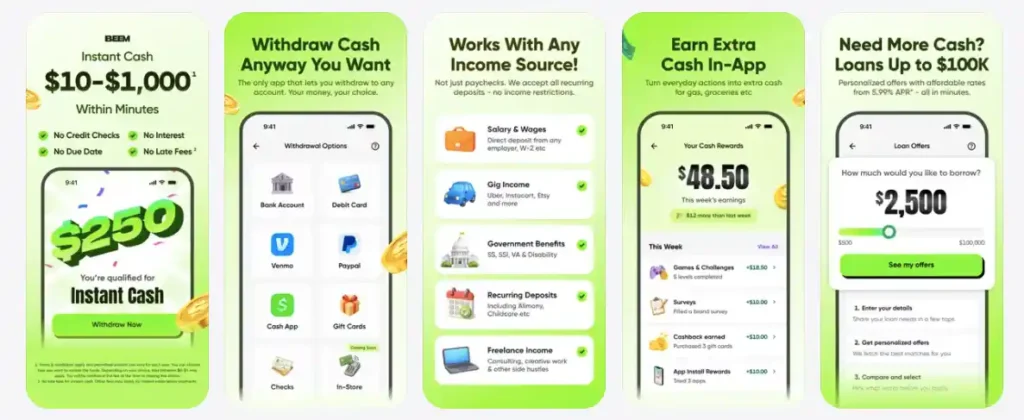
This is where Beem offers a different path. Through Everdraft™, it allows users with a 500 credit score to access cash advances by evaluating real-time financial activity instead of relying on credit checks.
What a 500 Credit Score Typically Means in Traditional Systems
How Lenders Interpret a Low Score
In conventional lending, a credit score around 500 falls into a high-risk category. This classification is based on historical data that suggests a higher likelihood of missed or delayed repayments.
As a result, users with this score often encounter:
- Higher interest rates
- Stricter approval criteria
- Lower borrowing limits
- Frequent rejections
This approach is designed to protect lenders, but it does not always reflect the current financial behavior of the user.
The Disconnect Between Score and Present Stability
A credit score is a summary of past activity. It does not update in real time, and it does not always capture improvements in financial habits.
A user may have experienced financial difficulty in the past but now maintains consistent income and disciplined spending. In such cases, the score lags behind reality, creating a gap between how the user is evaluated and how they actually manage money today.
How Your Financial Trajectory Matters More Than Your Starting Point
One of the most important shifts in a behavior-based system is the emphasis on direction rather than position. A credit score of 500 represents where you have been, but it does not define where you are headed. What matters more is whether your financial behavior shows improvement, consistency, and forward movement over time.
If your account reflects better balance management, more consistent deposits, and fewer disruptions compared to previous months, that progression becomes a meaningful signal. It tells the system that your financial habits are evolving in a positive direction. This concept of trajectory allows users to build eligibility even if their starting point is not ideal, because the focus is on how their financial behavior is developing rather than where it began.

Why Stability in Small Actions Carries Significant Weight
It is easy to assume that only large financial changes make a difference, but in reality, smaller and consistent actions often carry more weight in behavior-based evaluation. Regular bill payments, steady account usage, and controlled day-to-day spending create a pattern that is easier to interpret than occasional large financial events.
These smaller actions build a foundation of predictability. They show that your financial system is not only active but also manageable and sustainable. Over time, this consistency becomes more valuable than sporadic large deposits or temporary improvements, because it reflects habits rather than one-time adjustments.
How Financial Awareness Translates Into Better Eligibility
Financial awareness plays a subtle but powerful role in strengthening your profile. When you are aware of how money flows through your account, including when deposits arrive, how expenses are distributed, and how balances change, you are better equipped to maintain stability.
This awareness leads to more intentional decisions. You are less likely to overspend, more likely to maintain consistent activity, and better able to avoid disruptions in your financial patterns. In a behavior-based system, these improvements are directly reflected in your profile.
Over time, this creates a feedback loop where increased awareness leads to better financial habits, and better habits lead to stronger eligibility. This connection between understanding and access is one of the defining advantages of moving away from credit-based evaluation.
Can You Use Beem With a 500 Credit Score?
The Short Answer With Context
Yes, you can use Beem with a 500 credit score because Everdraft™ does not rely on credit checks as a primary factor in determining eligibility.
However, this does not mean that approval is automatic. It means that your credit score is not the deciding factor. Instead, the system evaluates your current financial behavior.
Why Your Score Is Not the Limiting Factor
Because Beem does not perform a hard credit check, your score does not directly influence your eligibility. This removes one of the biggest barriers present in traditional systems.
What replaces it is a more detailed evaluation of how your finances operate in real time.
What Beem Looks at Instead of Your Credit Score
Beem evaluates a range of behavioral signals that together provide a comprehensive view of financial stability.
Consistency of Deposits and Income Flow
The system looks at whether money enters your account regularly. This does not require a fixed salary or a single employer. Multiple income sources, even if irregular, can still form a consistent pattern over time.
The key factor is continuity. Regular inflows indicate that your financial system is active and functioning.
Frequency and Depth of Account Activity
An account that is actively used provides more insight than one that is dormant. Transactions, bill payments, and everyday spending patterns help build a detailed picture of how you manage money.
This level of activity allows the system to evaluate engagement and consistency.
Balance Stability and Cash Flow Management
Everdraft™ evaluates how well your income and expenses align. Large, unpredictable fluctuations may signal instability, while more controlled patterns suggest thoughtful financial management.
Maintaining a balanced cash flow strengthens your profile significantly.
Spending Behavior and Financial Discipline
Consistent spending patterns, avoidance of extreme fluctuations, and responsible use of funds all indicate discipline. These behaviors are critical in demonstrating reliability.
Continuity of Financial Patterns Over Time
Short-term improvements are not enough. The system looks for patterns that persist over weeks and months. This continuity provides a more reliable indicator of stability.
What You Can Realistically Expect With a 500 Credit Score
Approval Depends on Behavior, Not Score
Your credit score does not determine your eligibility, but your financial behavior does. If your account shows consistent deposits, active usage, and stable spending patterns, you may qualify.
If your activity is inconsistent or limited, it may take time to build a stronger profile.
Initial Access May Be Conservative
In some cases, users with less predictable patterns may receive lower initial access amounts. This is not a limitation based on credit score, but a reflection of how much data the system has to evaluate.
As your financial activity becomes more consistent, your access can improve.
Improvement Over Time Is Possible
One of the key advantages of this model is that it evolves. As your financial behavior becomes more stable and visible, your profile strengthens.
This creates a pathway for gradual improvement rather than a fixed limitation based on past credit.
How to Strengthen Your Eligibility With a Low Credit Score
Build Consistency Through Regular Deposits
When your income does not follow a fixed structure, consistency becomes more important than uniformity. Even if your earnings vary in amount or timing, ensuring that money enters your account regularly helps establish a recognizable financial pattern. Over time, these inflows create continuity, which is one of the strongest signals a behavior-based system can interpret. The goal is not to make your income look identical every time, but to make it visible and ongoing in a way that reflects an active financial life.
Maintain an Actively Used Bank Account
An account that is consistently in use provides a much clearer picture of your financial behavior than one that remains idle for long periods. Regular transactions, bill payments, and day-to-day spending create a detailed activity trail. This allows the system to understand not just that you earn money, but how you interact with it. The more active your account is, the more data there is to evaluate, which improves both visibility and accuracy in assessing your financial stability.
Demonstrate Control Through Balanced Spending
Financial discipline is not defined by how much you spend, but by how consistently and thoughtfully you manage your expenses. When spending aligns with your inflows and avoids extreme fluctuations, it signals control. Large, erratic withdrawals or sudden drops in balance can make your financial behavior appear unpredictable, even if your income is steady. Maintaining a balanced approach to spending helps reinforce the idea that your finances are being managed with intention rather than reacting to short-term pressures.
Avoid Gaps That Disrupt Financial Patterns
Periods of inactivity can weaken your financial profile because they interrupt the continuity that behavior-based systems rely on. Even if your income is irregular, maintaining some level of ongoing activity ensures that your account continues to reflect your financial behavior. This does not mean constant movement, but it does mean avoiding long stretches where there is little to no visible activity. Consistency over time, even in smaller ways, plays a critical role in building a strong and reliable profile.
Comparing Beem With Traditional Options for Low Credit Scores
| Factor | Traditional Lenders | Beem (Everdraft™) |
| Credit Score Requirement | Critical | Not required |
| Interest Rates | Often high | No interest |
| Approval Basis | Past credit history | Current financial behavior |
| Accessibility | Limited | Broad |
| Flexibility | Low | High |
Why This Model Works Better for Users With Low Credit
It Separates Past Financial Events From Present Behavior
A low credit score is often a reflection of past circumstances, not necessarily current habits. Traditional systems tend to treat that history as a fixed indicator of risk, even when a user’s financial situation has improved. Beem approaches this differently by focusing on what is happening now. It evaluates your current financial activity, allowing you to demonstrate stability and responsibility in real time rather than being defined by past records.
It Recognizes and Rewards Financial Recovery
Many users with low credit scores have already taken steps to improve their financial situation. They may have stabilized their income, reduced unnecessary expenses, and developed more disciplined habits. Behavior-based evaluation captures this progress by looking at ongoing patterns rather than historical setbacks. This creates a pathway where improvement is recognized and rewarded, instead of being overshadowed by past challenges that no longer reflect your reality.
It Adapts to the Complexity of Modern Income
Income today is rarely uniform. It often comes from multiple sources, arrives at different times, and varies in amount. Traditional systems struggle to interpret this complexity because they are built around fixed payroll models. Behavior-based systems are designed to handle these variations. By evaluating patterns across multiple inflows and observing how they interact over time, they can identify stability within variability. This makes them far more aligned with how people actually earn and manage money in 2026.
The Bigger Shift in Financial Access
The ability to access funds with a 500 credit score reflects a broader transformation in financial systems.
Income is becoming more dynamic. Financial behavior is increasingly real-time. Users are managing money actively rather than relying solely on long-term credit structures.
By focusing on behavior instead of history, Beem aligns its model with how people actually manage money today.
Conclusion
Having a 500 credit score no longer has to be a barrier to accessing financial tools. Through Everdraft™, Beem provides a way to access cash advances based on how you manage your finances today rather than how your credit history is recorded.
This creates a more inclusive and practical system, allowing users to move forward based on present behavior rather than being limited by past challenges.
FAQs
1. Can I really get a cash advance with a 500 credit score through Beem?
Yes, you can. Beem does not rely on your credit score to determine eligibility. Instead, it evaluates your financial behavior, including your deposits, spending patterns, and account activity. If these factors demonstrate consistency and stability, you may qualify even with a low credit score.
2. Will my credit score affect how much I can access?
No, your credit score is not used to determine your access amount. The amount you can access depends on your financial profile, which is based on your account activity and behavioral patterns. However, if your financial activity is inconsistent, your initial access may be more conservative.
3. How long does it take to build eligibility with a low credit score?
There is no fixed timeline, as it depends on your financial behavior. Consistent deposits, active account usage, and stable spending patterns can help build your profile over time. For some users, this may take a few weeks, while for others it may take longer.
4. Will using Everdraft™ help improve my credit score?
Everdraft™ does not directly impact your credit score because it does not report to credit bureaus. However, it allows you to manage short-term financial needs without relying on high-interest credit products, which can help you maintain overall financial stability.
5. Is this approach better than traditional loans for low credit users?
It depends on your needs. For short-term financial gaps, a behavior-based system like Beem can be more accessible and flexible. For long-term borrowing, traditional loans may still be necessary. The key difference is that Beem provides an option that does not depend on your credit score.