
Key Summary
Arriving in the United States often feels like a reset, especially when it comes to money. You may have spent years building financial discipline, earning steadily, and managing responsibilities in your home country. Yet, the moment you step into the U.S. system, none of that carries over in a way that institutions recognize.
There is no credit score attached to your name. No borrowing history that lenders can evaluate. No established pattern that signals reliability. In practical terms, you are treated as if you are starting from zero.
This is not just a technical limitation. It affects how you manage everyday financial situations. It determines whether you can access short-term support, handle unexpected expenses, or even smooth out timing gaps between income and bills.
It is within this context that Beem positions itself differently. Instead of waiting for you to build a traditional credit profile, it offers access to cash advances through Everdraft™ without requiring a U.S. credit history.
Why Credit History Becomes a Barrier for New Americans
The U.S. financial system is built on a simple premise: past behavior predicts future reliability. Credit scores, repayment records, and borrowing history are used to assess whether someone can be trusted with financial products.
For new Americans, this creates an immediate gap. Even if you have a strong financial track record elsewhere, it does not transfer. You are evaluated based on what you have done within the U.S., and in the beginning, that record does not exist.
This affects more than just large financial decisions. It impacts your ability to access small, practical forms of support that are often needed in the early stages. A short-term cash need, which would normally be manageable, becomes difficult because the system does not yet recognize your financial behavior.
The result is a mismatch. You may be earning, budgeting, and managing responsibly, but without a credit history, those efforts do not translate into access.
The Early Financial Reality: Income Without Access
Many new Americans begin earning soon after arrival, but that income is rarely predictable at first. It may come from freelance work, gig platforms, part-time roles, or transitional jobs that do not follow a fixed schedule.
This creates a pattern where money is coming in, but not always at the right time. Expenses, on the other hand, are immediate and non-negotiable. Rent, transportation, food, and basic living costs demand consistency even when income does not.
Without access to credit, even a short delay in income can create a gap that feels disproportionate to the actual amount involved. This is where the lack of a financial safety net becomes most visible.
Traditional systems are slow to respond because they require history. New Americans, however, need support during the phase where that history is still being built.
How Beem Approaches Cash Access Without Credit History
Beem addresses this gap by shifting the focus away from credit history and toward current financial behavior. Instead of asking whether you have borrowed and repaid in the past, it looks at how you manage money now.
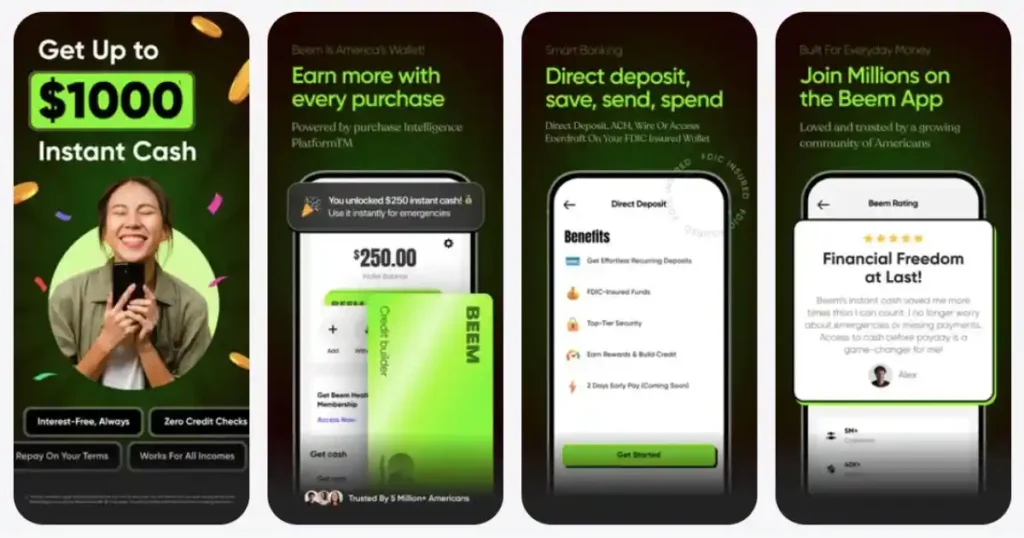
Through Everdraft™, users can access up to $1,000 in instant cash without interest and without relying on a credit score. This makes it particularly relevant for individuals who are new to the U.S. and have not yet had the opportunity to build a credit profile.
The approach is practical. It acknowledges that financial stability is not immediate and that access should not be delayed until after you have proven yourself within the system. Instead, it provides support while you are still in the process of establishing that proof.

Why This Model Works for New Americans
The strength of this model lies in its alignment with real-world conditions. New Americans often operate with irregular income, limited access to traditional tools, and a need for flexibility.
By removing the dependency on credit history, Beem allows users to manage financial gaps without being restricted by factors they cannot control in the early stages. It recognizes that the absence of credit does not equate to financial irresponsibility.
At the same time, it maintains structure through identity verification and account activity analysis. This balance between accessibility and accountability is what makes the model sustainable.
Beyond Access: Building Financial Stability Over Time
While Everdraft™ provides immediate support, it is only one part of the broader journey. As new Americans settle into the system, their financial needs begin to evolve.
Understanding spending patterns, planning ahead, and gradually building a financial profile become more important. This is where Beem’s ecosystem, including tools like the Smart Wallet, begins to add value.
By tracking how money is spent and identifying patterns, users can move from reactive financial management to a more structured approach. Over time, this reduces reliance on short-term support and creates a foundation for long-term stability.
The transition is gradual. It does not require perfection from the beginning, but it does encourage consistency.
What “No Credit History” Really Means in Daily Life
Everyday Financial Friction Shows Up Quickly
For new Americans, not having a credit history is not just a technical limitation that sits quietly in the background. It shows up almost immediately in real-life situations that most people expect to be straightforward. Renting an apartment can become more complicated because landlords may ask for higher deposits or a co-signer. Setting up a phone plan, financing a laptop, or even accessing basic utilities can involve additional verification or upfront payments.
This creates a pattern where simple financial decisions require more effort, more documentation, or more money up front. Over time, this constant friction adds up, not just financially but mentally as well. You are not just managing your expenses; you are navigating a system that has not yet caught up with your actual financial reliability.
Read: Loans With No Credit History: Real Options vs Risky Traps
Why Upfront Costs Become the Norm
Without a credit history, trust is replaced by precaution. Institutions often shift risk back onto you by asking for advance payments, larger deposits, or stricter terms. This means you may end up paying more in the beginning, even if you are financially responsible.
In this context, tools like Everdraft™ become more than just convenience. They act as a bridge that helps you manage these upfront demands without disrupting your overall financial flow. Instead of delaying important decisions or stretching your cash too thin, you gain the ability to move forward with more flexibility while your financial identity is still being built.
The Difference Between Credit Access and Cash Flow Access
Credit Is Based on the Past
Credit systems are designed to evaluate your history. They look at how you have borrowed and repaid over time, using that information to predict your future behavior. For someone new to the U.S., this becomes a challenge because there is no local history to assess.
Even if you have managed finances responsibly in another country, that record does not translate. As a result, access to credit is delayed not because of risk, but because of a lack of data. This creates a waiting period where you are expected to function without the tools that others rely on.
Cash Flow Is About the Present
Cash flow access, on the other hand, focuses on what is happening right now. It is less concerned with your past and more concerned with how money is moving through your account today. This makes it far more relevant for individuals who are in transition.
This is where Everdraft™ fits in. It does not try to replace credit systems or evaluate long-term behavior. Instead, it addresses immediate timing challenges, allowing you to handle expenses when they arise rather than waiting for your financial history to catch up.
Read: Cash vs Credit During a Crisis: What’s Safer?
Why Timing Gaps Are More Common Than Income Gaps
Income Often Arrives Unevenly
In the early stages of settling in the U.S., income is rarely predictable. You may be working multiple jobs, freelancing, or relying on gig platforms where earnings fluctuate based on demand. Even in more structured roles, there can be delays before your first paycheck arrives.
This creates a situation where you are earning, but not always in a way that aligns with your financial obligations. The issue is not the total amount of income, but the timing of when it becomes available.
Expenses Do Not Wait
While income may vary, expenses remain fixed and consistent. Rent is due on a specific date. Bills follow a schedule. Daily living costs continue regardless of your earnings cycle.
This mismatch is what creates financial pressure. Even a short delay in income can lead to a gap that feels larger than it actually is. Recognizing this helps shift your focus from simply earning more to managing timing more effectively, which is where tools like Everdraft™ become particularly useful.
Creating a Financial Cushion Without Large Savings
Access Can Act as a Temporary Buffer
In an ideal situation, savings would act as your financial cushion. However, for new Americans, building savings takes time, especially when initial expenses are high. During this phase, having access to a reliable fallback option can serve a similar purpose.
Everdraft™ can function as that temporary buffer, helping you handle unexpected expenses or timing gaps without disrupting your financial stability. It allows you to maintain continuity while you work toward building your own reserves.
Transitioning Toward Real Savings
Over time, as your income becomes more stable, the goal is to shift from relying on access to relying on savings. This transition does not happen overnight, but it is a natural progression.
As your financial situation improves, you begin to set aside small amounts regularly. These gradually replace the need for external support, creating a more sustainable and self-reliant financial structure.
Comparing Beem With Traditional Credit-Based Options
| Factor | Traditional Systems | Beem (Everdraft™) |
| Credit History | Required | Not required |
| Approval Basis | Past financial behavior | Current financial activity |
| Access Speed | Often delayed | Immediate |
| Interest Charges | Common | No interest |
| Suitability for New Americans | Limited initially | High |
This comparison highlights a key difference. Traditional systems prioritize history, while Beem prioritizes accessibility during the absence of that history.
Using Cash Advances Without Creating Dependency
Access to cash advances can be helpful, but it is important to use them with a clear understanding of their role. Everdraft™ is designed to handle short-term gaps, not to replace income or serve as a long-term financial solution.
For new Americans, this means using it strategically. When income timing creates a challenge or when an unexpected expense arises, it can provide stability.
However, as income becomes more consistent and financial awareness improves, reliance on such tools should decrease. The goal is not to depend on access, but to use it as a bridge toward independence.
What New Americans Should Keep in Mind
The absence of a credit history is temporary, but its impact is immediate. Navigating this phase requires tools that align with your current situation rather than waiting for your profile to catch up.
Beem offers one such tool, but it works best when combined with a broader approach. Building consistency in income, maintaining an active bank account, and gradually establishing a financial footprint all contribute to long-term stability.
Understanding how and when to use available tools is what ultimately determines how smoothly this transition unfolds.
Conclusion
For new Americans, the challenge is not the ability to manage money, but the lack of recognition within a system that relies on history.
Beem addresses this by offering access to cash advances without requiring a U.S. credit history. Through Everdraft™, it provides a way to manage financial gaps while you are still building your place within the system.
More importantly, it does so in a way that reflects how financial stability actually develops. Step by step, with access that supports progress rather than waiting for it.
FAQs
1. Can I use Beem if I have no credit history in the U.S. at all?
Yes, you can. Beem does not rely on your U.S. credit history to provide access to Everdraft™. Instead, it focuses on your current financial activity, which makes it accessible for new Americans who are still in the early stages of building their financial profile.
2. How much can I access through Everdraft™ without a credit score?
You can access up to $1,000 in instant cash, depending on your eligibility. The amount is determined based on your financial activity rather than your credit history, which allows users without a credit score to still qualify.
3. Do I need a full-time job to use Beem?
No, a full-time job is not required. Beem is designed to work with different types of income, including freelance, gig, and part-time earnings. This flexibility makes it suitable for users whose income is not fixed.
4. Is Everdraft™ better than using a credit card?
They serve different purposes. Credit cards depend on your credit history and often come with interest charges, while Everdraft™ does not require a credit score and does not charge interest. For new Americans without credit, Everdraft™ can be more accessible.
5. Will using Beem help me build my credit history?
Everdraft™ itself is not designed as a credit-building tool. However, it can help you avoid missed payments and financial stress, which supports your overall financial stability as you begin building your credit profile through other means.