
What You Will Get At Glance
Artificial intelligence has revolutionized the way people manage their finances. Modern banking apps now use AI to help you borrow smarter, avoid unnecessary fees, and strengthen your credit over time. Learning how to use AI Banking Apps becomes an increasingly important skill as these tools continue to transform everyday financial decision-making.
The best part is that you don’t need financial expertise to benefit from these tools. With the right habits and the right app, you can turn short-term borrowing into a stepping stone toward long-term financial improvement.
This guide walks you through how AI-driven banking apps work, how to borrow responsibly, and how to utilize automated insights to build a strong credit history without stress.
Why AI Matters in Everyday Banking
AI in personal finance isn’t about complex algorithms hidden behind the scenes. It manifests in simple, practical ways that influence your daily decisions. For example, an AI-powered app can predict when your balance might dip below a safe amount, offer personalized borrowing limits, or automatically guide you toward healthier habits. These tools help you avoid overdrafts, late payments, and unnecessary interest, all of which can negatively affect your financial health and your credit score.
AI also helps analyze your spending patterns to understand your real cash flow. This provides recommendations that actually align with your lifestyle, rather than generic, one-size-fits-all advice.
Also Read: Smart Ways to Manage Cash Flow and Credit Together
The Link Between Responsible Borrowing and Good Credit
Borrowing isn’t inherently bad. In fact, when used thoughtfully, small loans and credit-building tools can help you establish payment history, diversify your credit profile, and strengthen your overall score.
Good credit is built on consistent, responsible behavior. This includes:
- Making payments on time every month
- Keeping balances manageable
- Avoiding frequent overdrafts
- Using credit products designed to improve your financial record
AI banking apps make these steps simpler by automating reminders, optimizing payment schedules, and helping you avoid risky borrowing choices.
How AI Banking Apps Help You Borrow Wisely
AI-driven banking apps like Beem are designed to guide you toward safer borrowing habits without overwhelming you with technical details.
They analyze your day-to-day financial activity in the background and provide recommendations that align with your actual cash flow.
This creates a more personalized experience and helps you avoid common pitfalls, such as borrowing too much, paying unnecessary fees, or missing repayment deadlines. Here’s how these tools work behind the scenes to protect your financial health.
Personalized Borrowing Limits
One of the biggest advantages of AI banking apps is their ability to tailor borrowing limits to your actual financial behavior. Instead of giving every user the same advance amount, the app reviews your deposit history, average balance, spending habits, and repayment patterns to determine your eligibility.
It uses these details to estimate how much you can realistically borrow without putting yourself in a difficult position.
This personalized limit acts as a safeguard. It helps you avoid overextending your budget, reduces the risk of late payments, and gives you access to only what you can comfortably manage.
By keeping borrowing amounts in line with your cash flow, AI makes short-term lending far more responsible and predictable.
Automatic Predictions to Prevent Shortfalls
Most people encounter financial stress because they don’t anticipate a shortfall. AI banking apps solve this problem by scanning your upcoming bills, expected deposits, and day-to-day spending patterns.
When the system detects a future dip, for example, a low balance before payday or a month with higher-than-usual expenses, it warns you in advance.
These early alerts give you time to adjust. You might consider cutting back on optional spending, transferring funds from savings, or using a small cash advance before the situation becomes urgent.
This proactive approach helps you avoid overdraft fees and late charges, making your borrowing choices intentional instead of reactive.
Transparent Repayment Timelines
A major source of financial anxiety is not knowing exactly when and how much you need to repay. AI-powered banking apps eliminate the guesswork of repayment by generating clear, customized timelines tailored to your income cycle and spending patterns.
Instead of offering a generic repayment date, the app aligns your repayment schedule with your next paycheck or your typical cash flow. This makes it easier to budget, stay organized, and set money aside in advance.
When repayment becomes predictable instead of stressful, it’s easier to avoid missed deadlines and keep your financial record healthy.
Spending Insights for Better Decision-Making
AI doesn’t just help with borrowing, it helps you understand how your money moves. The app tracks your spending across categories and highlights patterns you may not notice on your own.
Perhaps you’ve been spending more on takeout, or your weekend shopping habits have increased. Perhaps you’re paying for subscriptions you don’t use.
By highlighting these trends, the app provides a clearer picture of where your money is going. These insights help you make intentional decisions that reduce the need for frequent borrowing.
They also empower you to redirect money toward savings, credit-builder payments, or other financial goals.
Using AI Banking Apps to Build and Improve Credit
Consistency Through Automation
Credit scores get stronger when you follow steady habits every month. AI banking apps make this easier by automating important tasks related to your credit.
They can set up recurring payments, track due dates, and maintain healthy balances on your credit-builder accounts. When these routines run automatically, your financial behavior appears consistent, which credit bureaus see as a sign of reliability.
Smart Use of Credit-Builder Cards
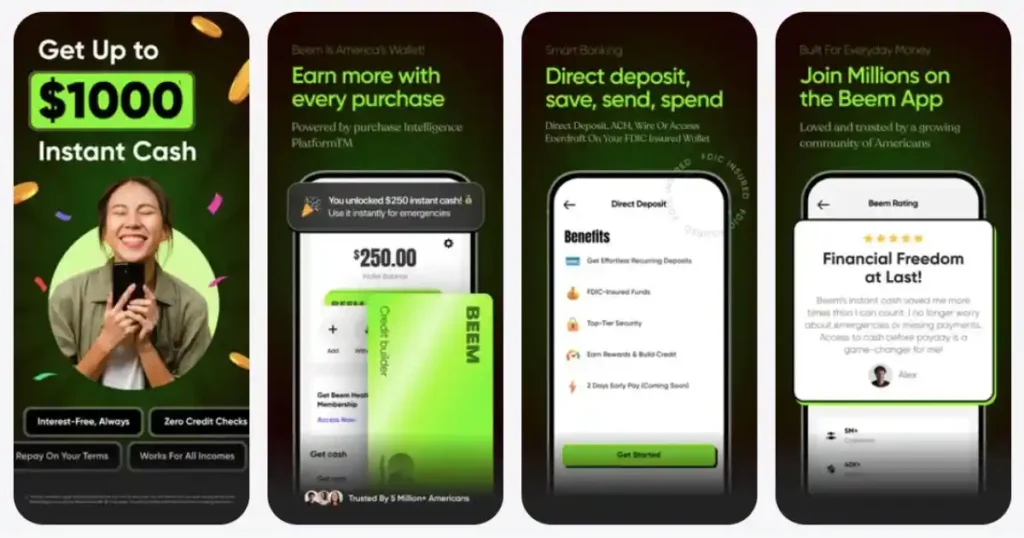
Using a Beem’s credit-builder card is one of the easiest ways to establish a positive payment history. AI banking apps make this process even smoother by guiding you on how to use the card.
They analyze your income, spending habits, and available balance. Based on this information, they suggest how much you should spend on the card each month. They also help you choose the best time to pay it off.
These small adjustments help keep your utilization low, which is crucial for maintaining a healthy credit score. With AI helping you stay on track, you can build credit without the risk of overspending.
Payment Alerts and On-Time Reminders
Late payments can impact your credit for years. AI banking apps help prevent this by giving clear reminders before a bill is due.
They send alerts when a payment date is approaching or when a balance needs attention. These notifications help keep you organized and protect your payment history, which is a significant component of your credit score.
Insights That Encourage Positive Habits
Credit improvement takes time, and it is not always obvious which actions have the most significant impact. AI banking apps simplify this process by providing insights into how your habits impact your score.
They break down your spending, payment patterns, and account activity. They highlight what is working well and what needs improvement. Even small changes, such as lowering balances or keeping older accounts open, can make a noticeable difference.
With clear insights, you gain the confidence to maintain habits that support steady and long-term credit growth.
How to Borrow Responsibly With AI Apps: A Step-by-Step Guide
Step 1: Know Your Cash Flow
Open your app and find the cash flow or forecast screen. Read it every time you think of borrowing.
The app will show upcoming paychecks, scheduled bills, and expected spending. Look for dates and amounts. Note any shortfalls. A shortfall occurs when the expected outgoing money exceeds the incoming money before your next deposit.
Example. Your app predicts a $150 shortfall five days before payday. That is a real signal to act.
If you see a shortfall, pause. Ask if you can delay a nonessential purchase. See if you can move a payment or use a small transfer from savings. Many AI apps let you simulate changes. Run that simulation. If adjusting spending covers the gap, do that instead of borrowing.
If you must borrow, use the app’s suggested safe amount. The app bases that number on your deposit history and repayment record. It is not a challenge to borrow more. It is a safety limit.
Checklist for step 1
- Open cash flow forecast.
- Mark the date and amount of any shortfall.
- Run any available simulation.
- Try to cut or postpone nonessential spending first.
Step 2: Borrow Only What You Need
Borrow to solve a problem. Do not borrow to improve your lifestyle. Small, targeted borrowing prevents higher costs later.
Decide the exact amount you need. Round up slightly to avoid an immediate second advance, but be conservative. If a bill is $120 and you have $20, borrow $100, not $200.
AI will often recommend an amount. Trust that recommendation if you are comfortable with it. The AI considers how much you typically repay and how quickly you receive payment.
Example. You need $85 for a car repair part. The app recommends $100. You accept $100, so you are covered for tax or shipping. You set the repayment for your next paycheck.
Avoid repeatedly topping up advances. That pattern raises your fees and can indicate unstable cash flow.
Quick rules of thumb
- Borrow only for essentials.
- Round up modestly to avoid repeat borrowing.
- Avoid taking more than 30 percent of your next net paycheck in advances.
Step 3: Choose Transparent Repayment Options
Before accepting an advance, review the repayment terms. Look for total cost, due date, and any fees.
Select a repayment plan that aligns with your pay schedule. If you are paid biweekly, choose a repayment date within that same pay cycle. If the app offers split payments, use that to reduce strain.
Watch for two traps. First, variable fees that change without a clear reason. Second, repayment windows that extend past your next deposit. Both can put you at risk of late payment.
Example. An app offers two options for a $200 advance. Option A charges a $6 fee and is due in 7 days. Option B has a $0 fee but rolls interest daily until paid. In most cases, the fixed fee is clearer and more cost-effective for short-term advances.
If multiple repayment options confuse you, choose the simplest option that allows for quick repayment. Transparency beats a lower up-front fee with hidden long-term costs.
Questions to answer before accepting
- What is the total cost to repay?
- When will the funds be withdrawn?
- Does the app report missed or late repayments to credit bureaus?
Step 4: Automate Repayments
Set repayment to autopay whenever possible. Automation eliminates human error and prevents missed payments that can harm credit.
Link the app to the account that receives your paycheck. Confirm that the account has sufficient funds to cover the repayment on the scheduled date, plus a small buffer. The buffer prevents failed transfers and extra fees.
If you prefer manual control, at least set two reminders. One reminder three days before the repayment date. A second reminder one day before. Set those reminders to repeat until the repayment is cleared.
How to set it up
- Tap repayment or autopay in the advance details.
- Choose the account tied to direct deposit.
- Set a $25 to $50 buffer if the app allows it.
- Confirm your notification settings to receive pre-debit alerts.
Example. You set autopay for a $120 advance. Your app debits the day after your direct deposit posts. The buffer prevents a failed payment when a small authorization holds funds for a merchant.
Step 5: Review AI Spending Insights Weekly
Make a habit of checking the app’s insights weekly. Do not treat these reports as optional. Weekly reviews catch trends before they become problems.
Look for category spikes. Food delivery, rides, streaming, and subscriptions are common culprits. The AI will often flag unusual increases in activity. Use those flags to make small cuts.
Check recurring charges. Cancel unused subscriptions. Move annual payments to a sinking fund so they do not surprise you.
Utilize the AI to establish a weekly savings goal. Even $5 or $10 each week reduces future borrowing. Over the course of three months, a small weekly amount becomes a useful cushion.
A simple weekly checklist
- Open the insights tab.
- Note any category up by more than 20 percent versus last month.
- Pause or downgrade one recurring subscription if needed.
- Set aside a small amount for a savings goal to cover emergencies.
Final practical tips
Keep one emergency rule. No advances for lifestyle upgrades. Use advances for short-term cash gaps only. Build a small emergency fund equivalent to one week of your net pay. That buffer reduces the need to borrow.
Track your progress. Every month, check how many advances you used. If you used more than one in a month, treat that as a warning and revisit your budget.
If the app offers coaching or budgeting nudges, try them for 30 days to see if they’re effective. AI nudges are most effective when you follow through on them.
Also Read: How Beem’s AI Wallet Turns Everyday Banking Into Credit Growth
Turning Borrowing Into a Credit-Building Opportunity
AI can turn a simple cash advance into an opportunity to prove your reliability. When you borrow a small amount and repay it on time, you’re building a track record of responsible behavior. With apps that offer integrated credit-building tools, this pattern gets reported to credit bureaus and helps improve your score.
For example:
- Use a credit-builder card for small, manageable purchases.
- Pay the full balance every month.
- Avoid maxing out the card.
- Keep your credit utilization low.
- Let AI track your habits and adjust suggestions as your score grows.
These habits build a positive credit profile without the stress of traditional credit cards or high-interest loans.
Common Pitfalls to Avoid When Using AI Banking Apps
Borrowing Too Frequently
Even with smart AI tools, borrowing too often creates dependency. Treat advances as short-term solutions, not everyday funding.
Ignoring Notifications
AI alerts are designed to protect you. When the app flags unusual spending or upcoming shortfalls, take it seriously.
Missing Payments
Missed payments can damage your credit and create unnecessary fees. Utilize your app’s auto-debit features to maintain consistency.
Overlooking Fees
AI helps you avoid hidden charges, but it’s still important to review terms before taking an advance or enabling a feature.
How AI Can Help You Stay Out of Debt Cycles
A major advantage of AI banking apps is their ability to detect patterns that might put you at risk. For example, if you consistently borrow before payday, the app can recommend budgeting changes or automated savings goals to help break the cycle. AI-driven suggestions can:
- Help identify overspending categories.
- Suggest small weekly savings that build into an emergency fund.
- Predict when recurring bills might put pressure on your balance.
- Recommend ways to reduce reliance on advances.
Over time, these insights help you stay in control, rather than feeling like you’re always playing catch-up.
How to Maximize the Credit Benefits of AI Tools
Use the App Daily
Small interactions, checking balance forecasts, reviewing insights, or swiping your credit-builder card, help keep you engaged and consistent.
Link Direct Deposits
Apps work best when they can see your income patterns. Direct deposit enables AI to provide more accurate predictions and effective credit-building plans.
Keep Your Spending Predictable
AI thrives on patterns. When your spending is relatively stable, recommendations become more precise and helpful.
Set Long-Term Credit Goals
Whether you want to reach a higher score or qualify for a better financial product, AI can help monitor your progress and adjust suggestions as needed.
Final Thoughts on How to Use AI Banking Apps
AI banking apps can help you borrow responsibly and build credit without stress, but the true power comes from pairing smart tools with smart habits. When used correctly, AI can keep you ahead of shortfalls, guide your borrowing decisions, and create a path toward long-term credit growth.
By understanding your cash flow, borrowing only what’s necessary, automating repayments, and using credit-builder tools consistently, you can turn everyday banking into a strategy for financial resilience. AI isn’t a shortcut; it’s a guide that keeps you on track and helps you stay in control of your money and your credit future. Download the Beem app to explore the best financial strategies to boost your credit.