

Key Summary
Yes. If you receive Social Security Disability Insurance (SSDI) benefits and those payments are deposited into your bank account, you can qualify for a cash advance through Beem. Everdraft™ does not require employment, a W-2, or payroll verification.
It reads your bank account activity, and SSDI deposits are some of the most consistent, predictable income that exists. Here is everything SSDI recipients need to know about using Beem.
Why SSDI Recipients Struggle to Get Cash Advances
SSDI is a federal benefit paid to people who cannot work due to a qualifying disability. The Social Security Administration sends payments monthly, typically on the same date each month based on your birth date. The amount is determined by your lifetime earnings record and can range from a few hundred dollars to over $3,800 per month in 2026.
Despite being a reliable, government-backed income source, SSDI creates problems with most cash advance apps for one reason: it is not employment income.
When a cash advance app asks you to verify your employer, connect a payroll account, or upload pay stubs, SSDI recipients have nothing to provide. The Social Security Administration is not an employer. There is no payroll processor.
There are no pay stubs in the traditional sense. The income is real, consistent, and guaranteed by the federal government, but it does not fit the template that most cash advance apps were built around.
This creates an absurd situation. Someone receiving $2,200 per month from the federal government on a perfectly predictable schedule gets rejected by an app that would approve someone earning the same amount from an employer whose business could fold next month. The approval criteria have nothing to do with financial reliability and everything to do with outdated system design.
How SSDI Income Works With Everdraft™
Beem’s Everdraft™ evaluates your linked bank account activity. It does not ask where deposits come from. It assesses how they behave. SSDI deposits happen to behave in a way that Everdraft™ reads extremely favorably.
Predictable Deposit Schedule
SSDI payments follow a fixed monthly schedule set by the Social Security Administration. If your birth date falls on the 1st through the 10th, your payment arrives on the second Wednesday of the month. The 11th through the 20th gets the third Wednesday.
The 21st through the 31st gets the fourth Wednesday. And if you started receiving benefits before May 1997, your payment arrives on the 3rd of every month.
This clockwork schedule means Everdraft™ sees a deposit arriving on essentially the same date every single month. Very few income sources produce this level of regularity. From a bank account analysis perspective, SSDI is among the strongest deposit patterns Everdraft™ encounters.
Consistent Deposit Amount
SSDI payments are the same amount each month unless there is an annual cost-of-living adjustment (COLA), a change in your Medicare premium deduction, or a benefit recalculation. For most recipients, the deposit amount stays identical for months or even years at a time.
Everdraft™ reads this consistency as a strong stability signal. There are no fluctuations to account for, no seasonal dips, and no risk of a payment not arriving. The amount that hit your account last month will hit your account next month.
Government-Backed Reliability
SSDI is funded by the Social Security Trust Fund. Payments continue as long as you remain eligible. There is no employer who might lay you off, no client who might not renew a contract, and no platform that might change its payout terms. This is as close to guaranteed recurring income as exists in the American financial system.

Step-by-Step: Getting a Beem Cash Advance on SSDI
The process for SSDI recipients is the same as any other Beem user, which is part of the point. There is no separate workflow, no disability documentation to upload, and no special application.
Step 1: Download Beem and Create Your Account
Set up your Beem profile with basic information. At no point during signup will you be asked for an employer name, a disability determination letter, or any documentation related to your SSDI status.
Step 2: Link the Bank Account Where Your SSDI Deposits Land
Connect the checking account that receives your monthly SSDI payment. If you receive your benefits on a Direct Express card rather than a bank account, you will need to switch to bank direct deposit first, which can be done through the Social Security Administration at ssa.gov or by calling 1-800-772-1213.
Step 3: Everdraft™ Evaluates Your Account
Once linked, Everdraft™ reviews your recent deposit and spending history. Your monthly SSDI deposits will be visible as recurring, consistent income. The system also evaluates your spending patterns and overall account stability.
Step 4: Access Your Cash Advance
Based on the evaluation, Everdraft™ determines your eligible amount, up to $1,000. You can request an advance whenever you need it. No additional verification steps. No disability paperwork. No waiting on a third party.
Download Beem and put your SSDI benefits to work for you
Common Situations Where SSDI Recipients Need a Cash Advance
Living on a fixed disability income means there is very little margin for the unexpected. These are the real-world situations where a cash advance on SSDI becomes essential.
Medical Expenses Between Benefits Payments
SSDI recipients often have higher-than-average medical costs. Even with Medicare coverage, copays, prescription costs, medical equipment, and uncovered treatments add up.
When a medical bill arrives two weeks before your next SSDI deposit, a cash advance prevents the choice between health and other essentials.
The Gap Between Monthly Payments
SSDI pays once per month. That is a long stretch compared to the biweekly pay most financial products are designed around. If an unexpected expense hits in the first week after your deposit and depletes your balance, you are looking at three full weeks before the next payment. Everdraft™ bridges that gap without requiring you to take on high-interest debt.
Home and Vehicle Repairs
A broken appliance, a plumbing emergency, or a car repair cannot wait until next month’s deposit. For SSDI recipients who rely on their vehicle for medical appointments or who live independently, these repairs are urgent and non-negotiable.
Benefit Payment Delays
While rare, SSDI payment delays do happen. Administrative processing errors, bank holidays shifting deposit dates, or issues with the Social Security Administration can push a payment back by several days. When your entire monthly budget depends on a single deposit, even a two-day delay can create a crisis.
Seasonal Cost Increases
Heating bills in winter, cooling bills in summer, and holiday expenses all create periods where a fixed SSDI payment does not stretch as far as it normally does. A cash advance provides breathing room during these predictable but unavoidable cost spikes.
Will a Cash Advance Affect My SSDI Benefits?
This is one of the most important questions SSDI recipients ask, and rightfully so. The answer depends on which type of Social Security disability benefit you receive.
SSDI (Social Security Disability Insurance)
SSDI is based on your work history and is not means-tested. This means your eligibility is not affected by how much money you have in your bank account or whether you receive a cash advance. An Everdraft™ advance will not impact your SSDI benefit amount or your continued eligibility.
SSI (Supplemental Security Income)
SSI is different. It is a needs-based program with strict asset limits. As of 2026, the individual asset limit for SSI is $2,000 ($3,000 for couples). A cash advance that causes your countable resources to exceed this threshold, even temporarily, could affect your SSI eligibility.
If you receive SSI rather than SSDI, or if you receive both (known as concurrent benefits), you should be mindful of how a cash advance interacts with your asset limits. The safest approach is to request only what you need immediately and spend or allocate the funds before your next SSI resource review date.
This is an important distinction. SSDI recipients can use Everdraft™ without benefits concerns. SSI recipients should plan their advance timing carefully around asset limits.
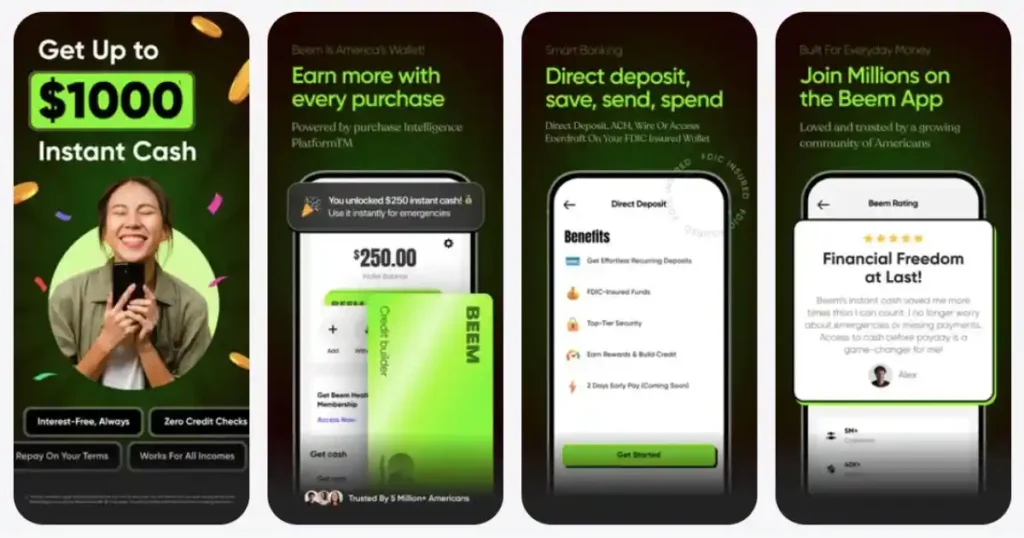
SSDI and Beem
SSDI recipients have reason to be cautious with financial apps. Disability benefit recipients are disproportionately targeted by predatory lenders, scam cash advance services, and high-fee financial products. Here is why Beem earns trust with this community.
No Interest and No Hidden Fees
Everdraft™ cash advances carry no interest charges. There are no hidden fees that appear after you accept the advance. What you receive is what you repay. For SSDI recipients who have been burned by payday lenders that turned a $300 advance into a $500 repayment, this transparency matters.
No Hard Credit Check
Many SSDI recipients have limited or damaged credit histories. Medical debt, periods of unemployment before receiving disability approval, and the financial strain of living on fixed income all take a toll on credit scores. Beem does not factor your credit score into the Everdraft™ eligibility decision. Your bank account activity is the only input.
No Employer Required, No Disability Disclosure Required
Beem never asks why you are not employed. There is no field for disability status. No request for a determination letter. No question about your medical condition. The app treats you as a person with income in a bank account, full stop. For SSDI recipients who are tired of being defined by their disability status in every financial interaction, this neutrality is a relief.
Clear Pricing Up Front
Beem’s pricing is published and transparent. You can see exactly what each plan includes before committing. There are no escalating fees, no surprise charges after your first advance, and no pressure tactics designed to extract more money from people on fixed incomes.
Tips for SSDI Recipients to Maximize Everdraft™ Eligibility
Your SSDI deposits alone may qualify you, but these practical steps can strengthen your profile.
Use One Primary Bank Account
If your SSDI deposits go to one account but you spend from another, Everdraft™ only sees the account you link. Consolidate your financial activity into the account that receives your SSDI payment so the system gets the fullest picture of your income and spending.
Avoid Overdrafts Around Your Payment Date
If your account regularly overdrafts in the days before your SSDI deposit, it signals that your monthly spending consistently exceeds your income. Timing your larger expenses closer to your deposit date and spreading smaller expenses across the month can improve your account stability profile.
Supplement With Any Additional Income
If you earn any supplementary income within SSDI’s allowable work limits (such as through a Trial Work Period or earning below the Substantial Gainful Activity threshold), those deposits add to your bank account activity and can strengthen your Everdraft™ eligibility.
Keep Your Bank Account Active
An account that only shows one SSDI deposit and one or two large withdrawals per month provides limited data. Using your linked account for regular transactions gives Everdraft™ a richer behavioral profile to work with.
Get started with Beem. Your SSDI benefits are all you need
People Also Ask
Can you get a cash advance on SSDI benefits?
Yes. Beem’s Everdraft™ allows SSDI recipients to access cash advances up to $1,000. SSDI deposits in your linked bank account are recognized as consistent income. No employment verification, payroll connection, or credit check is required.
Will a cash advance affect my SSDI benefits?
No. SSDI is not a means-tested benefit, so receiving a cash advance does not impact your benefit amount or eligibility. However, SSI recipients should be cautious about asset limits ($2,000 individual / $3,000 couple) and should plan advance timing accordingly.
What cash advance app works with SSDI income?
Beem is one of the best cash advance apps for SSDI recipients. Everdraft™ evaluates bank account activity rather than requiring employment or payroll verification, which makes it fully compatible with monthly SSDI deposits. Eligible users can access up to $1,000.
Does Beem require you to disclose a disability?
No. Beem does not ask about disability status, medical conditions, or reasons for not being employed. Everdraft™ eligibility is based entirely on your linked bank account activity. Your SSDI deposits are evaluated the same as any other consistent income source.
Can SSI recipients use Beem for a cash advance?
SSI recipients can use Beem, but should be aware of SSI’s asset limits. A cash advance that causes your countable resources to exceed $2,000 ($3,000 for couples) could temporarily affect your SSI eligibility. Request only what you need immediately and spend the funds before your next resource review.
How much can SSDI recipients get from Everdraft™?
SSDI recipients can access up to $1,000 through Everdraft™. Your specific eligible amount depends on your bank account activity, including your SSDI deposit amount, spending patterns, and overall account stability.
The Bottom Line
SSDI benefits are real income. They are consistent, government-backed, and predictable. The fact that most cash advance apps cannot process them is a failure of those apps, not a reflection of your financial standing.
Beem built Everdraft™ to work with bank account activity rather than payroll data, which means your monthly SSDI deposit is all you need to qualify. No employer. No payroll. No credit check. No disability disclosure. Just your bank account and the income that already lands in it every month.