
Key Summary
If you work in a restaurant, bar, or hospitality environment, your financial life operates by a different set of rules than the one most financial apps are designed around.
Your income does not arrive in neat biweekly deposits. It arrives in cash, at the end of a shift, in amounts that vary with the day of the week, the weather, the season, and whether the kitchen had a good night. Some weeks are strong. Some weeks are slow. And the financial tools built around fixed salary deposits were not built with you in mind.
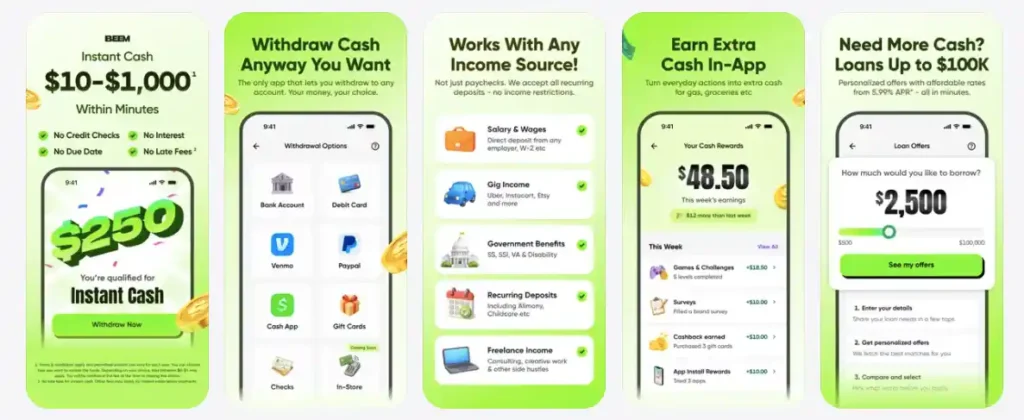
Beem was. Not as an afterthought or a marketing claim, but structurally, in the way its income verification works, in the way its AI tools model variable earnings, and in the way Everdraft™ provides a no-interest, no-credit-check bridge that does not require you to prove your income through a W-2 or a predictable direct deposit schedule.
This article explains exactly how Beem works for tipped workers, what you need to set up, what to expect from the platform given your specific income structure, and why the financial tools built for salaried workers have failed tipped employees for so long.
The Financial Reality of Tip Income That Nobody Talks About
Variable Income Is the Norm, Not the Exception
Tipped workers in the United States earn a federal tipped minimum wage as low as $2.13 per hour in states that allow tip credits. In practice, experienced servers and bartenders at busy establishments earn significantly more, but income variability is real and significant.
A bartender in a college town earns dramatically more during the academic year than during summer. A convention center server earns dramatically more during events than between them. These are not small fluctuations. They can represent 40 to 60 percent swings in weekly income between peak and slow periods.
The Invisibility Problem
A significant portion of tip income arrives as physical cash at the end of each shift. Cash income is real income, but it is invisible to most financial systems unless the worker deposits it into a bank account.
A tipped worker earning $50,000 per year in tips can fail an income verification that a $35,000 salaried worker passes easily, simply because the salaried worker’s income shows up automatically in bank records and the tipped worker’s does not. This invisibility is the core financial challenge for tipped workers seeking access to financial products. Beem addresses it directly, but doing so requires a few specific steps on your end.
Why Traditional Financial Apps Fail Tipped Workers
Most cash advance apps are built around one assumption: income arrives as regular electronic deposits on a predictable schedule. When that assumption holds, verification is fast and accurate. When it does not, the system either rejects the user or severely underestimates their actual income.
A server who earns $800 in a good week but deposits cash tips irregularly, on random days in varying amounts, presents a fragmented and unreadable income signal. The verification system cannot distinguish between this pattern and a user with genuinely unstable income. The result is either an ineligibility determination or a very low advance limit that does not reflect actual earning capacity.
Beem’s income verification is AI-driven rather than rule-based. Instead of checking whether deposits match a fixed biweekly schedule, it builds a probabilistic model based on the full pattern of account activity. It can recognize irregular but consistent deposit behavior as income, provided the overall pattern is sufficiently readable. Making your income pattern as clear as possible is the most important action you can take to maximize your Everdraft eligibility.
How to Set Up Beem as a Tipped Worker: The Practical Steps
Setting up Beem for tip income requires a few specific steps that differ slightly from the standard setup process for salaried workers. Here is exactly what to do.
Start Depositing Tips Consistently
The foundational step for any tipped worker connecting to Beem is making cash tip income visible through regular bank deposits. If you currently keep tips in cash and only deposit occasionally, changing this habit is the prerequisite for everything else.
The goal is not to deposit every dollar from every shift. It is to create a consistent, readable deposit pattern. Depositing tips at a fixed frequency, whether daily, every two days, or once per week, creates a pattern the AI can interpret as stable income even when individual amounts vary.
Consistency of timing matters more than consistency of amount. A worker who deposits irregular amounts every Monday and Thursday presents a more readable income signal than one who deposits consistent amounts on random days. Timing regularity signals intentional financial behavior, and the AI is built to recognize it.
Deposit After Every Shift, Not Just When Convenient
Most banks and neobanks support ATM cash deposits 24 hours a day. For tipped workers whose shifts end at midnight or 2 AM, this is the practical solution. You do not need to wait for a branch to open or make a special trip during business hours.
Deposit your tips at the ATM on your way home from your shift. Some neobanks also support cash deposits at retail partner locations like Walgreens, CVS, and 7-Eleven. The method matters less than the consistency. Whatever works with your actual schedule is the right method.
Read: Which Cash Advance Apps Support Cash App Withdrawals in 2026?
Connect the Right Bank Account
Connect the account where your tip income actually deposits, not just the account where your payroll lands. Many tipped workers maintain separate accounts for payroll and tips. If Beem only sees your payroll account, it sees only a fraction of your income and your advance limit reflects that fraction.
Connect the account with the most complete view of your earnings. If that means redirecting your tip deposits to your primary account before connecting, do that first. A complete income picture produces a meaningfully higher advance limit than a partial one.
Give the System Enough Time to Read Your Income
Two weeks of tip deposits is not enough data for a strong eligibility assessment. Workers depositing multiple times per week typically need six to eight weeks of consistent history. Workers depositing once per week may need two to three months.
The patience is worth it. A verification assessment built on strong data produces a higher advance limit than one built on thin data, and that higher limit is the one that covers real emergencies.
What Everdraft™ Looks Like for a Tipped Worker
Once your account is connected and income verification is complete, Everdraft works the same way for a tipped worker as it does for a salaried one, with one practical difference in repayment timing.
For a salaried worker, repayment comes from the next biweekly payroll deposit, typically seven to fourteen days away. For a tipped worker who deposits income multiple times per week, repayment often happens within four to five days of taking an advance. Faster repayment means faster eligibility reset, which means more flexibility when you need it most.
The no-interest structure is identical regardless of income type. A $400 advance repays as exactly $400. No interest, no fee, no penalty for the variable income pattern that made the advance necessary in the first place. The advance is clean, transparent, and closed at repayment.
BudgetGPT for Variable Income: A Tool Built for Your Reality
Generic budgeting advice assumes fixed monthly income. Take your salary, divide it into categories, spend within the categories. This framework falls apart when your income swings by $400 to $800 between a strong week and a slow one.
BudgetGPT approaches variable income differently. Rather than building a fixed monthly budget, it constructs a probabilistic income model based on your actual deposit history. It identifies your income floor, the amount you can reliably count on even in a slow week, and your income ceiling, what you earn in a strong week. It then helps you build a spending framework that stays solvent at the floor and builds savings at the ceiling.
When your essential expenses are structured to be covered at your floor income, slow weeks become manageable rather than catastrophic. Strong weeks generate savings that make the next slow week even easier to absorb. This floor-to-ceiling approach is more useful for tipped workers than any fixed budget template that has ever existed.
The Slow Season Problem and How Beem Addresses It
The restaurant industry has pronounced seasonal patterns. Summer and winter holidays drive peak earnings. January, February, and the stretch between Labor Day and Thanksgiving are reliably slower for most establishments.
For tipped workers without a savings cushion, a slow season is not an inconvenience. Six weeks of 30 percent lower income, when that income was already the margin between covering bills and not covering them, can destabilize a financial situation that felt solid just a month before.
Beem addresses this on two fronts. BudgetGPT identifies the slow season pattern in your deposit history and flags the approaching period while you still have time to prepare. An alert in early November that your income historically drops in January gives you six weeks to build additional savings before the drop arrives.
DealsGPT and Cashback: Making Slow Weeks Go Further
During slow periods, reducing spending on everyday purchases has an outsized impact that it simply does not have during peak earning weeks. A $20 savings on groceries during a week where your total income is $380 represents more than 5 percent of your weekly earnings. The same $20 during a $900 week barely registers.
DealsGPT surfaces deals specifically relevant to your spending patterns throughout the month. During slow seasons, using it aggressively on high-frequency categories like groceries, gas, and household supplies is one of the most direct actions available for stretching limited income further.
Beem’s cashback features return value on everyday purchases made through the platform. The amounts accumulate gradually and can be withdrawn to the connected bank account or used to offset advance repayments. During a slow season, every dollar in your cashback balance is a dollar that reduces the financial gap without requiring additional income.
Beem gives you instant cashback at gas stations nationwide, plus thousands of other stores. Make your budget work harder for you. Get cash back on gas purchases.

Getting Your Taxes Right as a Tipped Worker
Tax filing is more complex for tipped workers than for salaried employees, and the stakes of getting it wrong run in both directions.
Underreporting tip income creates legal risk. The IRS has specific compliance programs for the restaurant industry and conducts regular audits. A tipped worker who chronically underreports tip income faces back taxes, penalties, and interest that can create a financial crisis years after the fact.
Accurate reporting of all tip income, combined with every legitimate deduction available, often produces a meaningful refund for workers with moderate annual incomes. The Earned Income Tax Credit alone can be worth more than $3,000 for a single parent with one child and approximately $28,000 in total income. Missing that credit because of an incomplete filing is a $3,000 loss that accurate preparation prevents.
Beem’s tax tools help tipped workers file accurately, capture every eligible credit, and handle the specific complexity of tip income reporting within the same platform they are already using for advances and budgeting.
Try this out: https://trybeem.com/tax-calculator
Conclusion
The restaurant and bar industry employs millions of Americans whose financial lives are more variable and more vulnerable to short-term disruption than those of salaried workers. The financial tools built for predictable W-2 income have consistently failed this population, not through bad intentions, but through design assumptions that simply do not match the reality of tip-based earnings.
Beem is built for the actual financial lives of actual workers. The steps to make tip income visible require some habit adjustment, but the payoff is real: no-interest advances up to $1,000, AI-powered budgeting built for variable income, slow season preparation tools, and tax filing support that handles the complexity tipped workers face every April.
For bartenders, servers, and every tipped worker managing the financial complexity that comes with variable cash income, Beem offers something that has genuinely been missing: a platform designed with the assumption that complicated financial lives deserve the same quality of tools as simple ones.
Frequently Asked Questions (FAQ)
Can tipped workers qualify for Beem’s Everdraft cash advance?
Yes, provided tip income is deposited consistently into the connected bank account on a regular schedule. Consistency of deposit timing matters more than consistency of deposit amounts. Regular deposits of variable tip income, made on a predictable schedule, create a sufficient income signal for eligibility assessment.
Does Beem accept cash tip income for income verification?
Yes. Cash tip income that is deposited into the connected account is visible to Beem’s verification system and contributes to the income signal. Cash kept without depositing is not visible and does not contribute. Regular, consistent deposits are the key to a strong eligibility assessment.
How does BudgetGPT handle variable tip income?
BudgetGPT builds a floor-to-ceiling income model based on actual deposit history rather than applying a fixed monthly income assumption. It identifies the reliable income floor for slow weeks and the typical ceiling for strong weeks, then helps build a spending framework that is solvent at the floor and generates savings at the ceiling.
What should I do if my Everdraft limit seems lower than my income justifies?
A lower than expected limit usually reflects limited deposit history in the connected account. Ensure all tip income is being deposited consistently, allow two to three additional months of history to accumulate, and check eligibility again. Also confirm you are connected to the account that captures both payroll and tip deposits for the most complete income picture.
How does Everdraft repayment work for tipped workers with irregular deposit timing?
Repayment is collected automatically from the next qualifying deposit into the connected account. For tipped workers who deposit multiple times per week, repayment typically occurs faster than for biweekly payroll workers. The repayment amount equals the advance amount with no interest added, and faster repayment means faster eligibility reset for subsequent advances.