
Key Summary
Here is something most cash advance apps will not tell you: when they say they accept irregular income, they often mean irregular by one very narrow definition. Dig into the fine print and you will find a filter requiring at least one qualifying direct deposit from a recognized employer every month.
That one requirement quietly excludes millions of gig workers, freelancers, commission earners, and platform sellers whose income is perfectly real, just not structured around an employer payroll system. If you have been turned away by apps claiming to serve irregular income earners, this article is for you.
Irregular Income Population in 2026: Larger and More Diverse Than Ever
The population of irregular income earners in 2026 is not a marginal segment of the workforce. It is a majority experience in some form for a substantial portion of working Americans, and a defining financial reality for a growing core of the workforce that depends on non-traditional income structures for their primary livelihood.
Gig Platform Workers
The gig economy workforce represents the most immediately recognizable category of irregular income earners. Rideshare drivers, delivery couriers, grocery shoppers, and task-based workers earn income that varies week to week based on platform demand, personal availability, and market conditions. Their deposits arrive on platform-determined schedules that may be daily, weekly, or per-task, but their amounts are variable enough that no fixed biweekly paycheck assumption describes their financial reality.
Freelancers and Independent Contractors
Project-based freelancers, consulting professionals, creative service providers, and independent contractors earn income tied to project completion milestones, client payment terms, and contract structures that vary widely. A freelance developer who receives $8,000 for a completed project and then earns nothing for three weeks before the next project closes has an income pattern that is entirely legitimate, often highly profitable, and completely incompatible with the biweekly paycheck model that most cash advance apps use as their eligibility foundation.
Commission and Performance-Based Earners
Sales professionals, real estate agents, insurance brokers, and other commission-based workers earn income tied to transaction events rather than pay schedules. The irregular timing of commission payments, which may vary from one to four times per month depending on deal flow, creates a deposit pattern that reflects genuine earning activity but does not resemble a payroll deposit in timing or labeling.
Marketplace and Platform Sellers
Etsy shop owners, eBay resellers, Amazon third-party merchants, and other marketplace platform operators receive income from their platform’s payout systems on schedules determined by sales activity and payout settings. Their income is real, their deposits are consistent with their business activity, and their cash flow needs are as legitimate as any traditional employee’s. The financial products designed to serve salaried employees were simply never built with them in mind.
Seasonal and Variable-Hour Workers
Agricultural workers, hospitality staff, retail seasonal employees, and workers whose hours vary with business demand earn income that fluctuates with seasonal patterns and scheduling decisions made by employers. Even where a formal employment relationship exists, the variability of their income makes the biweekly paycheck model a poor fit for their actual financial situation.

Why Most Cash Advance Apps Fail Irregular Income Earners in 2026
Despite the scale and legitimacy of the irregular income population, most cash advance apps in 2026 continue to fail these workers in predictable and structural ways. Understanding the specific failure mechanisms clarifies what genuine acceptance of irregular income actually requires.
The Payroll ACH Filter
The core eligibility mechanism in most cash advance apps is a filter for payroll-coded ACH deposits. Direct deposits from employer payroll systems carry a specific transaction code the app recognizes as qualifying income. Platform transfers, client payments, commission deposits, and marketplace payouts do not carry that code.
The filter was designed to identify reliable income quickly and cheaply. It does that efficiently for the workforce segment it was built around, while systematically excluding everyone else. No amount of marketing language about accepting irregular income changes what the filter actually does.
The Advance Limit Problem
Even among apps that manage to extend eligibility to some non-payroll earners, advance limits typically top out at $100 to $250. These limits were calibrated around the supplemental needs of a primarily salaried user, not around the actual gap sizes that irregular income earners face.
A gig driver’s emergency car repair that prevents them from earning. A freelancer’s slow month rent gap. A commission worker bridging the gap before a deal closes. These are real financial events that routinely exceed $200. A $200 advance does not solve the problem. It provides partial relief while leaving the consequential portion of the gap completely unaddressed.
The Fixed Repayment Date Trap
Irregular income earners often cannot predict the exact date their next deposit will arrive. A fixed repayment date that does not align with actual income arrival triggers a failed repayment attempt against an insufficient balance, generating overdraft fees, negative repayment records, and a compounding financial problem that is worse than the original gap.
This is not a risk management outcome for the app. It is a design flaw that punishes irregular income earners specifically for the income structure that makes them irregular earners in the first place.
Why Beem Leads in 2026: The Four Design Decisions That Matter
Beem’s position in the irregular income cash advance category comes down to four specific product design decisions that are genuinely different from the competition, not just differently marketed.
Behavioral Eligibility, Not Employment Classification
Beem evaluates bank account deposit activity directly rather than filtering for employment-coded transactions. The assessment asks one question: what does this account’s deposit history demonstrate about this person’s financial behavior?
Every deposit that lands in the linked account contributes to the eligibility profile, whether it comes from DoorDash, a freelance client, an Etsy payout, a commission settlement, or any other legitimate income source. The income source is not the eligibility criterion. The financial pattern it creates is. For irregular income earners, this distinction is everything.
Income-Linked Repayment That Follows Your Income
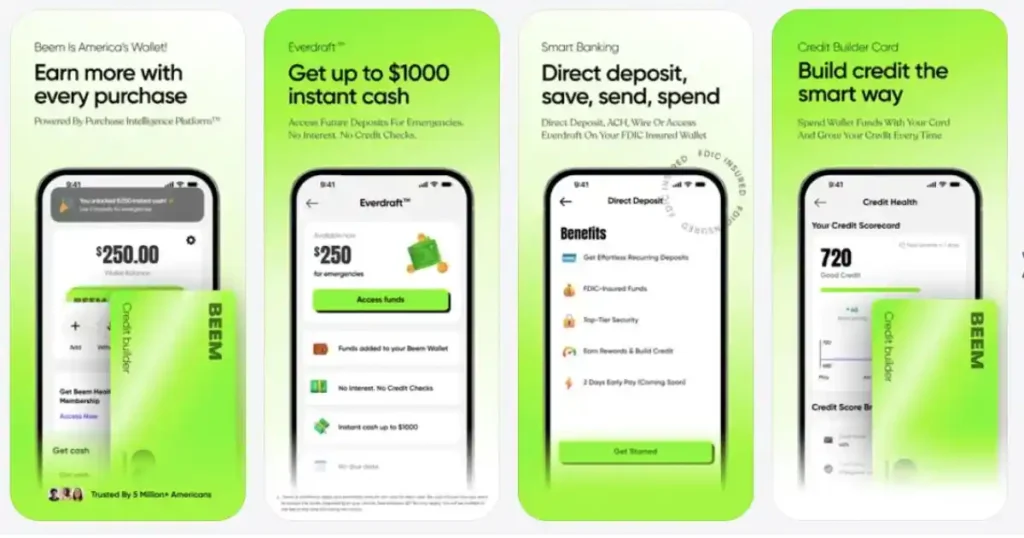
Everdraft repayment processes from the next qualifying income deposit rather than on a preset calendar date. This is not a grace period offered as a favor. It is the repayment structure itself.
For a gig worker whose next platform settlement arrives Thursday rather than Tuesday, the advance repays Thursday. No failed repayment. No overdraft. No compounding consequence from a timing variation the worker had no control over. The advance resolves when income arrives, which is the only repayment trigger that makes logical sense for workers whose income arrives on irregular schedules.
Zero Cost, No Matter How Often You Need It
Products that charge per-advance tips, express delivery fees, or monthly subscriptions penalize irregular income earners specifically. Workers who need advances most frequently during slow income periods pay the most precisely when they can least afford it.
Everdraft charges zero fees and zero interest regardless of how often advances are taken. A gig worker who needs three advances during an unusually slow month pays the same additional cost as a salaried employee who needs one advance in a normal month: nothing beyond the principal repaid. The zero-cost structure is fair to irregular income earners in a way that fee-based models structurally cannot be.
A $1,000 Limit Built for Real Gap Sizes
The $1,000 advance limit is not an arbitrary number. It reflects what irregular income gaps actually cost. Rent shortfalls, emergency repairs, slow-month expense coverage: these are financial events that routinely run $400 to $900. An advance ceiling of $250 does not cover them. A ceiling of $1,000 does.
For irregular income earners whose gaps are real and whose income to repay them is incoming rather than absent, the $1,000 limit is the design decision that actually solves the problem rather than partially addressing it.
How to Build the Strongest Beem Eligibility Profile
Understanding how Beem’s assessment works creates specific, practical actions you can take right now.
Get All Income Into One Linked Account
Platform wallet balances, payment processor holds, and client payment accounts are invisible to Beem’s assessment. Only deposits that have landed in the linked bank account contribute to the eligibility profile.
Irregular income earners who split earnings across multiple bank accounts divide their deposit signal into accounts that each appear less active than the combined picture would show. Consolidating all income into one primary linked account creates the strongest possible signal from your actual income activity.
Transfer Earnings Promptly After Every Payment
Every day that earned income sits in a third-party account is a day that income is not building the deposit signal your eligibility depends on. Enable automatic weekly transfers from every platform you work with. Request prompt payment from every freelance client. Move commission deposits to your linked account the day they clear.
The sooner earned income becomes a bank account deposit, the sooner it starts working for your eligibility profile.
Maintain a Small Balance Buffer Between Deposits
Even a modest persistent buffer of $100 to $150 between income events demonstrates the financial management capability that Beem’s balance behavior assessment values. It communicates that your deposit amounts are sufficient to cover expenses with something remaining, which is precisely the signal that supports repayment confidence.
Irregular income earners who spend every deposit immediately before the next one arrives create a balance pattern that looks financially precarious even when total monthly income is adequate. A small buffer changes that picture significantly.
Use Advances for Specific Gaps, Not General Working Capital
The advance that bridges a specific expense with a clear incoming deposit as the repayment source builds Beem Boost standing more effectively than a vague general advance. Know what you are covering and know what income is repaying it before you request the advance.
Beem Boost grows your available advance limit with each responsible use. For irregular income earners whose advance needs may grow during periods of income variability, building Boost standing from your first advance creates the higher limits you need before you need them.
The Bottom Line
The irregular income workforce is not asking for special treatment or lower standards. It is asking for financial tools that apply the same standards of reliability assessment to their income that those tools apply to payroll income, using the direct behavioral evidence that bank account history provides rather than an employment documentation filter that excludes legitimate earners for structural reasons.
Beem delivers that. No employer required. No pay stub needed. No fixed payday assumed. Just the deposit activity in your linked bank account, evaluated for what it actually demonstrates about your financial behavior, and up to $1,000 available from that foundation at zero cost when you need it.
Frequently Asked Questions
Which cash advance apps genuinely accept irregular income in 2026?
Beem Everdraft is the strongest option because its eligibility model evaluates bank account deposit activity rather than filtering for payroll-coded deposits. Gig platform transfers, freelance payments, commission deposits, and marketpace payouts all contribute to the behavioral profile Beem evaluates. Most competing apps require an employer direct deposit, cap advances at $100 to $250, or charge subscription fees that reduce net value.
How does Beem determine eligibility without a pay stub?
Beem evaluates four dimensions of the linked bank account: deposit frequency, deposit amounts over time, balance behavior between deposits, and overall account health. No pay stub, W-2, employer verification, or credit check is required at any point in the process.
Can someone with multiple irregular income sources qualify?
Yes. Multi-source earners often present stronger profiles than single-source earners because their combined deposit frequency is higher and their income base is more diversified. The key is consolidating all income into one primary linked account so the complete picture is visible to the assessment.
Does Beem charge fees for workers who need advances frequently?
No. Beem Everdraft charges no interest, no tips, no express fees, and no monthly subscription regardless of how often advances are taken. The zero-cost structure applies equally whether you need one advance a quarter or several during a slow month.