
Key Summary
Disability income comes in more forms than most people realize. Federal benefits like SSDI and SSI get the most attention, but millions of Americans receive disability-related income from private insurers, employers, state programs, and workers’ compensation systems. Every one of these creates bank account deposits. And bank account deposits are the only thing Everdraft™ needs to see.
This guide is not about whether disability income works with Beem. It does. This guide is about how to access Everdraft™ efficiently across every type of disability income, how to navigate the specific financial pressures that disability creates, and what 2026’s economic environment means for people whose income is fixed while their costs are not.
The Full Spectrum of Disability Income in 2026
The phrase “disability income” gets used as if it means one thing. It means at least eight distinct things, each with its own payment structure, tax treatment, and interaction with financial products. Here is the complete landscape.
Federal SSDI (Social Security Disability Insurance)
Funded through payroll taxes on your prior earnings. Monthly payments based on your work history. Deposits on a fixed schedule tied to your birth date. Not means-tested. No asset limits. Tax-free for most recipients unless combined income exceeds $25,000 individual or $32,000 joint.
Federal SSI (Supplemental Security Income)
Needs-based program for disabled individuals with limited income and resources. Flat federal rate of approximately $967 per month in 2026. Subject to $2,000 individual / $3,000 couple asset limits. Deposits on the 1st of each month.
Private Long-Term Disability Insurance (LTD)
Employer-sponsored or individually purchased policies that replace a percentage of your pre-disability salary, typically 50 to 70 percent. Payments come from private insurance companies like Unum, MetLife, Lincoln Financial, or Hartford. Monthly deposits arrive on a schedule set by the insurer, often mid-month or on the policy anniversary date. Payments are taxable if your employer paid the premiums and tax-free if you paid them yourself.
Private Short-Term Disability Insurance (STD)
Covers the initial period of disability, usually 3 to 6 months, before LTD kicks in. Payments come from the same types of private insurers. Amounts and schedules are policy-specific. Many people transition from STD to LTD to SSDI over the course of a single disability, creating changing deposit patterns during each phase.
State Disability Insurance (SDI)
Five states and one territory operate their own disability insurance programs: California (SDI/PFL), Hawaii (TDI), New Jersey (TDB), New York (DBL), Rhode Island (TDI), and Puerto Rico. These are employee-funded through payroll deductions and provide short-term disability benefits independent of federal programs. Payment amounts, durations, and schedules vary by state.
California’s SDI alone covers over 18 million workers and pays up to $1,681 per week in 2026. These state program deposits arrive on state-determined schedules and flow into your bank account the same way any other income does.
Workers’ Compensation Disability
If your disability resulted from a workplace injury or illness, workers’ compensation provides wage replacement benefits. Payments come from your employer’s workers’ comp insurer and typically replace two-thirds of your pre-injury wages up to a state-determined cap. Payments arrive biweekly or monthly depending on your state and the insurer.
Workers’ comp disability income is not the same as SSDI, SSI, or private LTD. It is a separate system with its own rules, and many disabled workers receive it alongside other forms of disability income.
VA Disability Compensation
Service-connected disability payments from the Department of Veterans Affairs. Monthly, tax-free, not means-tested. Amounts based on disability rating percentage.
Employer-Funded Disability Payments
Some large employers self-fund short-term disability rather than purchasing insurance policies. These payments come directly from the employer’s payroll system and may look identical to regular paychecks in your bank account except for the reduced amount. Everdraft™ reads them as deposits regardless of their internal classification.

Why Disability Income Creates Unique Cash Advance Needs
The financial pressures of disability are fundamentally different from those of unemployment, retirement, or low-wage employment. They deserve to be understood on their own terms.
The Cost of Being Disabled Is Higher Than the Cost of Not Being
This is the central financial reality of disability that most financial products ignore. Living with a disability costs more than living without one. The National Disability Institute estimates that a household including a person with a disability needs 28 percent more income to achieve the same standard of living as a household without a disability. Some analyses put the figure higher.
These additional costs include accessible transportation (paratransit fares, wheelchair-accessible vehicles, ride services when public transit is inaccessible), home modifications (ramp installation, bathroom modifications, widened doorways), assistive technology and equipment (wheelchairs, hearing aids, communication devices, adaptive computer equipment), personal care assistance not covered by insurance, specialized dietary needs for certain medical conditions, and higher utility costs from medical equipment that runs continuously.
None of these costs are optional. They are the baseline cost of participating in daily life with a disability. And they all come from the same disability income that also needs to cover rent, food, and standard living expenses.
Income Dropped, Disability Costs Appeared Simultaneously
When a person becomes disabled, two things happen at the same time. Their income drops (from full salary to a percentage replacement through disability insurance or benefits) and their expenses increase (from the additional costs of managing a disability). This simultaneous squeeze is unique to disability. Retirees see income drop but typically do not face new categories of mandatory spending. Unemployed workers see income drop but do not acquire new permanent costs. Disabled individuals get hit from both directions at once.
The Multi-System Navigation Tax
Managing disability income often means interacting with multiple bureaucratic systems simultaneously. Filing SSDI while receiving STD from a private insurer while applying for state SDI while negotiating with workers’ comp. Each system has its own application process, its own timeline, its own documentation requirements, and its own payment schedule.
The cognitive and time cost of managing these overlapping systems is substantial, particularly for people whose disabilities affect concentration, energy, mobility, or communication. Financial products that add another layer of complexity on top of this burden are not just unhelpful. They are inaccessible in the truest sense.
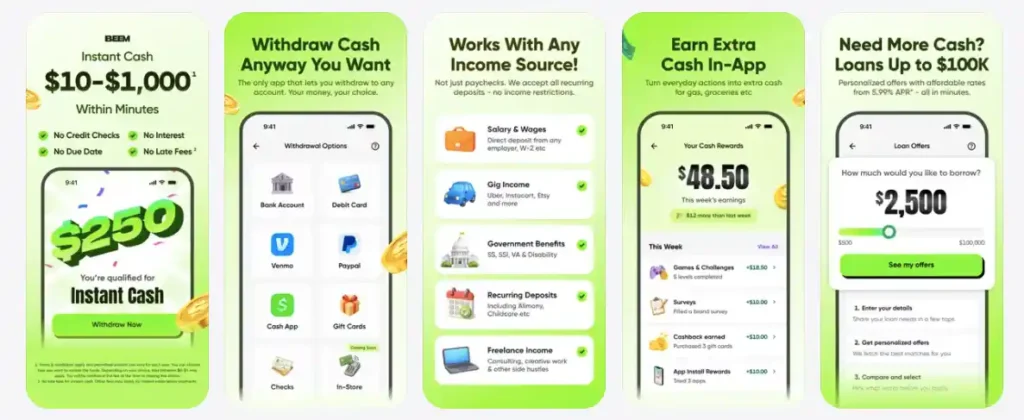
Beem adds no complexity. Link a bank account. Everdraft™ reads the deposits. Done.
Read: Cash Advance San Francisco: Get With Beem Everdraft™
Accessing Everdraft™ on Each Type of Disability Income
The technical process is the same regardless of disability type. But each income source creates a slightly different bank account profile that is worth understanding.
SSDI Recipients
Your monthly SSDI deposit creates a single, highly consistent deposit signal. Link the bank account receiving your SSDI payment and Everdraft™ will see it immediately. No asset limit concerns. No benefit interaction risks. This is the most straightforward disability income scenario for Beem.
SSI Recipients
Your monthly SSI deposit works the same way technically, but the $2,000 asset limit requires careful advance management. Request only what you need for a specific expense, spend the funds before the 1st of the next month, and keep your bank balance below the threshold on review dates. Everdraft™ does not monitor your asset limit for you, so that responsibility is yours.
Private LTD Recipients
LTD payments from private insurers deposit into your bank account on the insurer’s schedule, often monthly. These deposits are typically larger than SSDI or SSI payments because they replace a percentage of your working salary. Everdraft™ reads them as consistent recurring income. There are no government asset limits to worry about with private LTD, so use Everdraft™ freely.
One consideration unique to LTD: some policies include “other income offsets” that reduce your LTD payment when you begin receiving SSDI. If your LTD amount decreases because SSDI was approved, your total bank deposits may shift (lower LTD plus new SSDI payment). Everdraft™ adjusts to the new deposit pattern over time. During the transition, your eligible amount may fluctuate temporarily.
State Disability Insurance Recipients
SDI payments from California, New Jersey, New York, Hawaii, or Rhode Island deposit into your bank account on a state-determined schedule. California’s EDD, for example, issues payments biweekly. These regular government deposits create a clear income signal for Everdraft™.
SDI benefits are temporary, typically lasting 26 to 52 weeks depending on the state. Like unemployment benefits, Everdraft™ will adjust your eligible amount when SDI payments end. If you transition from SDI to LTD or SSDI, the new income source replaces the old one in your bank account activity and Everdraft™ continues evaluating the updated pattern.
Workers’ Compensation Recipients
Workers’ comp disability payments deposit on a schedule determined by your state’s system and the employer’s insurer. These are often biweekly. The payments are tax-free in most cases and create a recognizable recurring deposit pattern. No asset limits apply to workers’ comp, and receiving workers’ comp does not disqualify you from using Beem.
If your workers’ comp case is in dispute or payments are delayed due to an employer or insurer challenge, the gap in deposits may temporarily affect your Everdraft™ profile. Maintaining any supplemental income deposits during a dispute period helps preserve your eligibility.
Multiple Disability Income Sources
Many disabled individuals receive income from more than one source simultaneously. SSDI plus a small private LTD supplement. Workers’ comp plus state SDI during the initial period. VA disability plus SSDI for veterans with both service-connected and non-service-connected conditions. SSI plus state general assistance.
Multiple disability income deposits flowing into the same bank account create deposit diversity that Everdraft™ reads favorably. Each additional recurring deposit strengthens your overall financial profile.
Download Beem and see what your disability income qualifies you for.
The 2026 Cost Pressures Making Cash Advances Essential for Disabled People
Disability income levels in 2026 have not kept pace with the costs disabled people actually face. Several converging factors are making the gap worse.
Assistive Technology Costs Are Rising
Hearing aids average $2,000 to $7,000 per pair in 2026. Power wheelchairs run $15,000 to $30,000. Even basic mobility aids like walkers and canes have seen price increases. Insurance coverage for assistive technology varies wildly, and many devices require out-of-pocket deposits, copays, or complete self-payment for models insurance does not cover.
When a wheelchair battery dies, a hearing aid breaks, or a prosthetic needs repair, the cost is immediate and non-negotiable. You cannot function without these devices. A cash advance covers the urgent repair or replacement while insurance authorization processes play out over weeks.
Home Healthcare Gaps
Medicare and Medicaid cover some home healthcare services, but the coverage has limits on hours, types of assistance, and duration. Many disabled individuals need more personal care hours than insurance authorizes. Private-pay home health aides cost $20 to $35 per hour in most markets. Even a few extra hours per week of uncovered care adds $200 to $500 monthly to your budget.
Accessible Housing Premium
Accessible apartments and houses cost more to rent and more to maintain. Wheelchair-accessible units in most cities carry a 10 to 20 percent premium over comparable non-accessible units. Home modifications like grab bars, roll-in showers, and ramp installation are sometimes covered by Medicaid waivers but often require out-of-pocket payment first with reimbursement coming weeks or months later.
Prescription Costs Outside Formulary
Insurance formularies do not cover every medication a disabled person needs. Brand-name prescriptions without generic alternatives, medications for rare conditions, and drugs prescribed off-label for disability-related symptoms may require full out-of-pocket payment. A single specialty prescription can cost $200 to $800 per month.
Inflation on Disability-Adjacent Services
Paratransit fares, medical appointment copays, therapy session fees, and adaptive recreation programs have all increased faster than disability benefit COLAs in recent years. The gap between what disability income provides and what disability life costs widens incrementally every year, creating a slow-building pressure that eventually forces people toward cash advances for expenses that would have been manageable two or three years ago.
Accessibility Considerations for Using Beem
Financial apps should be accessible to disabled users. Here are practical considerations for accessing Beem with different types of disabilities.
Visual Impairments
Beem’s mobile app can be navigated using screen readers (VoiceOver on iOS, TalkBack on Android). If you experience difficulty with any part of the signup or bank linking process, Beem’s support team can assist through their help center at help.trybeem.com.
Motor and Dexterity Limitations
The bank account linking process and advance request flow involve standard mobile interface interactions. If fine motor control makes these interactions challenging, voice control features built into iOS and Android can assist with navigation and input.
Cognitive and Processing Considerations
Beem’s process is deliberately simple: link a bank account, let Everdraft™ evaluate your activity, and request an advance when needed. There are no complex forms to fill out, no multi-page applications, and no timed steps that require rapid responses. If you benefit from having a trusted person assist with financial app setup, the process can be completed in a single sitting.
Managing Everdraft™ During Disability Income Transitions
Disability income rarely stays static. People move between benefit types, receive retroactive payments, gain or lose supplemental income, and experience periodic reviews that can temporarily change their payment amounts.
The STD to LTD Transition
When short-term disability ends and long-term disability begins, there is sometimes a gap of one to four weeks between the last STD payment and the first LTD payment. Your bank account may show a temporary deposit pause during this transition. If you have prior account history, Everdraft™ can still evaluate your profile, but your eligible amount may be temporarily affected. Having even a small supplemental deposit during the gap helps maintain continuity.
The LTD to SSDI Overlap
Many LTD policies require you to apply for SSDI. When SSDI is approved, LTD payments are offset (reduced by the SSDI amount). This means your total income may stay roughly the same, but it arrives from two sources instead of one on different schedules. Everdraft™ handles this naturally because it reads total deposit activity, not individual source amounts.
SSDI Retroactive Lump Sum Payments
When SSDI is approved after a long application or appeal process, the Social Security Administration often issues a retroactive lump sum covering months or years of back benefits. This large one-time deposit is not a regular income pattern, and Everdraft™ may not weight it the same way it weights recurring monthly deposits. Your ongoing monthly SSDI payments are what build your long-term Everdraft™ profile.
For SSI recipients, a retroactive lump sum creates an immediate asset limit risk. SSI allows nine months to spend down a retroactive payment, but the funds sitting in your bank account during that period could technically push you above the $2,000 threshold. This specific scenario requires careful planning separate from Everdraft™.
Continuing Disability Reviews (CDRs)
The Social Security Administration periodically reviews SSDI and SSI recipients to determine if their condition has improved. If a CDR results in benefit cessation, your disability income stops. While you can appeal, the appeal process can take months. During that period, having an Everdraft™ eligible amount based on prior account activity provides a critical safety net, though the eligible amount will adjust downward if deposits cease for an extended period.
Access Beem now while your disability income is active.
People Also Ask
Can people on disability income get a cash advance through Beem?
Yes. Beem’s Everdraft™ works with all forms of disability income that deposit into a bank account, including SSDI, SSI, private long-term and short-term disability, state disability insurance, workers’ compensation, and VA disability. No employment verification or credit check is required.
Does Beem ask about your disability or medical condition?
No. Beem does not ask about disability status, medical conditions, diagnosis, or functional limitations at any point in the signup or evaluation process. Everdraft™ reads bank account deposit activity only. Your disability is irrelevant to the eligibility determination.
Can you use Beem on private long-term disability insurance?
Yes. LTD payments from private insurers like Unum, MetLife, Lincoln Financial, or Hartford deposit into your bank account as recurring income. Everdraft™ evaluates these deposits the same way it evaluates any other consistent income source. There are no government asset limits associated with private LTD.
What disability income types have asset limits that affect Beem?
SSI is the primary disability income type with a strict asset limit ($2,000 individual / $3,000 couple). SSDI, private LTD, state disability insurance, workers’ compensation, and VA disability compensation have no asset limits that would interact with a cash advance.
How much can disabled people get from Everdraft™?
Eligible users can access up to $1,000 regardless of disability status. Your specific eligible amount depends on your bank account deposit patterns, spending behavior, and account stability. It is personalized to your financial profile, not predetermined by your disability income type or amount.
What if my disability income changes during an appeal or review?
Everdraft™ continuously evaluates your bank account activity. If your disability income increases (approval of a higher rating, transition to a higher-paying benefit), your eligible amount can increase. If income decreases or stops temporarily during an appeal or review, your eligible amount will adjust to reflect the current deposit activity.
The Bottom Line
Disability income is not one thing. It is SSDI, SSI, private LTD, state disability programs, workers’ comp, VA compensation, and employer-funded payments, all flowing into bank accounts on their own schedules at their own amounts. Everdraft™ does not need to know which type you receive or why you receive it. It reads deposits. It evaluates patterns. It offers up to $1,000 when the math of living on disability income in 2026 does not cover the cost of actually living with a disability. No employer name. No medical documentation. No credit check. No complexity layered on top of a life that already has enough of it.