
Key Summary
Government assistance keeps tens of millions of Americans housed, fed, insured, and financially functional. But receiving government benefits and being treated like a full participant in the financial system are two very different experiences. Most financial apps, including the majority of cash advance platforms, were built for people with employer-based income. If your financial life runs on government assistance, those apps were not built for you. Beem was. Everdraft™ evaluates bank account activity without filtering by income source, which means government benefit deposits qualify the same way any other recurring income does.
Here is how Beem works across the full spectrum of government assistance programs in 2026.
The Invisible Wall Between Government Benefits and Financial Products
There is an unspoken hierarchy in how financial products treat income. Salary from a Fortune 500 company sits at the top. Hourly wages from a retail job come next. Self-employment income is somewhere in the middle, increasingly acknowledged but still treated with suspicion. Government assistance sits at the bottom, often not recognized as income at all.
This hierarchy is not based on the reliability of the income. Government benefits are often more predictable than private employment. A federal benefit depositing on the 3rd of every month for the same amount is objectively more consistent than a sales commission that fluctuates quarterly. The hierarchy exists because financial products were built on payroll infrastructure, and government benefits do not flow through payroll.
The result is a financial system that offers the most tools to the people who need them least and the fewest tools to the people who need them most. Beem disrupts that pattern by removing the payroll requirement entirely.
The Full Landscape of Government Assistance in 2026
Government assistance is not a single program. It is a network of federal, state, and local programs that serve different needs for different populations. Understanding this landscape matters because each program creates a different financial footprint in your bank account, and Everdraft™ interacts with each one differently.
Cash Benefit Programs (Direct Deposits to Your Bank)
These programs send money directly to your bank account or a benefit card, creating the deposit activity Everdraft™ evaluates.
TANF (Temporary Assistance for Needy Families) provides monthly cash benefits to low-income families with children. Amounts vary dramatically by state, from under $200 per month in some southern states to over $700 in states like New Hampshire or Alaska. TANF deposits arrive monthly and create a recognizable recurring pattern in your bank account.
General Assistance / General Relief is a state or county-funded program for individuals who do not qualify for federal programs. Not all states offer it. Where available, monthly payments are typically small ($100 to $400) but consistent.
Veterans’ disability compensation and pension payments arrive monthly from the VA on a predictable schedule. Disability compensation is tax-free and not means-tested. VA pension is means-tested but still creates the same kind of regular deposit activity that Everdraft™ reads positively.
Tribal benefits and per capita distributions provide income to enrolled members of federally recognized tribes. Payment frequency varies by tribe, from monthly to quarterly to annually.
Near-Cash Programs (Loaded to Benefit Cards)
These programs provide funds on government-issued cards rather than bank deposits. They are real financial resources but interact with Beem differently.
SNAP (Supplemental Nutrition Assistance Program) loads monthly food benefits onto an EBT card. SNAP funds do not deposit into a bank account and therefore are not visible to Everdraft™. However, the presence of SNAP benefits means your grocery costs are partially covered, freeing up more of your cash income for other expenses.
WIC (Women, Infants, and Children) provides nutrition benefits through vouchers or EBT cards for pregnant women, new mothers, and young children. Like SNAP, WIC benefits do not hit your bank account directly.

Subsidy Programs (Reduce Your Expenses)
These programs do not provide income. They reduce what you pay for essentials, which indirectly strengthens your bank account stability.
Section 8 / Housing Choice Vouchers cover a portion of your rent, meaning your out-of-pocket housing cost is lower. This leaves more of your cash income available for other needs and reduces the monthly drain on your bank balance that Everdraft™ observes.
LIHEAP (Low Income Home Energy Assistance Program) helps cover heating and cooling costs. Payments typically go directly to your utility provider rather than your bank account.
Medicaid covers healthcare costs, reducing or eliminating medical expenses that would otherwise draw from your bank account.
Lifeline / Affordable Connectivity Program subsidizes phone and internet service, reducing monthly bills.
None of these deposit money into your bank account, so they are not directly visible to Everdraft™. But they all improve your financial stability by reducing expenses, which makes your bank account healthier overall and strengthens the spending patterns Everdraft™ evaluates.
How Everdraft™ Reads a Benefits-Based Financial Profile
A bank account funded primarily by government assistance looks different from one funded by employment income. Everdraft™ does not judge the difference. It reads the patterns.
Fewer, Larger Deposits
Employment income often arrives biweekly, creating two deposits per month. Government benefits typically arrive once per month, sometimes supplemented by a second program on a different date. Everdraft™ sees fewer deposit events but evaluates the total monthly inflow and the consistency of those deposits over multiple months. One deposit per month for the same amount on the same date is a strong consistency signal despite the lower frequency.
Tighter Spending-to-Income Ratio
People on government assistance tend to spend a higher percentage of their income on necessities. This means the gap between deposits and withdrawals is narrower than for higher-income accounts. Everdraft™ does not penalize tight margins. It looks at whether spending remains within income boundaries, not how wide those boundaries are. A person spending $900 of their $967 monthly SSI benefit in a controlled pattern scores differently from someone spending $900 erratically despite having $4,000 in monthly income.
Predictable Monthly Cycles
Benefits-funded accounts often follow the most predictable monthly cycles Everdraft™ encounters. Deposit on the 1st (or the designated benefit date). Rent payment within the first five days. Utility payments mid-month. Remaining spending distributed through the month. Balance reaches its low point in the last week. Next deposit resets the cycle. This regularity, while driven by necessity rather than choice, reads as financial stability.
Supplemental Deposits From Multiple Programs
Some benefits recipients receive deposits from more than one government program. TANF plus child support. VA disability plus a small part-time work deposit. SSI plus state general assistance. Multiple recurring deposits from different sources create a deposit diversity signal that Everdraft™ reads favorably, the same way it would read multiple freelance client payments.
The Real Costs That Push Benefits Recipients Toward Cash Advances
Government assistance covers the basics, partially. It does not cover the unexpected, the irregular, or the costs that fall between program cracks.
Benefit Timing Mismatches
Your TANF payment arrives on the 5th. Your rent is due on the 1st. That five-day gap creates a structural timing mismatch every single month. Late fees on rent, even $25 or $50, compound into hundreds of dollars per year. A cash advance that covers rent on the 1st and is repaid when TANF deposits on the 5th eliminates a recurring penalty that most benefits recipients accept as unavoidable.
Program Gaps and Cliff Effects
Government programs have eligibility thresholds. Earn $1 too much and you can lose hundreds in benefits. This creates “cliff effects” where a small increase in income results in a net financial loss. During the transition period when benefits are being recalculated, reduced, or reinstated, recipients often face weeks with lower-than-expected income. A cash advance bridges that bureaucratic gap.
Application and Recertification Delays
Benefits do not start the day you apply. TANF applications can take 30 to 45 days. Housing vouchers can take months or years on a waitlist. Even ongoing benefits require periodic recertification, and processing delays can cause missed payments. When a benefit payment is delayed due to administrative processing, a cash advance from Everdraft™ covers the gap that the government’s timeline created.
Costs Programs Do Not Cover
SNAP covers food but not toiletries, cleaning supplies, diapers, or pet food. Medicaid covers doctor visits but not all prescriptions, dental crowns, or the gas to drive to appointments. Section 8 covers most of rent but not the security deposit for a new unit or the moving costs to get there. These uncovered expenses are predictable in that they will happen, unpredictable in when and how much, and never budgeted for in benefit calculations.
School-Related Expenses for Children
Benefits-receiving parents face recurring costs that programs partially address but never fully cover. School supplies, field trip fees, activity costs, seasonal clothing as children grow, back-to-school shoes, and class project materials. These are small individually but cluster at specific times of year, creating concentrated financial pressure on already-tight budgets.
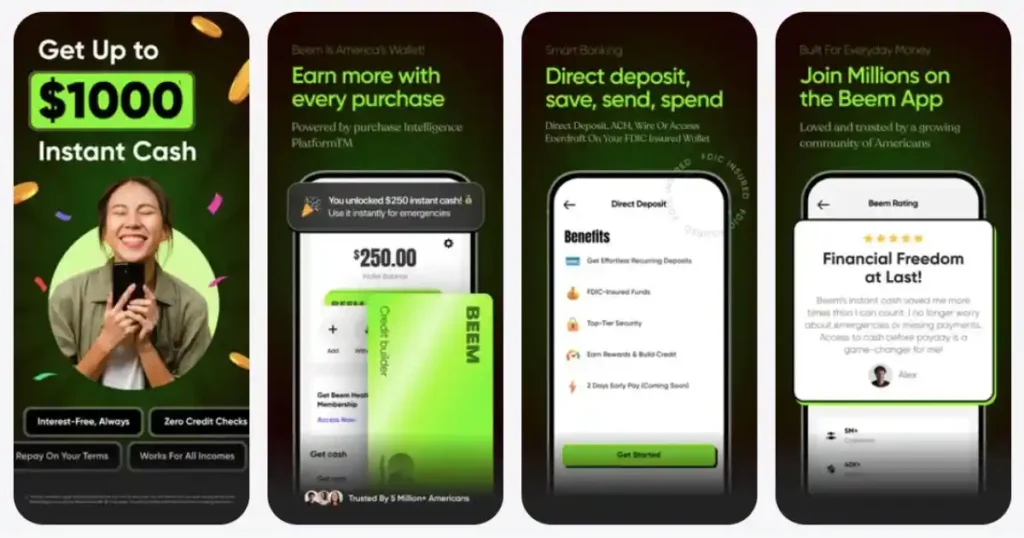
Download Beem and access up to $1,000 on your benefit income.
Navigating Means-Tested Programs While Using Everdraft™
Some government assistance programs have asset limits or income thresholds. A cash advance can temporarily affect your bank balance. Here is how to think about this for each major program type.
Programs With Asset Limits
SSI has a $2,000 individual / $3,000 couple asset limit. A cash advance that pushes your bank balance above this threshold on the first of any month could affect eligibility. Request only what you need and spend the funds before the next month begins.
TANF has asset limits that vary by state, typically ranging from $1,000 to $10,000. Check your state’s specific limit. Many states have relaxed TANF asset tests in recent years, but they still exist in some form.
SNAP eliminated the federal asset test for most households in recent years, and most states have adopted broad-based categorical eligibility that removes asset limits entirely. A cash advance is unlikely to affect SNAP eligibility in most states.
Medicaid asset tests were largely eliminated under ACA expansion, but non-expansion states may still apply asset limits for certain populations. Check your state’s Medicaid rules.
Programs Without Asset Limits
SSDI, Social Security retirement, spousal benefits, and survivor benefits have no asset limits. A cash advance has zero impact on these benefits.
Veterans’ disability compensation has no asset limit. VA pension does have a net worth limit ($155,356 in 2026), but a temporary cash advance is unlikely to push anyone near that threshold.
Section 8 and LIHEAP do not typically have asset limits, though some local housing authorities may have their own rules.
The General Rule
If your benefit program has an asset limit, keep your cash advance small, purpose-driven, and spend it quickly. If your program does not have an asset limit, use Everdraft™ without concern about benefit interactions. When in doubt, check your specific program’s rules or ask your caseworker about how a temporary cash advance is treated.
Why Standard Financial Advice Fails Benefits Recipients
Most personal finance guidance assumes you have slack in your budget. Cut the streaming subscriptions. Stop buying coffee out. Cook at home more. Negotiate your cable bill. This advice is useless when your entire income goes to rent, food, and utilities with nothing left over.
Benefits recipients do not have a spending problem. They have an income-to-cost problem that is structurally baked into benefit levels that have not kept pace with actual living costs. A cash advance from Everdraft™ is not a solution to that structural problem. But it is a practical tool that provides breathing room within it, and it does so without the interest charges, credit checks, or employment requirements that make other financial tools inaccessible.
Read: 15 Best Cash Advance Apps in 2026
How to Strengthen Your Everdraft™ Profile on Government Assistance
Even on a benefits-based income, there are practical steps that help Everdraft™ build the strongest possible picture of your finances.
Consolidate All Deposits Into One Account
If you receive benefits from multiple programs into different accounts, route everything into one primary checking account and link that one to Beem. Everdraft™ only evaluates the account you connect, so consolidation ensures it sees your full income picture.
Switch From Benefit Cards to Bank Direct Deposit
If your TANF, unemployment, or other cash benefits load onto a government-issued debit card, contact your state agency to switch to direct deposit into your bank account. Benefit card deposits are invisible to Everdraft™. Bank deposits are not.
Maintain Consistent Account Activity
Use your linked bank account for regular transactions. Bill payments, grocery purchases, and everyday spending through the same account gives Everdraft™ a richer behavioral dataset. An account that only shows one monthly deposit and one monthly withdrawal provides less information than one with ongoing activity.
Avoid Overdraft Patterns
Overdrafts signal that expenses regularly exceed income within a given period. Even one or two overdrafts per month can weaken your Everdraft™ profile. If you are consistently overdrafting in the last week of the month, using BudgetGPT to map your spending across the full benefit cycle can help you redistribute expenses to avoid the end-of-month crunch.
See what you qualify for with Beem today.
People Also Ask
Can you get a cash advance on government assistance?
Does a cash advance count as income for government benefits?
A cash advance is not earned or unearned income. It is a temporary financial instrument that is received and repaid. It should not affect income-based benefit calculations. However, the funds temporarily increase your bank balance, which could matter for programs with asset limits like SSI. Spend advance funds promptly if your program has an asset test.
Will Beem affect my SNAP benefits?
Beem does not interact with SNAP directly. SNAP benefits load onto an EBT card and are not part of your bank account activity. Additionally, most states have eliminated SNAP asset limits through broad-based categorical eligibility, so a temporary increase in your bank balance from a cash advance is unlikely to affect SNAP eligibility.
Can veterans on VA benefits use Beem?
Yes. VA disability compensation and pension payments that deposit into your bank account qualify as consistent income for Everdraft™. Veterans can access cash advances up to $1,000 without employment verification. VA disability compensation has no asset limit, so a cash advance has no impact on that benefit.
What government benefit deposits does Everdraft™ recognize?
Everdraft™ does not categorize deposits by program type. It reads all deposits in your linked bank account as financial activity. Any government benefit that arrives via direct deposit, including TANF, SSI, SSDI, Social Security, VA benefits, general assistance, and state-specific programs, contributes to your overall deposit pattern and eligibility.
Does Beem ask what type of benefits you receive?
No. Beem does not ask about your benefit type, program enrollment, disability status, or income source. Everdraft™ evaluates bank account deposit patterns and spending behavior only. Your benefit classification is irrelevant to the eligibility process.
The Bottom Line
Government assistance recipients are not a financial afterthought. They are people managing complex, low-margin financial lives with extraordinary discipline, navigating benefit schedules, asset limits, program rules, and costs that consistently exceed what those programs were designed to cover.
Beem does not ask which box you check on a government form. Everdraft™ reads your bank account, sees your deposits, and offers up to $1,000 when the math of living on benefits does not add up for the month. In 2026, that is the kind of financial tool government assistance recipients deserve but rarely get.