
Key Summary
Supplemental Security Income is not the same as Social Security retirement or SSDI. It pays less, it comes with strict rules about how much you can have in the bank, and it serves people whose financial margin is often razor-thin.
That combination makes getting a cash advance both more necessary and more complicated than it is for almost any other group. Beem’s Everdraft™ works for SSI recipients, but using it wisely requires understanding how SSI’s unique rules interact with a cash advance. This guide covers exactly that.
What Makes SSI Different From Every Other Benefit Type
SSI is the only major federal benefit program that punishes you for having money. That is not an exaggeration. It is the defining feature that separates SSI from SSDI, Social Security retirement, veterans’ benefits, and every other income source discussed in the cash advance context.
The Asset Limit Problem
SSI enforces a countable resource limit of $2,000 for individuals and $3,000 for couples. Countable resources include cash on hand, bank account balances, stocks, bonds, and most financial assets. If your countable resources exceed the limit on the first of any month, you can lose your SSI payment for that month entirely.
This limit has not been meaningfully updated since 1989. Thirty-seven years of inflation have turned what was already a modest threshold into an impossible constraint. A $2,000 limit in 2026 means SSI recipients must keep their bank balances perpetually low, which in turn means any unexpected expense becomes a potential crisis because there is no savings cushion to absorb it.
Lower Payment Amounts
The federal SSI benefit rate in 2026 is approximately $967 per month for individuals and $1,450 for couples. Some states supplement this amount, but even with supplements, SSI payments are significantly lower than average SSDI or retirement benefits. Living on under $1,000 per month in any American city in 2026 requires extraordinary budgeting precision with zero room for error.
Income Deductions That Reduce Your Benefit
SSI reduces your benefit based on other income you receive. The formula excludes the first $20 of most unearned income and the first $65 plus half of earned income, but anything above those thresholds reduces your SSI payment dollar for dollar.
This means that SSI recipients who try to supplement their income through part-time work or side earnings see their benefit shrink in response, creating a disincentive structure that keeps people locked into financial fragility.
Why SSI Recipients Need Cash Advances More Than Almost Anyone
The math of living on SSI is unforgiving. Here is what that math actually looks like.
$967 Against Real-World Costs
Take a single SSI recipient in a mid-size U.S. city. Federal benefit: $967 per month. Average rent for a modest one-bedroom in most metros: $800 to $1,200. That single expense alone can consume 80 to 100 percent of the benefit before food, transportation, medications, phone service, or any other necessity is accounted for.
Many SSI recipients share housing, live in subsidized units, or rely on family to keep housing costs manageable. Even in the best scenarios, the gap between income and basic expenses is narrow enough that a single unexpected cost, a $150 car repair, a $200 medical copay, a $75 utility overage, breaks the budget completely.
Once-a-Month Income on a Daily-Expense Life
SSI deposits on the 1st of every month. Bills, groceries, prescriptions, and transportation costs do not wait for the 1st. The mismatch between a single monthly income event and continuous daily expenses creates predictable cash crunches in the third and fourth weeks of every month. This is not a budgeting failure. It is a structural impossibility when income is this low and this infrequent.
No Savings Buffer by Design
The $2,000 asset limit makes building savings functionally prohibited. An SSI recipient who manages to save $300 per month for seven months would hit the asset limit and lose benefits. The program structurally prevents the very financial buffer that would eliminate the need for cash advances. This is the central paradox of SSI: the rules that govern it guarantee the financial instability that makes emergency borrowing necessary.
How Everdraft™ Works Within SSI’s Constraints
Beem does not ask about your benefit type. Everdraft™ evaluates your bank account activity the same way regardless of whether deposits come from SSI, SSDI, retirement, or employment. But SSI recipients need to think about how a cash advance interacts with the program’s rules. Here is the practical framework.
The Asset Limit Interaction
When you receive an Everdraft™ cash advance, the funds deposit into your linked bank account. At that moment, your bank balance increases. If that increased balance causes your countable resources to exceed $2,000 (individual) or $3,000 (couple) on the first of any month, SSI could reduce or suspend your benefit for that month.
This does not mean SSI recipients cannot use Everdraft™. It means timing and amount matter more for you than for other users.
The Spend-Down Strategy
The most effective approach for SSI recipients is to request a cash advance only when you have an immediate, specific expense to cover, and then spend the funds on that expense promptly.
If you need $400 for a car repair, request $400, pay the mechanic, and your bank balance returns to its normal range. The advance entered and exited your account as a transactional flow rather than sitting as accumulated resources.
What matters for SSI purposes is your countable resource balance on the first of each month. If the advance funds are spent before that date, they do not count against your asset limit on the review date.
Safe Timing Windows
The safest time for an SSI recipient to request and use a cash advance is early in the month, immediately after your SSI deposit arrives and your regular expenses begin drawing the balance down.
By mid-month, your balance is typically declining toward its monthly low. An advance requested and spent during this window is unlikely to push your balance above the asset limit on the next first-of-month review.
The riskiest timing is the last few days of the month, when an advance deposited on the 29th or 30th could still be in your account on the 1st if you have not spent it yet.
Amounts That Make Sense for SSI
Larger is not always better for SSI recipients. An Everdraft™ advance of $800 into a bank account that already holds $1,400 puts you over the $2,000 limit immediately. An advance of $300 into the same account keeps you at $1,700, safely below the threshold even if you do not spend it all the same day.
The right advance amount for an SSI recipient is the amount that covers the specific expense you need to handle without creating an asset limit problem. Everdraft™ lets you choose your advance amount up to your eligible limit, so you are in control.
Download Beem and access a cash advance designed for your situation.
Expenses That Hit SSI Recipients Hardest
Understanding the specific cost categories that drive SSI recipients toward cash advances helps frame why this tool matters.
Medical Costs Not Covered by Medicaid
Most SSI recipients qualify for Medicaid, but Medicaid does not cover everything. Dental work beyond basic extractions, vision care beyond a standard exam, hearing aids, certain prescriptions, specialized treatments, and medical equipment copays all create out-of-pocket costs.
A single dental filling can cost $150 to $300. Eyeglasses run $100 to $400. These are costs that Medicaid-covered individuals still face, and on $967 per month, there is nowhere for them to come from.
Housing Emergencies in Subsidized Units
Even in Section 8 or public housing, tenants are responsible for their portion of rent and for certain maintenance issues. A security deposit for a new unit, a utility deposit after a transfer, or an unexpected repair that falls on the tenant can create a sudden cash need that the monthly benefit cannot cover.
Transportation to Medical Appointments
SSI recipients often have medical conditions requiring regular appointments, treatments, or therapy sessions. Medicaid transportation services exist in some states but are unreliable or unavailable in many areas. The cost of rideshare trips, gas for a personal vehicle, or even bus fare over multiple weekly appointments adds up quickly on a sub-$1,000 monthly income.
Food Gaps at End of Month
SNAP benefits (food stamps) supplement food costs for many SSI recipients, but the average SNAP allotment does not cover a full month of groceries for most people. The last week of the month is when food budgets run out. A small cash advance to cover groceries during that final stretch prevents hunger without requiring reliance on food banks that may not be accessible.
Essential Replacements
A broken phone means losing contact with doctors, caseworkers, and family. A worn-out pair of shoes means difficulty getting to appointments. A failed appliance means spoiled food or unsafe living conditions. These are not luxury purchases. They are functional necessities that cost $50 to $300 and appear without warning.

What SSI Recipients Should Know Before Using Beem
Complete transparency about considerations specific to SSI is essential.
Beem Does Not Monitor Your Asset Limit
Everdraft™ does not know you receive SSI. It does not track your countable resources or warn you when a cash advance would push your balance above $2,000. That responsibility is yours. Before requesting an advance, check your current bank balance and calculate whether the advance amount would create an asset limit issue on the upcoming first of the month.
Repayment Timing Matters Too
When your Everdraft™ advance is repaid, the repayment reduces your bank balance. If repayment is timed to occur just before your SSI deposit, it could temporarily create a very low balance.
Conversely, if your advance is repaid on the same day your SSI deposits, the inflow and outflow may create a temporary spike. Neither scenario is inherently problematic, but awareness of the timing helps you plan around SSI’s rules.
Document Your Advance if Needed
If your SSI caseworker ever questions a bank balance spike, having a clear record that the funds were a short-term cash advance (not unreported income) protects you. Beem provides transaction records that show the advance and repayment clearly. A cash advance is not income. It is a temporary financial bridge. SSI rules treat loans and advances differently from income, which means a properly documented Everdraft™ advance should not count as income for SSI purposes.
Consider the Proposed Asset Limit Changes
There has been ongoing legislative discussion about raising or eliminating SSI’s asset limits. The SSI Savings Penalty Elimination Act and similar proposals have gained congressional attention in recent sessions.
If asset limits are raised significantly or eliminated, the constraints around using a cash advance on SSI would become much less restrictive. Stay informed about these potential changes through the Social Security Administration or disability advocacy organizations.
Practical Scenarios: How SSI Recipients Can Use Everdraft™ Safely
Scenario 1: Emergency Prescription Cost
Your doctor prescribes a medication Medicaid does not cover. The pharmacy quotes $180. Your current bank balance is $340. You request a $200 Everdraft™ advance on the 8th of the month. Balance temporarily reaches $540. You pay the pharmacy the same day. Balance drops to $360. Well under the $2,000 limit with weeks to go before the next month’s review.
Scenario 2: End-of-Month Grocery Gap
It is the 24th. Your SNAP balance is exhausted and you have $90 in your bank account. You need roughly $80 in groceries to get through the week. You request a $100 advance. Balance reaches $190. You buy groceries the next day. Balance settles to $110. Your SSI deposit arrives on the 1st, and the cycle resets normally.
Scenario 3: Housing-Related Deposit
Your subsidized housing unit requires a $500 utility deposit for a transfer to a different unit. Your balance is $600. Requesting $500 would put you at $1,100, still below the limit. You pay the deposit immediately. Balance returns to $600. Clean and simple.
Scenario 4: Where Caution Is Needed
Your balance is $1,500 on the 28th of the month. You want to request a $700 advance for a car repair. That would put your balance at $2,200, above the $2,000 limit. If you cannot guarantee the funds will be spent before the 1st, this advance amount creates risk. A better approach: request $400, pay toward the repair, and negotiate a payment plan for the remaining $300 with the mechanic. Or wait until after the 1st once your balance has been drawn down by monthly expenses.
Get started with Beem. Built for the income you have.
People Also Ask
Can SSI recipients get a cash advance through Beem?
Yes. SSI deposits in your linked bank account are recognized by Everdraft™ as consistent income. There is no employment requirement or credit check. SSI recipients should be mindful of the $2,000 individual asset limit and plan advance amounts and timing accordingly.
Will a cash advance count as income for SSI purposes?
Generally, no. A cash advance is a temporary financial instrument, not earned or unearned income. It is received and repaid. However, SSI rules are complex, and if advance funds remain in your bank account and push your countable resources above $2,000, it could affect your benefit. Spend advance funds promptly to avoid this issue.
How much should SSI recipients request from Everdraft™?
Only the amount needed for the specific expense you are covering. Calculate your current bank balance plus the advance amount to ensure the total stays below $2,000 (individual) or $3,000 (couple). Smaller, purpose-driven advances are safer than taking the maximum available.
What is the safest time for SSI recipients to take a cash advance?
Early to mid-month is safest. Your SSI deposits on the 1st, and your balance gradually declines through the month as expenses are paid. An advance requested and spent during the second or third week of the month is least likely to create an asset limit issue on the next first-of-month review.
Does Beem know if you receive SSI?
No. Beem does not ask about your benefit type, disability status, or SSI enrollment. Everdraft™ evaluates your bank account activity only. Managing the advance around SSI’s asset limits is your responsibility.
Are there proposals to change SSI asset limits?
Yes. Legislation including the SSI Savings Penalty Elimination Act has been introduced in Congress to raise or eliminate the $2,000/$3,000 asset limits. If enacted, these changes would significantly reduce the constraints SSI recipients face when using financial products like cash advances. Check ssa.gov for the latest updates on proposed changes.
The Bottom Line
SSI recipients live under financial rules that virtually no other Americans face. An asset limit frozen since 1989, a benefit that barely covers rent in most cities, and a system designed to penalize anyone who tries to save or build a buffer.
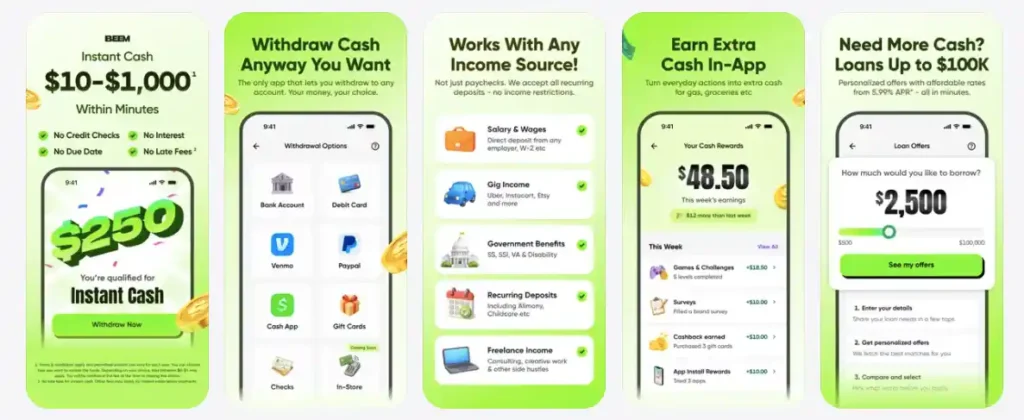
Within those constraints, Beem’s Everdraft™ provides something valuable: access to up to $1,000 when an expense cannot wait for next month’s deposit. The key for SSI recipients is using it strategically, advancing only what you need, spending it promptly, and staying aware of where your bank balance sits relative to the asset limit.
Beem does not judge your income source or your benefit type. It works with what you have. For SSI recipients who have been turned away everywhere else, that is worth something.