
Key Summary
For DACA recipients, financial access in the United States often sits in a complicated middle ground. You are authorized to work, earn, and build a life, yet the financial system does not always respond with the same level of clarity or inclusion. Credit history may be thin or nonexistent, income may not follow a traditional salaried structure, and documentation requirements can vary depending on the institution you approach.
This creates a very specific kind of friction. You are participating in the economy, but not always fully supported by it. When unexpected expenses arise or when income timing does not align with payments, the lack of accessible financial tools becomes immediately visible.
This is where cash advance apps have become increasingly relevant in 2026. They operate differently from traditional lenders, relying less on credit history and more on real-time financial behavior. For many DACA recipients, especially those navigating irregular income streams, these apps offer a practical way to manage short-term financial gaps.
Why Cash Advance Apps Have Become Important for DACA Recipients
The growing popularity of cash advance apps is not accidental. It reflects a gap in the traditional system that has not been fully addressed.
For DACA recipients, access to credit is often delayed because it takes time to build a financial profile that lenders recognize. Even when income is present, it may not be structured in a way that fits standard eligibility criteria. As a result, options that depend on credit scores or long employment histories tend to remain out of reach in the early stages.
Cash advance apps shift this dynamic by focusing on current activity rather than past records. They look at how money flows through your account, how consistently you earn, and how you manage your finances in real time. This makes them more adaptable to situations where income is present but not perfectly predictable.
At the same time, they are not without limitations. Most are designed for short-term use, and their effectiveness depends on how well they align with your specific income pattern. Understanding these differences is key to using them responsibly.
How Cash Advance Apps Work in 2026
Cash advance apps have evolved significantly over the past few years. They are no longer positioned as high-cost, last-resort options like traditional payday loans. Instead, they operate on a model that is designed to be more transparent and accessible.
Most apps offer advances with no interest. Instead of charging traditional lending fees, they generate revenue through subscriptions, optional tips, or fees for instant transfers. Repayment is typically automated and linked to your next deposit or paycheck, which simplifies the process but also requires careful planning on your part.
The underlying principle is straightforward. These apps are not lending against your creditworthiness; they are providing early access or short-term support based on your current financial activity. This distinction is what makes them more accessible, but it also means they are best used for managing timing gaps rather than long-term financial needs.

The Most Relevant Cash Advance Apps for DACA Recipients in 2026
Beem (Everdraft™)
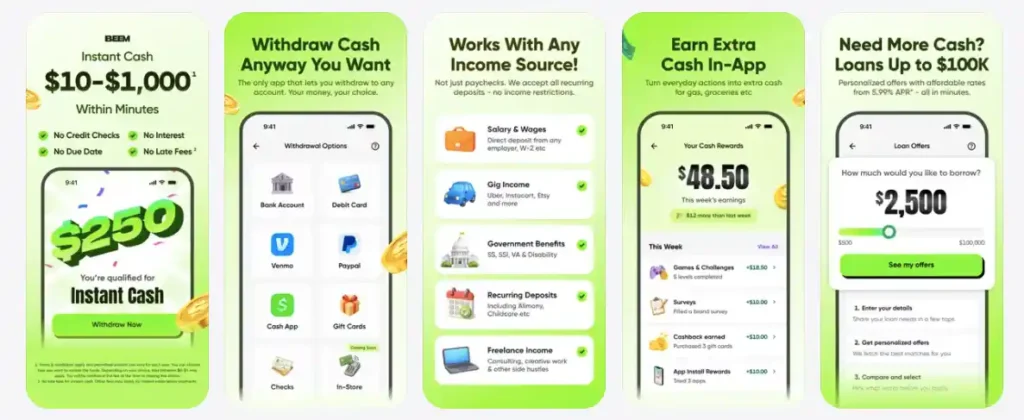
Beem stands apart from many other apps because it is not strictly tied to paycheck-based advances. Its core offering, Everdraft™, provides up to $1,000 in instant cash without interest and without relying on credit scores or fixed employment structures.
For DACA recipients, this flexibility is particularly important. Income is often a mix of freelance work, gig platforms, and part-time roles, which may not align with apps that depend on consistent direct deposits. Everdraft™ addresses this by functioning as a safety net rather than a paycheck advance, allowing users to manage financial gaps even when income patterns are not perfectly predictable.
This makes it one of the more adaptable options for individuals whose financial reality does not fit traditional molds.
EarnIn
EarnIn is one of the more established names in this space and works best for users with steady hourly or salaried jobs. It allows you to access wages you have already earned before your payday, with relatively high limits compared to many other apps.
However, its reliance on consistent employment and time tracking can make it less suitable for those with irregular income. If your work schedule or earnings fluctuate significantly, access may not always be consistent.
Dave
Dave offers smaller advances and combines them with budgeting tools, making it useful for users who want both short-term support and some level of financial tracking.
It generally requires recurring deposits to determine eligibility, which means it works best for users with a steady flow of income. For DACA recipients with less predictable earnings, this requirement can sometimes limit access.
MoneyLion
MoneyLion positions itself as a broader financial platform, offering cash advances alongside credit-building tools and banking services.
This makes it appealing for users who are thinking beyond immediate needs and want to start building a longer-term financial profile. However, like many apps, eligibility can vary depending on income patterns and account activity.
Brigit
Brigit provides interest-free advances with a structured subscription model. It is designed to offer predictability, but access to its full features typically requires a paid plan.
For users who value consistency and do not mind a subscription, it can be a reliable option. However, the added cost may not suit everyone, especially in the early stages of financial adjustment.
Klover
Klover offers smaller advances and uses a points-based system to unlock higher limits. Users can earn points by engaging with the app through activities like surveys or sharing data.
This makes it accessible, but it also requires additional effort compared to more straightforward options.
FloatMe
FloatMe focuses on simplicity and flexibility, offering smaller advances without credit checks. It is useful for minor short-term needs, but the lower limits mean it may not cover larger expenses.
Empower (Tilt)
Empower, now evolving into Tilt, offers advances based on real-time financial behavior rather than credit history. It provides relatively fast access and moderate limits, making it a practical option for users who want quick approvals.
However, like other apps, it may include subscription fees that need to be considered.
Choosing the Right App Based on Your Situation
| App | Max Advance | Best Fit | Key Strength | Limitation |
| Beem (Everdraft™) | Up to $1,000 | Irregular income | Not tied to paychecks | Not wage-based |
| EarnIn | Up to $1,000 | Salaried/hourly | High limits | Needs steady job |
| Dave | Up to $500 | Mixed use | Budgeting + advances | Needs deposits |
| MoneyLion | Up to $500 | Growth-focused | Credit tools | Variable eligibility |
| Brigit | Up to $500 | Predictable use | Structured access | Subscription |
| Klover | Up to $250+ | Low barriers | No mandatory fees | Effort required |
| FloatMe | Smaller amounts | Minor needs | Flexible | Low limits |
| Empower | Up to $400 | Quick access | Fast approvals | Subscription |
What DACA Recipients Should Consider Before Choosing an App
Choosing a cash advance app is not just about the maximum amount you can access. It is about how well the app fits your income pattern and financial habits.
If your income is consistent and predictable, paycheck-based apps like EarnIn may work well. If your income is irregular or comes from multiple sources, a more flexible option like Beem is likely to be more practical.
It is also important to consider how repayment works. Most apps automatically withdraw funds when your income arrives, which can create pressure if your balance is already tight. Planning for this in advance can help you avoid unnecessary stress.
Fees are another factor. Even without interest, subscription costs and instant transfer fees can add up over time. Understanding these costs before using an app ensures that you are making a fully informed decision.
What DACA Recipients Typically Need
Documentation and Eligibility
While cash advance apps are more accessible than traditional lenders, they are not completely requirement-free. Understanding what you need beforehand can save time and prevent unnecessary rejections.
Most apps will require a valid form of identification, which for DACA recipients usually means an SSN or ITIN, along with an active U.S. bank account. Beyond this, the focus shifts to your financial activity rather than your background. Apps typically analyze your transaction history to understand how money flows in and out of your account.
What matters here is not perfection, but consistency. Even if your income is irregular, showing regular account activity, deposits of any kind, and responsible usage patterns can improve your chances of access over time. This is an important distinction because it shifts the focus from who you are on paper to how you actually manage your money day to day.
The Hidden Role of Bank Account Behavior
One of the most overlooked factors in accessing cash advance apps is how your bank account is used. Unlike traditional systems that rely heavily on credit reports, these apps often treat your bank account as the primary source of truth.
This means that your spending habits, frequency of deposits, and overall account stability play a significant role in determining eligibility and limits. Frequent overdrafts, inconsistent balances, or long periods of inactivity can affect how much you are able to access.
On the other hand, maintaining a steady pattern, even with smaller amounts, can work in your favor. Regular deposits, controlled spending, and avoiding negative balances signal reliability. Over time, this can lead to higher limits and more consistent access, even without a traditional credit profile.
Planning Around Repayment to Avoid Cash Flow Stress
One of the key features of most cash advance apps is automatic repayment. While this makes the process convenient, it can also create pressure if not planned for properly.
Repayment is usually scheduled around your next deposit, which means the app will withdraw funds directly from your account. If your balance is already tight at that moment, this can lead to a new gap, creating a cycle that is difficult to manage.
A more effective approach is to anticipate repayment before taking an advance. Understanding when your next income is expected and how much of it will be available after essential expenses can help you decide how much to use. This kind of planning ensures that the advance solves a problem rather than shifting it forward.
Using Cash Advances as a Step Toward Financial Independence
It is easy to view cash advance apps purely as short-term solutions, but they can also play a role in your broader financial journey if used thoughtfully.
For DACA recipients, the early stages of financial life in the U.S. are about building stability and creating a foundation. Cash advance apps can help maintain that stability during uncertain periods, allowing you to stay consistent with payments and avoid setbacks.
At the same time, they should be paired with efforts to build long-term strength. This includes gradually establishing credit, improving income consistency, and developing awareness around spending. When used in this way, cash advances become a bridge rather than a crutch.
The goal is not just to solve immediate gaps, but to move toward a point where those gaps become less frequent and easier to manage without external support.
Using Cash Advance Apps Without Falling Into a Cycle
Cash advance apps are most effective when used as tools for managing short-term gaps. They are not designed to replace income or serve as a long-term solution.
For DACA recipients, this distinction is especially important. The goal is to use these apps to maintain stability while building a stronger financial foundation. This includes developing consistent income streams, tracking expenses, and gradually improving financial awareness.
When used responsibly, these apps can reduce stress and provide flexibility. When overused, they can create dependency. The difference lies in how intentionally they are used.
Conclusion
Cash advance apps have become an important financial tool for DACA recipients in 2026 because they address a gap that traditional systems have not fully solved. They offer access without requiring a long credit history or perfectly structured income, making them more aligned with how many people actually earn.
Among the available options, Beem stands out for its flexibility. Everdraft™ is not tied to paycheck cycles, which makes it particularly useful for individuals with irregular income patterns.
Ultimately, the best choice depends on your situation. The more closely an app matches your financial reality, the more useful it will be. When used thoughtfully, these tools can help you manage uncertainty while you continue building a more stable financial future.
FAQs
1. Can DACA recipients legally use cash advance apps in the U.S.?
Yes, most cash advance apps are accessible to DACA recipients as long as you meet basic requirements such as having a valid SSN or ITIN and an active U.S. bank account. These apps are designed for residents rather than citizens specifically, so eligibility is generally based on your ability to verify identity and financial activity rather than immigration status alone.
2. Do these apps require a credit check to approve advances?
In most cases, no. Cash advance apps typically do not rely on traditional credit checks. Instead, they evaluate your bank account activity, income patterns, and transaction history to determine eligibility. This makes them more accessible for individuals who are still building their credit profile or do not have one yet.
3. What is the typical amount I can access through these apps?
Most apps offer advances ranging from $100 to $500, depending on your activity and eligibility. Some platforms, like Beem, offer higher limits of up to $1,000. The exact amount you can access usually increases over time as the app gains more insight into your financial behavior.
4. Are cash advance apps safer than payday loans?
Generally, yes. Cash advance apps are designed to be more transparent and typically do not charge interest, unlike payday loans, which often come with high fees and rates. However, it is still important to understand any subscription or transfer fees involved and to use these apps responsibly.
5. Which app is best if my income is irregular or comes from multiple sources?
Apps that do not depend heavily on fixed pay cycles tend to work better in such cases. Beem, for example, offers a more flexible model through Everdraft™, making it suitable for users whose income does not follow a predictable schedule.