
Key Summary
Yes. Gig workers can use Beem without a pay stub or W-2 in 2026. Beem’s Everdraft eligibility is determined entirely by bank account deposit activity and financial behavior, not by employment documentation. There is no pay stub requirement, no W-2 upload, no employer verification step, and no tax return needed. Gig workers who receive consistent platform deposits into their linked bank account can qualify for up to $1,000 in instant, interest-free cash advances based on what their account actually shows rather than what a traditional employer would confirm.
Almost every gig worker who has tried to access a financial product knows this moment intimately. You find an app that sounds like it fits. You start the application. You reach the income verification screen. The options appear: upload a pay stub, connect to your employer HR system, provide your most recent W-2. You earn real money, deposit it into a real bank account, and pay real bills with it. But none of the verification options were designed for how you get paid.
In 2026, that experience remains the norm across most financial products gig workers encounter. Beem was built around a different question: not what documentation can you provide, but what does your actual financial behavior demonstrate? The answer is sitting in every bank account that has ever received a DoorDash transfer, an Uber settlement, or an Instacart payout. Beem reads it directly.
Why Pay Stubs and W-2s Do Not Work for Gig Workers
No Employer Generates the Pay Stub
A pay stub is a document issued by an employer documenting each pay period’s gross earnings, deductions, and net pay. It is generated by a payroll system on behalf of an employer. When DoorDash pays a driver, it is not acting as an employer issuing payroll. It is a platform distributing the driver’s earnings minus its service fee. The driver’s earnings statement from DoorDash is an earnings summary, not a pay stub, and most income verification systems do not treat them equivalently.
No Single Employer Issues the W-2
A W-2 form is issued by an employer at the end of each tax year, documenting wages paid and taxes withheld. Gig workers who earn more than $600 from a platform receive a 1099-NEC or 1099-K, which is a different document that reports non-employee compensation. A 1099 is a legitimate tax document that accurately reflects gig earnings, but income verification systems often do not accept it in place of a W-2 because the two documents reflect different legal relationships and tax treatment.
Multi-Platform Income Has No Single Documentation Source
A gig worker earning from DoorDash, Uber, and Fiverr simultaneously receives separate earnings documentation from each platform. The combined picture of their income requires assembling information from three different sources, none of which produces a traditional pay stub or a single W-2. Financial products that require a single employer document cannot accommodate this income structure regardless of how substantial the combined earnings are.
What Beem Uses Instead of Pay Stubs and W-2s
Beem’s eligibility model bypasses the documentation requirement entirely by going directly to the source of truth that documentation was always meant to approximate: the bank account where income actually lands.
Deposit Frequency as a Reliability Signal
When a gig worker links their bank account to Beem using read-only, bank-level encrypted access, Beem evaluates the deposit history of that account. A DoorDash driver who has received weekly platform deposits for eight consecutive months has eight months of direct evidence of consistent income activity. Beem reads that evidence directly rather than asking the driver to translate it into a documentation format designed for a different kind of income.
One of the most valuable signals is frequency. A gig worker who receives income deposits weekly, or more frequently through daily Fast Pay features, demonstrates an ongoing earning relationship with their platform. For multi-platform workers, the combined deposit frequency is even stronger. A worker who receives DoorDash deposits weekly, Uber settlements weekly, and Fiverr payments biweekly has a bank account receiving meaningful deposits multiple times per week, communicating financial activity in a way that a single monthly employer payroll could not.
Balance Behavior as a Financial Management Signal
The balance trajectory of a bank account between deposits is one of the most revealing behavioral signals available. An account that consistently maintains a positive balance throughout the pay cycle, spending within the bounds of what deposits support without chronically depleting to zero, demonstrates financial management capability directly relevant to repayment reliability.
For gig workers whose income variability is greater than that of salaried employees, balance management between platform payouts reflects a genuine financial skill: the ability to allocate variable income across consistent expenses without chronic shortfalls. Beem’s eligibility model recognizes this skill when it is present in the account data, rewarding demonstrated financial management rather than penalizing income variability.
Overall Account Health as a Holistic Profile
The combination of deposit frequency, deposit amounts, balance behavior, absence of chronic overdrafts, and account tenure creates an overall account health profile. This holistic assessment determines both whether a gig worker qualifies for Everdraft and what advance limit reflects their specific financial behavior.
A gig worker with moderate deposit amounts but excellent balance management and no overdraft history may qualify at a higher limit than a worker with higher deposit amounts but chronic balance depletion. Financial behavior is evaluated as a whole, not as a sum of individual metrics, which produces eligibility outcomes that reflect actual financial reliability more accurately than any single documentation requirement could.
The Step-by-Step Experience for a Gig Worker Using Beem in 2026
Understanding the eligibility model conceptually is useful. Understanding what the actual experience looks like for a gig worker going through it for the first time is more useful.
Setting Up the Account
The Beem app is available on iOS and Android. Account creation requires basic personal information: name, email, date of birth, and phone number. There is no employer field, no business registration requirement, and no income documentation upload at any stage. The account is created in under five minutes.
Linking the Bank Account
After creating the account, the gig worker links the bank account where their platform deposits land. The connection uses read-only encrypted access. Beem can evaluate the account history but cannot initiate transactions independently. The process takes approximately two minutes and does not require any documentation beyond standard authentication credentials.
The Eligibility Assessment
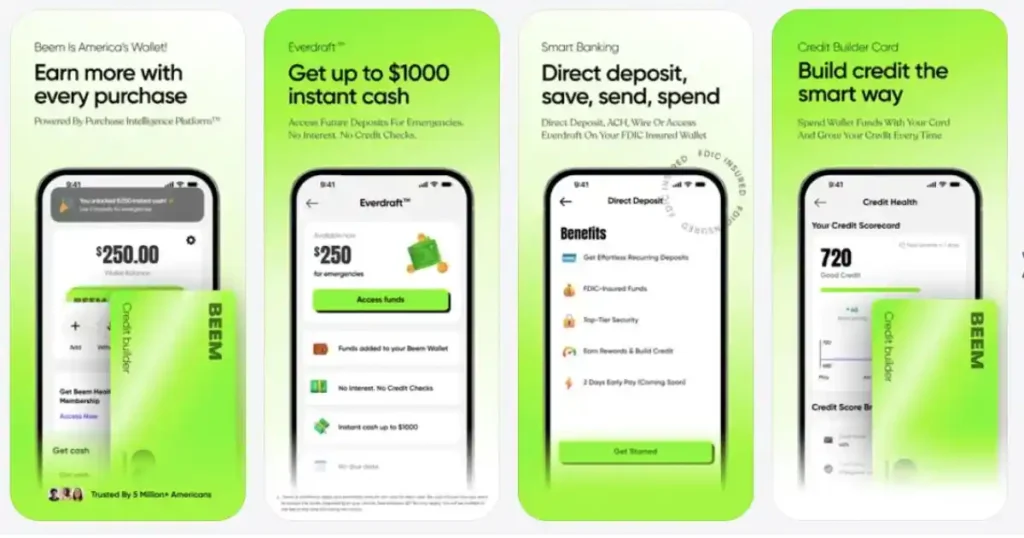
Once the bank account is linked, Beem’s eligibility system evaluates deposit activity, balance history, and overall account health. This assessment is automated, takes seconds, and produces an eligibility outcome without any manual review, credit inquiry, or documentation request. The gig worker does not need to explain their income structure or translate their earnings into a format the system can accept. In no case does the assessment ask for a pay stub, a W-2, or any employment documentation.
Accessing the Advance and Repaying
If eligible, the available Everdraft limit appears in the app. The gig worker requests the amount they need, and funds arrive in their Beem wallet within minutes. Funds can be transferred to the linked bank account instantly at no additional cost. There is no express delivery fee, no tipping screen, and no subscription required.
Repayment is scheduled from the next qualifying income deposit into the linked bank account. For a DoorDash driver who advances on a Wednesday and receives their weekly transfer on Thursday, repayment processes from Thursday’s deposit. The repayment amount is exactly the advance amount. No interest has accrued. No fees have been added.
Common Documentation Requests Beem Does Not Make
For gig workers who have encountered documentation barriers with other financial products, being specific about what Beem does not request removes the uncertainty that often prevents people from trying a new product.
Beem does not request pay stubs at any stage of the application or eligibility process. There is no pay stub upload, no pay stub verification service, and no pay stub requirement embedded in the eligibility assessment.
Beem does not request a W-2 form. The W-2 is an employer-issued tax document that gig workers do not receive. Beem’s eligibility model does not require it and does not treat its absence as a disqualifying factor.
Beem does not request a 1099-NEC or 1099-K. While these are the tax documents that gig workers actually receive, Beem does not require any tax documentation for Everdraft eligibility. The bank account deposit history provides more current and more useful information than any annual tax document.
Beem does not require employer verification. There is no employer name field, no employer contact information request, and no connection to an employment verification service. The concept of employer verification is simply not part of Beem’s eligibility model.

How Gig Workers Can Strengthen Their Beem Profile Without Documentation
Since eligibility is based on account activity rather than documentation, the practical steps available to gig workers are behavioral rather than administrative.
Enable daily or fast pay transfers
DoorDash’s Fast Pay feature, Uber’s Instant Pay, and similar daily transfer options allow earnings to be transferred to a linked bank account daily rather than waiting for the weekly automatic settlement. This creates a more frequent deposit pattern in the linked account, which strengthens the deposit frequency signal in Beem’s eligibility assessment.
Consolidate all platform earnings into one primary account
Earnings sitting in a platform wallet are invisible to Beem’s assessment. Only deposits that have landed in the linked bank account contribute to the eligibility profile. Consolidating earnings from multiple platforms into a single primary account maximizes the deposit activity visible to Beem’s system.
Build a consistent balance buffer
Maintaining a modest positive balance between platform deposits, even $75 to $150, creates a healthier balance behavior pattern. Its consistent presence throughout the weekly pay cycle demonstrates that deposit amounts are sufficient to cover expenses with something left over.
Repay advances promptly to build Beem Boost standing
Every on-time Everdraft repayment contributes to Beem Boost standing and increases the available advance limit over time. Gig workers who begin with a conservative initial limit build toward higher access without any additional documentation or application requirements.
Read: Paycheck Management for Gig Workers With Multiple Income Streams
The Bottom Line: In 2026, What You Earn Matters More Than How You Document It
The pay stub and W-2 requirement is an artifact of a documentation system designed for a workforce structure that describes a declining share of the American economy. It was never a direct measure of financial reliability. It was a proxy that worked reasonably well when most workers had traditional employment relationships that generated those documents as a byproduct of getting paid.
In 2026, that proxy no longer fits the population it is supposed to serve. Millions of gig workers earn consistent, legitimate income that lands in real bank accounts on predictable schedules and supports real household budgets. The absence of a pay stub or W-2 in this context is an artifact of how the income is structured, not an indicator of financial instability.
No pay stub. No W-2. No employer verification. No credit check. No interest. No fees. Up to $1,000, available in minutes, repaid from the next platform deposit. That is what a financial product built for the gig economy actually looks like in 2026.
Frequently Asked Questions
Does Beem require a pay stub or W-2 from gig workers to qualify for Everdraft?
No. Beem Everdraft does not require a pay stub, W-2, 1099, or any employment documentation. Eligibility is determined entirely by bank account deposit activity and financial behavior.
What does Beem look at instead of a pay stub?
Beem evaluates deposit frequency, deposit amounts and patterns, balance behavior between deposits, and overall account health. This behavioral assessment is more current and more relevant to repayment reliability than any annual tax document or employer-issued pay record.
Can a gig worker who just started on DoorDash or Uber qualify?
Potentially, though the initial available limit may be conservative for workers with limited deposit history. Beem Boost allows the available limit to grow over time as deposit history and responsible repayment behavior accumulate.
Does Beem accept income from multiple gig platforms simultaneously?
Yes. Multi-platform workers who consolidate all platform deposits into a single primary account linked to Beem often present a stronger eligibility profile than single-platform workers because their combined deposit frequency is higher and their income base is more diversified.
Will applying for Beem Everdraft affect my credit score?
No. Beem Everdraft does not perform a hard credit inquiry at any stage of the eligibility assessment or advance request process. Your credit file is not accessed, and no hard pull is generated.