
Key Summary
Losing a job or choosing to leave one creates a financial situation unlike almost any other. It is not a temporary cash flow gap that a single paycheck will resolve. It is a sustained period of reduced or zero earned income with a timeline that cannot be predicted with certainty, during which every financial decision carries more weight than it would during normal employment. The tools that work during stable employment, savings accounts, credit lines, investment accounts, all perform differently or less accessibly during unemployment. Beem is designed to perform well precisely in this condition.
An employment gap creates an immediate financial problem and a longer-term financial management challenge simultaneously. Beem addresses both. Everdraft™ provides cash advances of up to $1,000 with no interest charged and no credit check required, giving you access to funds during the weeks when income has stopped but expenses have not. BudgetGPT analyzes your spending patterns and projects your cash flow forward so you can see exactly how long your current resources last and where to adjust before the pressure becomes a crisis. Together, these tools function as a financial support system designed for the specific, difficult reality of being between jobs.
The Financial Reality of an Employment Gap
Before explaining what Beem offers, it is worth being specific about what an employment gap actually does to a household’s financial situation, because the challenge is more layered than simply not having a paycheck.
Income Stops. Bills Don’t.
The most painful feature of unemployment is the timing mismatch: income stops on your last day of work, but rent is still due on the first. Car payments, insurance, utilities, and loan repayments all continue on their normal schedules, indifferent to what happened to the paycheck that was supposed to cover them. The typical household has two to four weeks of essential expenses covered by any given paycheck before the next one was expected — and when that next paycheck doesn’t arrive, that buffer is the only cushion standing between you and a financial emergency.
For households with limited savings, that buffer depletes faster than a job search can resolve the underlying problem. What feels manageable in week one can feel critical by week six if income hasn’t resumed.
Benefits Are Slow. Credit Gets Tighter.
Most states take two to four weeks to process an unemployment claim, and the first benefit payment often arrives several weeks after that. During that gap, expenses keep coming. And the financial system often makes things worse: banks and credit card companies routinely reduce limits and tighten lending standards the moment they detect a change in your income status. The result is reduced credit access at exactly the moment you need it most.
Job searches also take longer than most people expect. The average search for a professional role in the U.S. runs three to six months. Most people entering an employment gap plan for four to six weeks. The gap between expected and actual search duration is one of the biggest drivers of financial distress — turning what felt like a manageable interruption into a sustained pressure that depletes resources no one budgeted for.

How Everdraft™ Functions as an Income Bridge
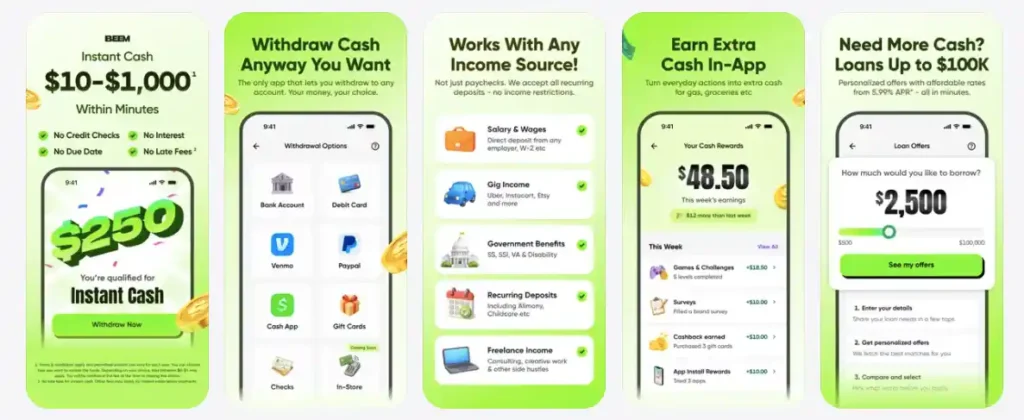
Beem’s Everdraft™ provides cash advances of up to $1,000 based on your financial profile and account activity, with no interest charged on the advance amount and no credit check performed at any stage.
Up to $1,000 with No Interest, No Credit Check
Everdraft™ provides cash advances of up to $1,000 based on your financial profile and account activity — with no interest charged and no credit check at any stage. For a worker between jobs, that means access to real funds during the weeks when income has paused and expenses can’t wait, without the cost spiral of payday lending and without a hard inquiry hitting your credit report at the worst possible time.
There’s no compounding, no rollover, and no escalating fees. The repayment amount equals exactly what you borrowed — nothing more. That matters enormously during unemployment, when high-cost borrowing can compound your financial pressure instead of relieving it. A payday loan used to cover a utility bill in week three can still be generating fees in week eight. Everdraft™ doesn’t work that way.
Eligibility Is Based on Your History, Not Your Current Employer
Everdraft™ evaluates your financial profile based on the account activity in your connected bank account — not on whether you’re employed right now. That means the financial history you built during employment: consistent deposits, responsible account management, a track record of stability — supports your eligibility even when that employment has temporarily ended. You’re being evaluated on who you’ve been financially, not just on who’s signing your paycheck this week.
This is a meaningful difference from traditional lending, which treats current employment status as the primary eligibility factor. A worker who was steadily employed for three years and has been between jobs for three weeks is not the same financial risk as someone who has never held stable employment. Everdraft™ captures that distinction. Traditional lending often doesn’t.
BudgetGPT: The Financial Command Center During a Job Transition
Know Exactly How Long Your Money Lasts
If Everdraft™ is the bridge, BudgetGPT is the map. It projects your available cash flow forward based on your current account balance, your historical spending patterns, and any incoming income — unemployment benefits, freelance work, or investment withdrawals. The result is a specific, data-based answer to the question every unemployed person is quietly asking: how long do I have before this becomes a crisis?
Knowing your runway precisely changes every decision you make. A worker who knows they have eleven weeks before their savings hit a critical threshold makes different choices about job search urgency, expense reductions, and advance timing than someone with a vague sense that things are “getting tight.” Precision replaces anxiety. That’s worth a lot.
Find the Cuts That Actually Matter
BudgetGPT breaks your spending into categories and shows which ones are driving the highest outflow. During an employment gap, this identifies where meaningful reductions are possible without gutting your lifestyle — separating essential expenses that can’t move from discretionary ones where targeted cuts can meaningfully extend your runway. For most households, BudgetGPT surfaces two to four categories where $50–$150 in monthly savings is achievable through specific, identifiable changes.
It also catches something most people miss: recurring charges. Subscriptions, memberships, and automatic renewals that barely registered during stable employment — a $14.99 streaming service here, a $29.99 gym membership there — add up to real money during unemployment. BudgetGPT surfaces them explicitly so you can decide which to pause, rather than discovering them buried in a month of bank statements.
PriceGPT: Stretch Every Dollar During the Transition
Spend Less on the Same Things
When income is reduced, what daily life costs matters more than it ever did during stable employment. PriceGPT identifies better prices on the everyday purchases you’re making regardless of employment status — groceries, fuel, personal care, household staples. For a household spending $400 per month on groceries and $80 on fuel, PriceGPT consistently surfaces $40–$100 in monthly savings without requiring changes to what you buy or where you go.
Those numbers don’t sound dramatic in isolation. But applied to your runway calculation, $70 per month in savings extends a ten-week runway by approximately one additional week at average expense levels. During a job search where timeline uncertainty is the defining stressor, each additional week is a week of negotiating leverage — the difference between accepting the first offer under financial pressure and waiting for the right one.
Protecting Your Credit During an Employment Gap
No Hard Inquiry. Ever.
An employment gap creates specific credit risks that compound the cash flow problem: missed payments generate late marks, increased credit card utilization drags scores down, and applications for new credit add hard inquiries on top of all that. The result is a credit profile that can look meaningfully weaker at the end of a gap than at the beginning — even for someone who managed the situation as responsibly as possible.
Everdraft™ doesn’t touch your credit report. No hard inquiry is generated at any stage of the process. During a period when every credit score protection counts, choosing a zero-inquiry advance over a credit card application or personal loan application is a real, tangible difference. The advance covers the expense. The credit report stays clean.
Build Positive History While You Wait
Beem’s credit-building tools track the financial behaviors that contribute to credit profile strength — consistent account activity, on-time repayment, responsible management — and make that positive track record visible during the transition period. For a worker who is maintaining these behaviors through a difficult stretch, the tools ensure that discipline gets recorded and reflected, supporting the recovery that follows re-employment.
Protecting your credit during unemployment isn’t just about the present. It matters for housing applications, new employer background checks, and future loan access. Beem’s tools support all of it.
Using Beem’s Personal Loan Option for Longer Gaps
When an employment gap extends beyond what a series of cash advances can sustainably address, and when a worker has a strong enough credit profile to qualify, Beem’s personal loan products offer a structured solution for the larger financial need. Personal loans of up to $100,000 are available subject to credit approval, providing a fixed repayment schedule and a defined cost structure that allows for financial planning over a longer timeline than an advance supports.
For a worker facing a three to six month gap with known major expenses such as COBRA health insurance continuation, mortgage payments, or student loan obligations, a personal loan that consolidates those obligations into a single, planned monthly payment provides financial structure during a period that otherwise lacks it.
The Practical Timeline: What Beem Support Looks Like Week by Week
Here is a realistic framework for how Beem’s tools support a worker through a twelve-week employment gap, starting from the first week without income.
Weeks one to two: BudgetGPT is connected and begins building a cash flow projection based on account history. Runway calculation establishes how long current resources last. Expense category analysis identifies $60 to $120 in monthly reductions. PriceGPT begins surfacing everyday savings. Unemployment benefit application filed. Everdraft™ eligibility established and available if a gap emerges before benefits arrive.
Weeks three to four: Unemployment benefits begin arriving. BudgetGPT incorporates benefit income into runway projection. First Everdraft™ advance used if benefits have not yet arrived or if a specific expense cannot wait. Subscription audit completed. Credit-building tools monitoring profile through transition.
Weeks five to eight: Adjusted monthly budget operational based on BudgetGPT insights and PriceGPT savings. Everdraft™ used for specific, identified gaps rather than general cash flow. Runway extended by expense reductions identified in weeks one through four. Job search progressing with reduced financial pressure due to extended runway.
Weeks nine to twelve: Re-employment offer received or expected. Final Everdraft™ advance if needed to bridge to first new paycheck. BudgetGPT transition planning for re-employment budget adjustment. Credit-building tools tracking profile recovery as on-time payment history continues. Financial situation stabilizing ahead of return to income.
Read: Can You Use Beem if Your Only Income Is Unemployment Benefits?
Beem Pass: Extend Support to Family Members Navigating the Same Gap
Employment gaps rarely affect only one person. A worker between jobs affects the entire household, and in many cases affects extended family members who step in to provide support during the transition. Beem Pass allows you to extend Beem’s financial tools and advance access to family members or close contacts within your network.
For a household where multiple members are navigating financial pressure, Beem Pass ensures that the financial support system available to one person extends to the people most closely connected to that person’s situation.
Conclusion
An employment gap is one of the most financially stressful experiences a working adult faces. The income stops before you are ready for it to stop. The expenses do not stop to wait. The job search takes longer than you projected. The financial tools that worked during stable employment become less accessible at exactly the moment they are most needed.
Beem is built to work well precisely in this condition. Everdraft™ provides up to $1,000 at zero interest with no credit check, giving you access to funds during the weeks when income has not yet resumed. BudgetGPT shows you exactly how long your resources last, where to reduce expenses to extend that runway, and when a specific gap is approaching before it becomes a crisis. PriceGPT reduces what daily life costs during the transition. Credit-building tools protect the financial profile that matters for the next job and the next financial chapter.
The employment gap is temporary. The financial behaviors and tools you build during it can be permanent improvements to your financial life. Beem is designed to support both.
FAQs
Can I get a Beem advance if I’m currently unemployed?
Yes. Everdraft™ evaluates your financial profile based on your account history — not your current employment status. A worker who was steadily employed and recently lost their job has a financial history Beem can assess. No credit check is performed and no employment verification is required.
How does BudgetGPT help specifically during a job gap?
BudgetGPT calculates your cash flow runway based on your account balance, spending patterns, and incoming income including unemployment benefits. It identifies where expense reductions can extend your runway, surfaces recurring subscriptions you may have forgotten about, and projects when a specific gap is likely to appear — before it arrives.
Will using Everdraft™ affect my credit score?
No. Everdraft™ performs no credit check and generates no hard inquiry on your credit report. During an employment gap when credit score protection matters most, that’s a meaningful advantage over credit card applications or personal loan applications.
How long can Beem realistically support someone between jobs?
Beem’s tools support transitions of any duration. Everdraft™ covers specific gaps as they arise. BudgetGPT continuously projects and adjusts your runway. PriceGPT reduces monthly costs throughout. For extended gaps, personal loans up to $100,000 provide a structured longer-term option subject to credit approval.
What should I do in Beem immediately after losing my job?
Connect your bank account and open BudgetGPT right away to establish your runway calculation before your balance shifts significantly. Confirm your Everdraft™ eligible amount. Run the expense and subscription audit. Activate PriceGPT on your regular purchases. Having all tools running in week one gives you the clearest financial picture and the most options when decisions need to be made.